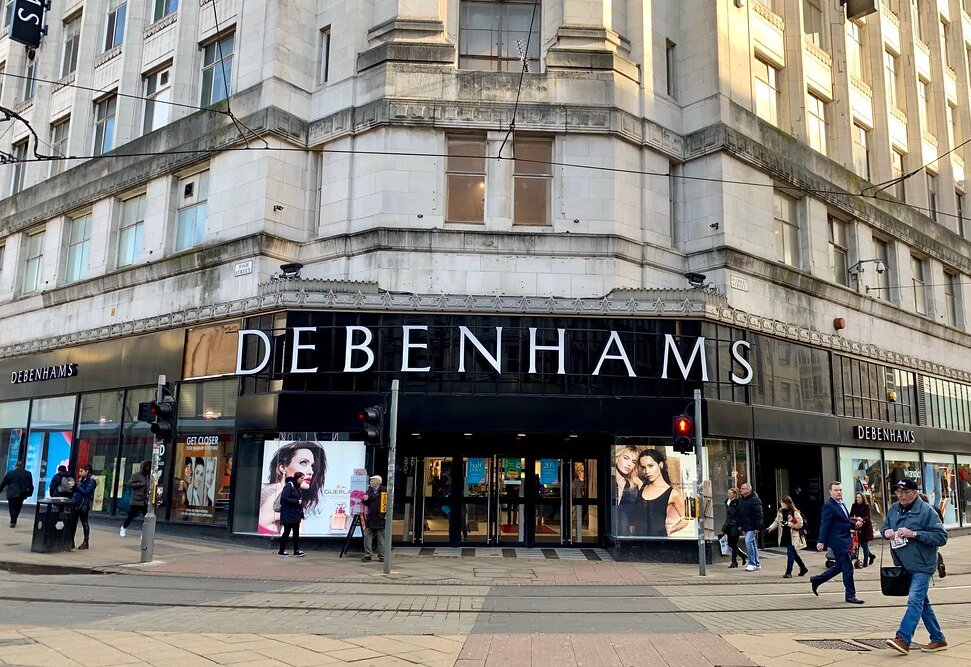
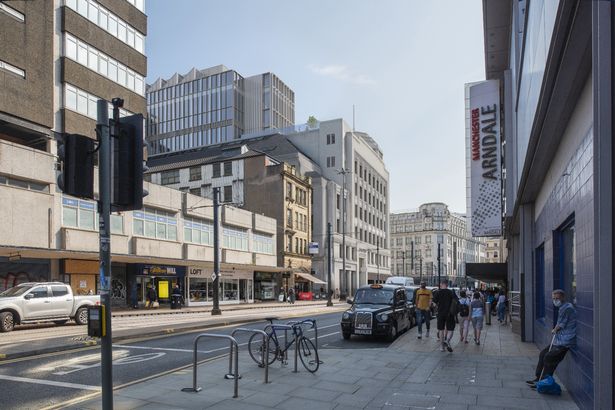
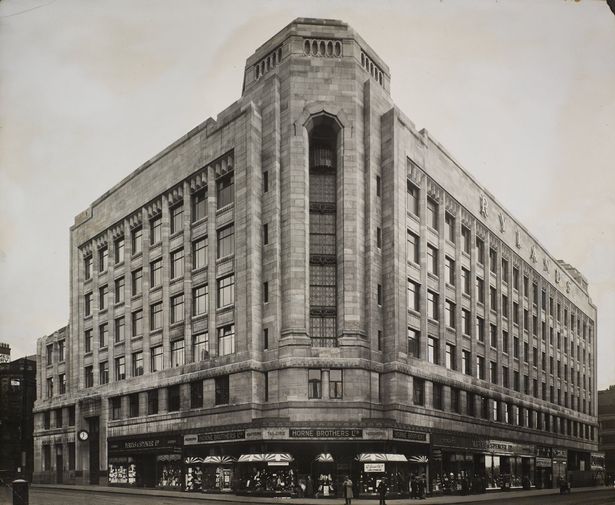
Major redevelopment plans for the building which houses the Manchester city centre branch of Debenhams will go ahead.
The Rylands building will be transformed, despite previous concerns about an “ugly” rooftop extension.
The plans for the £68.5 million redevelopment – which were first revealed back in August of last year, before it went to full public consultation – by owners AM Alpha will see the iconic building provide a new shopping arcade at street level, along with several floors of new offices.
It would also involve the Grade II listed landmark on Market Street getting a much-needed makeover aimed at restoring its Art Deco glory.
Redevelopment plans come after department store chain Debenhams – which has occupied the Rylands building since 1973 – announced it is closing its flagship premises after battling ongoing financial troubles that were heightened amid the coronavirus (COVID-19) pandemic, before eventually going into administration last year and putting 12,000 jobs at risk across the UK.
ADVERTISEMENT
There are no plans for another department store to take its place either, and instead, new shopping, dining and leisure outlets will open in the ground floor and basement.
AM Alpha had also considered converting the building into apartments, a cinema or a gallery, but it has been confirmed that office space was seen as the most sustainable long-term use of the building, with up to 258,000 sq ft of new offices set to occupy most of the vacant upper floors, as well as a 40,000 sq ft four-storey rooftop extension.
ADVERTISEMENT
An atrium providing natural light between the second and seventh floors is also planned, along with a winter garden on the sixth floor.
AM AlphaAM Alpha
The redevelopment plans have been met with some criticism though.
Piccadilly councillor Sam Wheeler told Manchester’s planning committee that the extension would have a detrimental effect on 15 families living in neighbouring buildings, saying on Thursday that: “I think we can all admit that the box on top of the Grade II listed building is incredibly ugly.
ADVERTISEMENT
“It has been a policy of the council for some 30 years or so now to promote city centre living, not just city centre existing.
“Each time there is a loss of habitability caused by loss of light in several apartments, that does lower the livability of the city centre.”
The planning committee meeting also heard that a loss of light would have a negative impact on the mental and physical wellbeing of those who would be affected by the rooftop extension, with committee member Councillor Jon-Connor Lyons – also a Piccadilly ward member – adding that the extension would “box in” hundreds of residents living between Market Street and Church Street.
But Katie Wray – Assistant Director at Deloitte, acting on behalf of AM Alpha – said the proposals would “restore and rejuvenate” the Rylands building, and secure its long-term future.
The vote to approve the application was passed by eight councillors, with two voting against and one abstaining.
You can find more information via the Future Rylands website here.
News
NHS launches new AI and robot cancer detection pilot offering ‘glimpse into future’
Emily Sergeant
The NHS has launched a ‘trailblazing’ new AI and robot pilot to help spot cancers sooner.
Patients who are facing suspected lung cancer could get answers sooner under the new pilot that makes use of artificial intelligence (AI) and robotic technology to help doctors reach hard-to-detect cancers earlier, and all without with fewer tests too.
At the moment, patients are faced with weeks of repeat scans and procedures to come to a diagnosis.
But this could soon be replaced with a single, half-hour cancer biopsy – reducing prolonged uncertainty, and avoiding more invasive surgery.
According to the NHS, the new approach uses AI software to rapidly analyse lung scans and flag small lumps that are most likely to be cancerous, before a robotic camera is then used to guide biopsy tools through the airways with much greater precision than standard techniques.
A new NHS pilot using AI and robotic technology will help doctors reach hard-to-detect lung cancers earlier.
Weeks of scans and procedures could be replaced with a single biopsy, reducing uncertainty and avoiding more invasive surgery.
The robot can reach nodules as small as 6mm – which is around the size of a grain of rice – that are hidden deep in the lung and are often deemed too risky or difficult to access using existing methods, and once AI has highlighted higher-risk areas, doctors can then take a precise tissue sample, which is sent to specialist laboratories and reviewed by expert cancer teams to confirm or rule out cancer.
The NHS’s top cancer doctor hailed the pilot – which is currently being carried out at Guy’s and St Thomas’ NHS Foundation Trust – as ‘a glimpse of the future of cancer detection’.
“Waiting to find out if you might have cancer is incredibly stressful for patients and their families,” admitted Professor Peter Johnson, who is NHS England’s National Clinical Director for Cancer.
The NHS has launched a new AI and robot cancer detection pilot that’s offering a ‘glimpse into future’ / Credit: rawpixel
“Our lung cancer screening programme means that we are picking up more cancers at an early stage than ever, and by bringing AI and robotics together in this trailblazing NHS pilot, we’re bringing in the very latest technology to give clinicians a clearer look inside the lungs and support faster, more accurate biopsies.
“This is a glimpse of the future of cancer detection.
“Innovation like this is exactly how we can help diagnose more cancers faster, so treatment can be most effective, and why the NHS continues to lead the way in bringing new technology safely into frontline care.”
If successful, the pilot will help the NHS to generate evidence to develop a national commissioning policy for robotic bronchoscopy.
It will also support more consistent access to the technology across the NHS in future.
Featured Image – Tima Miroshnichenko (via Pexels)
News
Chester Zoo announces new spring date for its popular running event to help UK wildlife
Emily Sergeant
Chester Zoo has announced that its popular Run For Nature is back again this year, and this time, there’s a new spring edition.
The UK’s biggest charity zoo seen success with this event in the past few years, with thousands of runners signing up for one of the North West’s most unique athletic experiences and all funds raised going towards efforts to protect highly-endangered giraffes in Africa.
This year though, the much-loved event’s focus brings conservation ‘a little closer to home’ and will protect some of the UK’s most threatened species instead – with all funds helping to safeguard hedgehogs, kingfishers, otters, harvest mice, and more.
It comes as the UK is currently considered one of the most nature-depleted countries on Earth.
Participants will first get to wind through the zoo and enjoy glimpses of elephants, lemurs, and other incredible species along the way, before heading out into the picturesque Cheshire countryside.
Adults can choose from a 10K or 5K route, while younger runners are invited to take part in a one-mile ‘Zoom’ race, open to children aged four-15, which takes place entirely within the zoo’s incredible 130-acre grounds.
All runners will receive free entry to the zoo for the rest of the day as part of their registration, along with a 25% discount for friends and family who come along to show support.
Chester Zoo’s popular 10K charity run is returns with a new spring date / Credit: Chester Zoo
Lorraine Jubb, who is the Fundraising Lead at Chester Zoo, called the Run For Nature a ‘really special event’.
“In previous years, runners have already supported conservation efforts for Asian elephants, Eastern black rhinos and Northern giraffe,” she explained. This springtime though, we’re turning our attention much closer to home in the UK, and to the wildlife we share our gardens, parks and countryside with.
“With one in six species now at risk of extinction in the UK, every runner will be playing a vital role in helping us protect animals and supporting our growing nature recovery work across right across Cheshire.