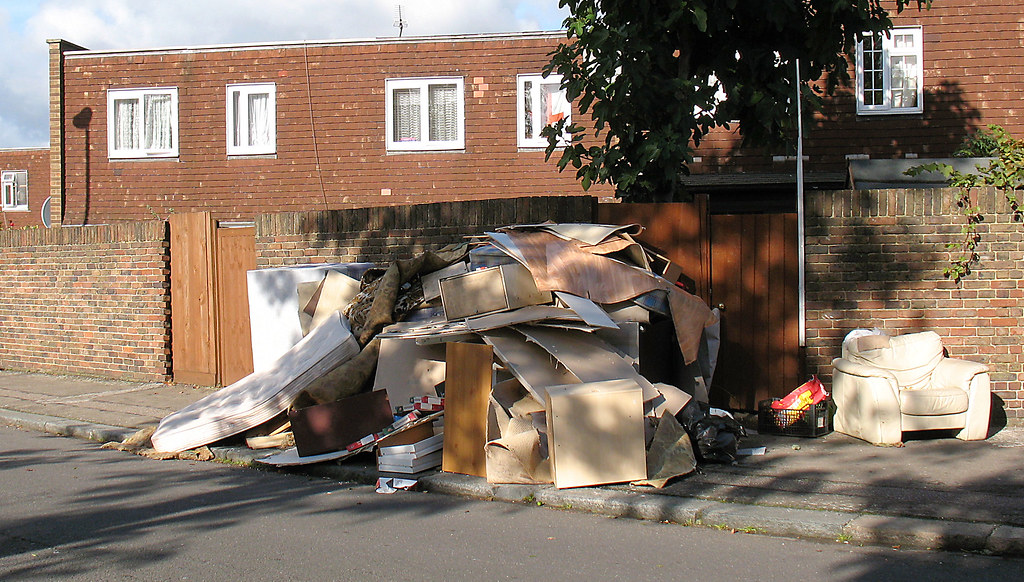
Three Greater Manchester boroughs have unfortunately claimed place in the list of the UK’s top 10 fly-tipping hotspots.
There’s absolutely no denying that fly-tipping has becoming an increasing issue in recent years, with the UK’s rubbish problem piling up… literally. And now new analysis of Government data has revealed that councils in England dealt with more than 2.7 million fly-tipping incidents in the past year.
In theory, this is the equivalent of more than 7,397 illegal dumps every single day.
The research, which has been conducted by garage clearance company, Rainbow Rubbish Removals, ranked local authorities on the scale of their littering crisis, looking at the number of waste and land incidents, as well as the total amount of fines issued.
This was all in a bid to find out who has earned the unwelcome title of Britain’s fly-tipping capital – and it’s not pleasant news for Greater Manchester.
ADVERTISEMENT
Three Greater Manchester boroughs have been named in the UK’s top 10 fly-tipping hotspots / Credit: Alan Stanton (via Flickr)
Thankfully though, while three boroughs in our region have found themselves on the top 10 list, they’re not right near the top and actually claim the last three places – with Oldham at number eight, Manchester at number nine, and Bolton in the tenth spot.
Oldham recorded 479.28 fly-tipping incidents per 10,000 residents, Manchester recorded 348.36, and Bolton had 503.36.
ADVERTISEMENT
While Bolton recorded the most incidents out of the three local regions, it actually dished out the least amount of fines for the incidents, hence why it falls below below Oldham and Manchester.
Claiming the non-so-favourable title of the UK’s fly-tipping capital is Lewisham.
Top 10 Fly-tipping Hotspots in the UK
Lewisham
Newcastle
Westminster
Peterborough
Newham
Hammersmith and Fulham
Brent
Oldham
Manchester
Bolton
Several other boroughs in London also found themselves in the top 10, with Westminster, Newham, Hammersmith and Fulham, and Brent all featuring.
ADVERTISEMENT
“Fly-tipping isn’t just an ugly blot on the landscape, it’s a stubborn public health risk and an environmental time bomb,” commented Miroslav Radov, who is a waste expert at Rainbow Rubbish Removals.
“Our findings reveal a worrying pattern in big cities, especially London [and Greater Manchester].
“If action isn’t stepped up, these areas could become permanent dumping grounds, with taxpayers footing the clean-up bill year after year.
“Solving this crisis means more than just sweeping up the mess – it calls for tougher penalties that bite, more accessible waste disposal options, and a cultural shift where people take real responsibility for the rubbish they create.”
Featured Image – Wikimedia Commons
News
Police provide update after stabbing of 14-year-old boy at Manchester Arndale carpark
Emily Sergeant
Police have provided an update following the stabbing of a young boy in Manchester city centre over the weekend.
At around 3:15pm this past Saturday afternoon (17 October 2026), officers from Greater Manchester Police (GMP) were called out to reports of a stabbing on the ninth floor of the Arndale carpark in Manchester city centre.
Emergency services attended the scene, and a 14-year-old boy was taken to hospital with injuries consistent with a stab wound.
Thankfully, the victim’s injuries are not believed to be life-threatening or life changing, but an investigation and enquiries are ongoing.
Detective Inspector Sam Jones, of GMP’s City of Manchester District CID, said this will ‘understandably’ cause concern, but has assured the public that police believe this to be an ‘isolated incident.
“Detectives at the scene are working extremely hard to process the scene with Crime Scene Investigators,” explained DI Jones in an update statement issued.
“The car park is expected to be closed for several hours, so we ask for your understanding and patience whilst we gather evidence to bring these offenders to justice.
“Detectives and Officers will be in the area today to speak with local businesses and members of the public to provide reassurance. This is believed to be an isolated incident with no risk to the wider public.
“Greater Manchester Police are committed to diligently investigating all knife crime and bringing offenders to justice, and we are asking for anyone with information about this incident to come forward to assist with our enquiries.”
Anyone with information is asked to contact police on 101, quoting log 2050 of 17/10/2026, or via the LiveChat function. Alternatively, contact Crimestoppers anonymously on 0800 555 111.
Featured Image – Wikimedia Commons
News
TfGM issues statement as ‘essential’ work begins on three major Metrolink lines across Greater Manchester
Emily Sergeant
Passengers are being urged to plan ahead as no trams will be running on three major Greater Manchester lines for the next two weeks.
If you need bringing up to speed a little, as part of the ongoing £150m investment into Greater Manchester’s tram network, essential improvement work is being carried out on three major Metrolink lines across the region in a bid to make the network ‘safer’ and ‘more resilient and reliable for passengers’ for years to come.
This means that from today (Monday 19 October) through to Sunday 1 November, tram improvement works will take place at Deansgate-Castlefield, and Trafford Bar.
Additional works will also take place in the city centre during this time, allowing TfGM to keep closures of the tram network to a minimum.
During the dates above, no trams will run on the Altrincham, Trafford Centre, and Eccles lines.
A number of shuttle bus services will the running over the course of the two-week closure, however – with services arriving every 10 or 15 minutes, depending on the line, and you can find a full list of these here.
But despite the alternative services, widespread disruption is still expected for hundreds of people.
TfGM has issued a statement on the works being carried out, and offered support to anyone who may need it: “This is essential work that will help keep our tram network safe, reliable and fit for the future. We’re sorry for the disruption and we’ll be doing everything we can to make sure people can still get around while it’s taking place.
“We’ve listened carefully to feedback from customers during previous closures and have introduced more direct shuttle buses between key locations and extra buses on local Bee Network routes.
“If you use any of the affected lines, now is the time to check your travel plans.
“We’d encourage everyone to visit the Bee Network website or app before travelling so they can see the options available to them and allow extra time where necessary.”
Services will resume on these lines from start of service on Monday 2 November.
However there will be some minor route changes through the city centre in place from Monday 2 to Wednesday 4 November, so it’s important to check your journey before you travel.

 Emily Sergeant -
18th August 2025
Emily Sergeant -
18th August 2025