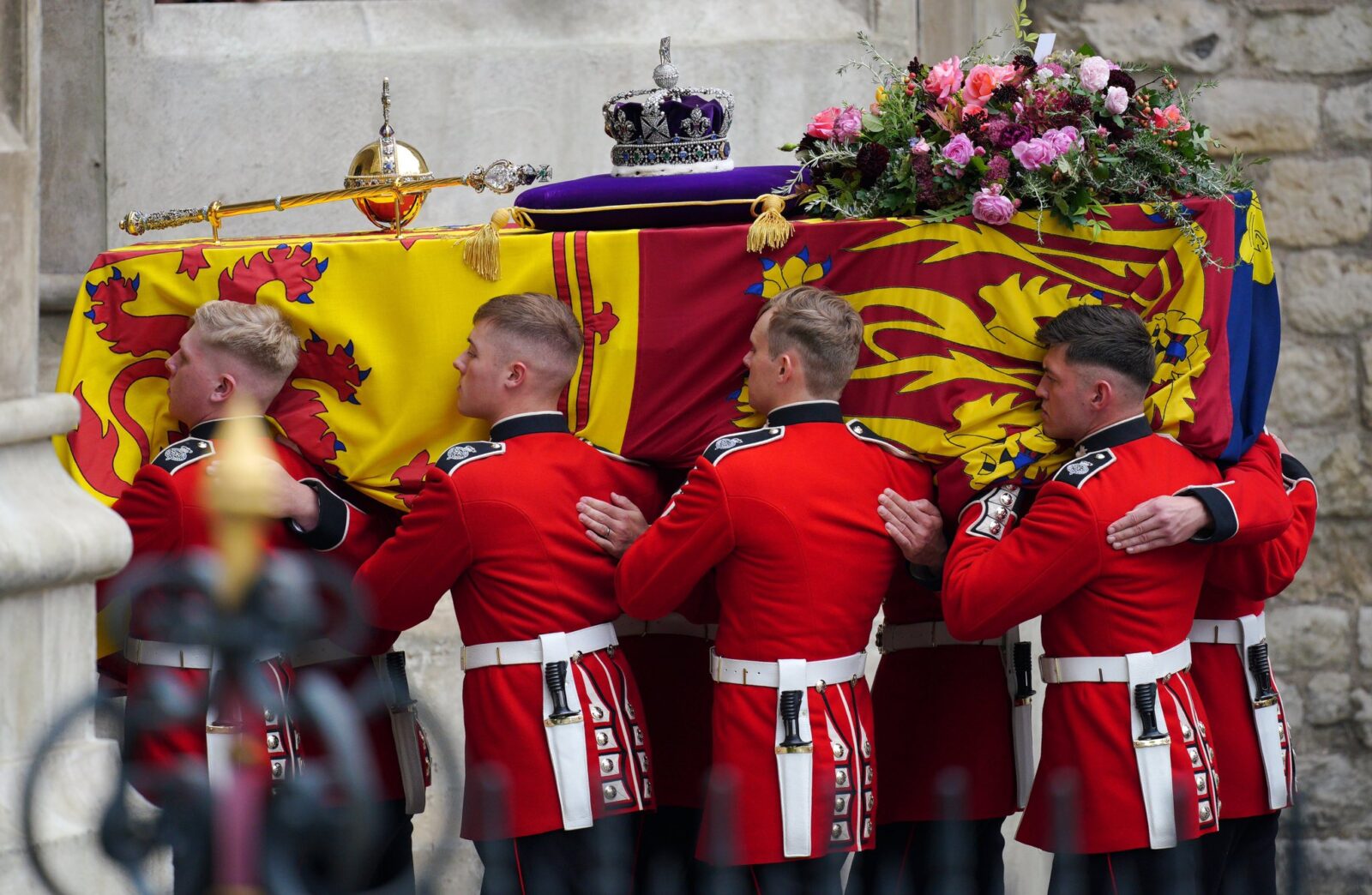
The significance of the floral arrangement on top of HM Queen Elizabeth II‘s coffin has been revealed, as well as the words written on the “loving” note placed in the centre.
The nation bid a final farewell to our longest-reigning monarch at a State Funeral today.
Around 2,000 guests attended the official service at Westminster Abbey, including world leaders representing nearly 200 countries and territories, 500 foreign dignitaries – such as politicians, civil servants, and some celebrities – and many ordinary members of the public selected for charitable or community works.
Tens of thousands of mourners also travelled to London and Windsor for the State Funeral and burial service, and many more were seen gathering at different hubs across the UK to watch the historic event in real-time.
Queen Elizabeth II’s children – including the newly-ascended King Charles III and Queen Consort – were in attendance, as were her grandchildren, great-grandchildren, and other extended family members.
ADVERTISEMENT
The service concluded with a two-minute silence observed by the nation.
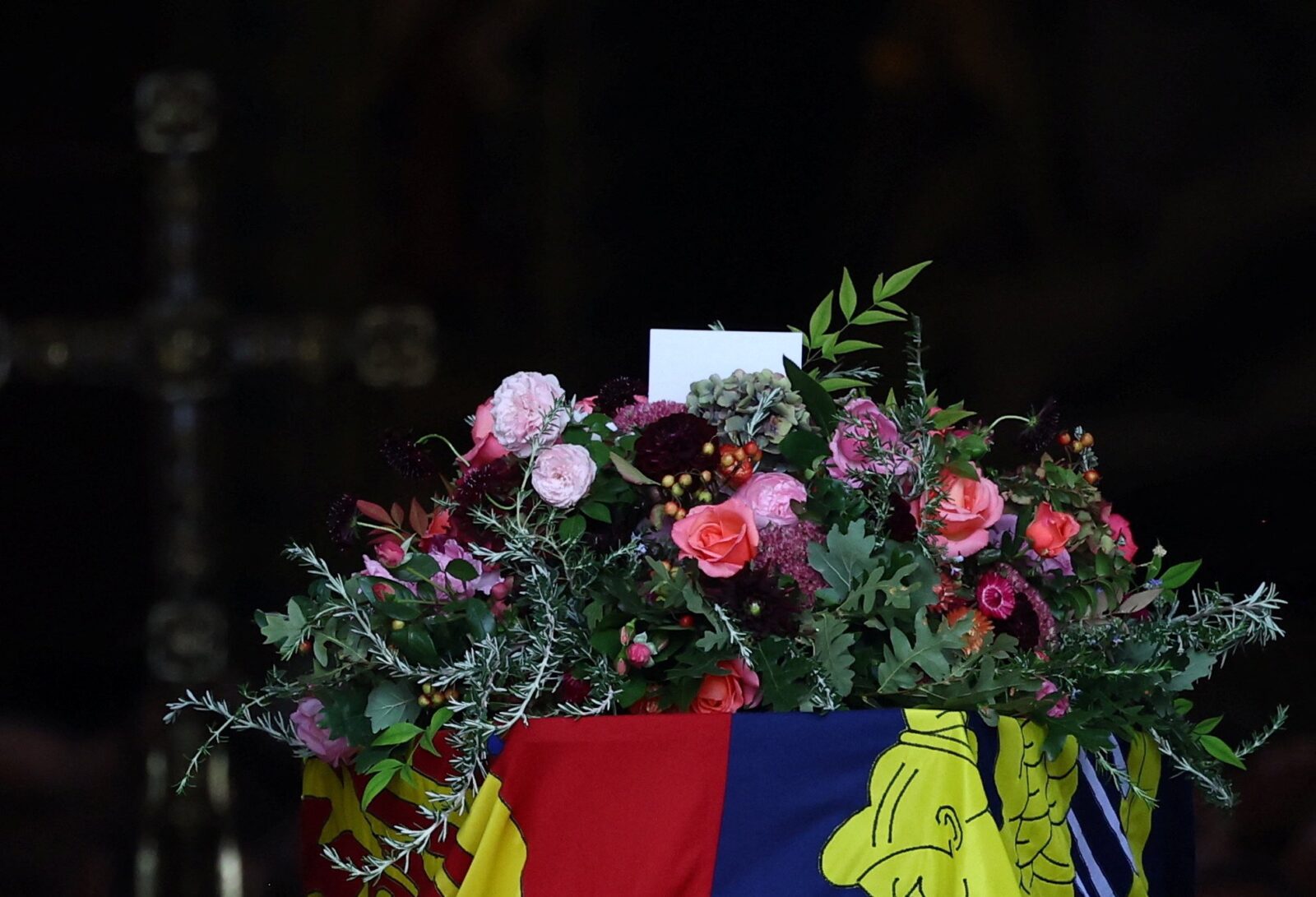
Now, it has been revealed why the floral arrangement placed on top of the Queen’s coffin is so significant and sentimental to her and the Royal Family, as well as what the message written on the card placed within the flowers reads.
ADVERTISEMENT
HM Queen Elizabeth II’s State Funeral took place at Westminster Abbey today / Credit: The Royal Family
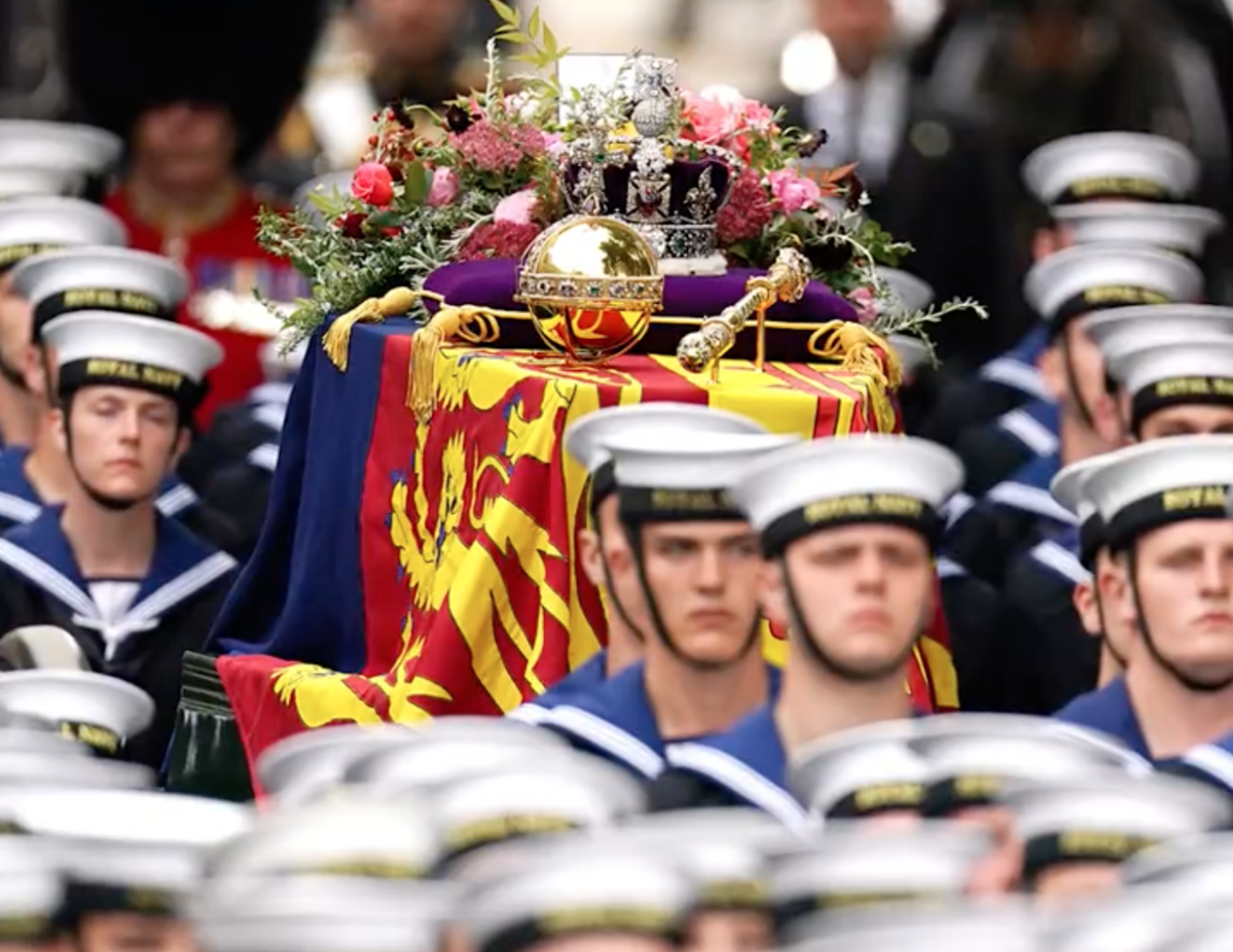
The millions of people watching the State Funeral broadcast live will have seen the colourful wreath of flowers siting on top of Her Majesty’s coffin, along with the Royal Standard flag, and the Queen’s crown, orb and sceptre.
The wreath was made completely sustainably, upon King Charles III’s request.
The Royal Family has revealed that, also upon the King’s request, the floral wreath includes myrtle flowers which have been grown from a sprig of the Queen’s wedding bouquet when she married Prince Philip The Duke of Edinburgh back in 1947.
ADVERTISEMENT
The wreath also features foliage of rosemary, which is an ancient symbol of remembrance, and English Oak, which is a national symbol of strength.
The nation came together to commemorate the life of our longest-reigning monarch / Credit: The Royal Family
Flowers cut from the gardens of the Balmoral estate – the Scottish castle where the Queen spent much of her time including her final days before her passing – also feature prominently in the arrangement, and these include the Queen’s favourite flower, the sweet pea, as well as dahlias, phlox, white heather, and pine fir.
Many of these floral tributes also hold a poignant tribute to the Queen’s relationship with her late husband.
Dahlia flowers symbolise a lasting bond and lifelong commitment between two people, while sweet peas are associated with departures and goodbyes, as well as being the birth flower of April – which was the Queen’s birth month.
ADVERTISEMENT
At The King's request, the wreath contains foliage of Rosemary, English Oak and Myrtle (cut from a plant grown from Myrtle in The Queen's wedding bouquet) and flowers, in shades of gold, pink and deep burgundy, with touches of white, cut from the gardens of Royal Residences. pic.twitter.com/5RteIWahuW
Typical of many floral arrangements at funeral services, many spectators also noticed that there was a card with a tribute message was placed in the centre of the wreath, and the message written on the note has now been revealed and shared by the BBC on the live television broadcast.
The message on the note card was from King Charles III, and was said to simply read – “In loving and devoted memory, Charles R.”
___
HM Queen Elizabeth II died aged 96 on 8 September 2022.
During her reign, she served as Queen of the United Kingdom and the Commonwealth – undertaking an important symbolic and unifying role as a head of state, spanning numerous geographical regions, cultures, and religions.
ADVERTISEMENT
She was not just the longest-reigning British monarch in history, but she was also the first-ever monarch to reign in the UK for 70 years.
Admired for her duty and dedication to the role, today her remarkable life was remembered by all.
Featured Image – The Royal Family (via Twitter)
News
Council announces return of FREE firework displays in Manchester parks
Emily Sergeant
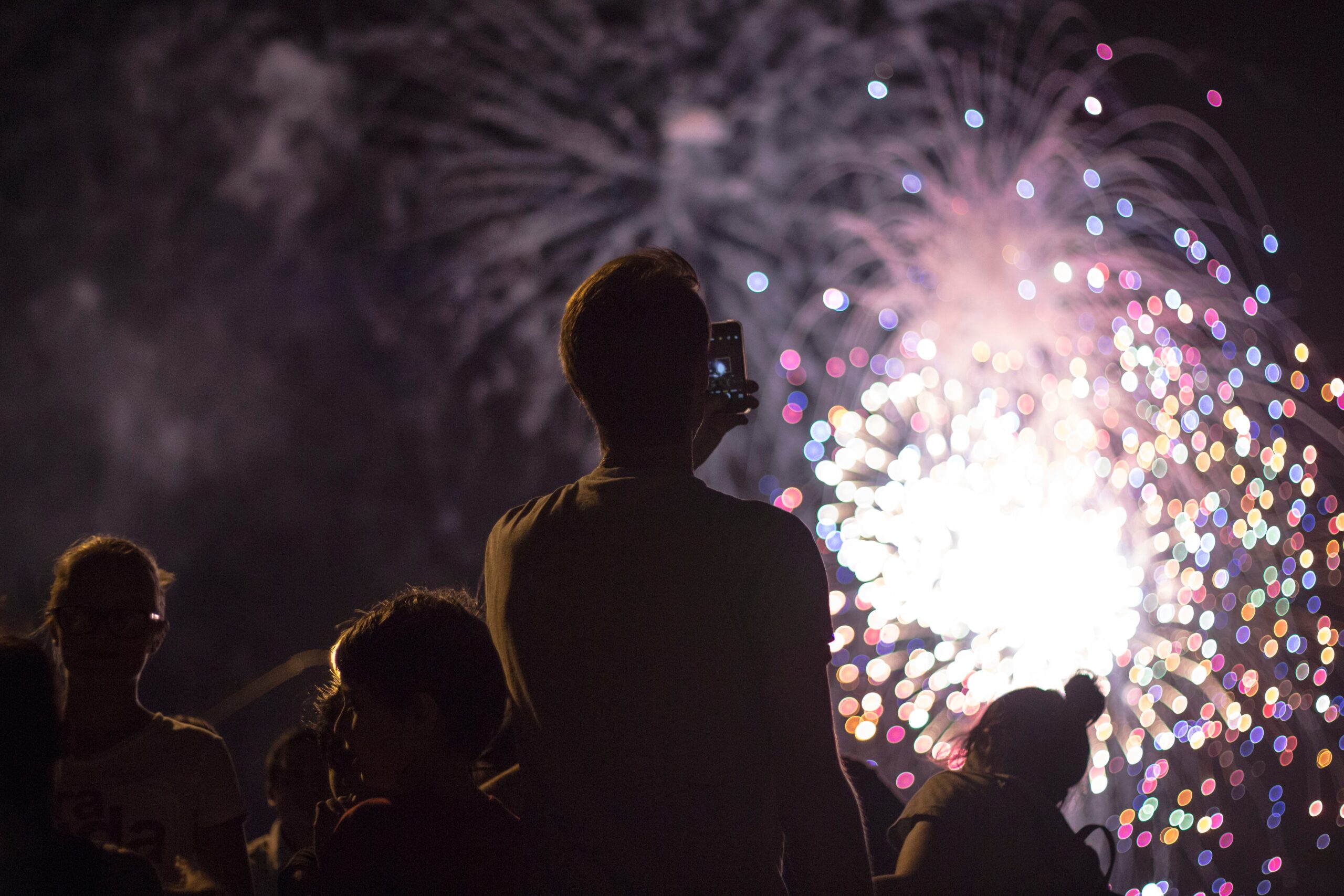
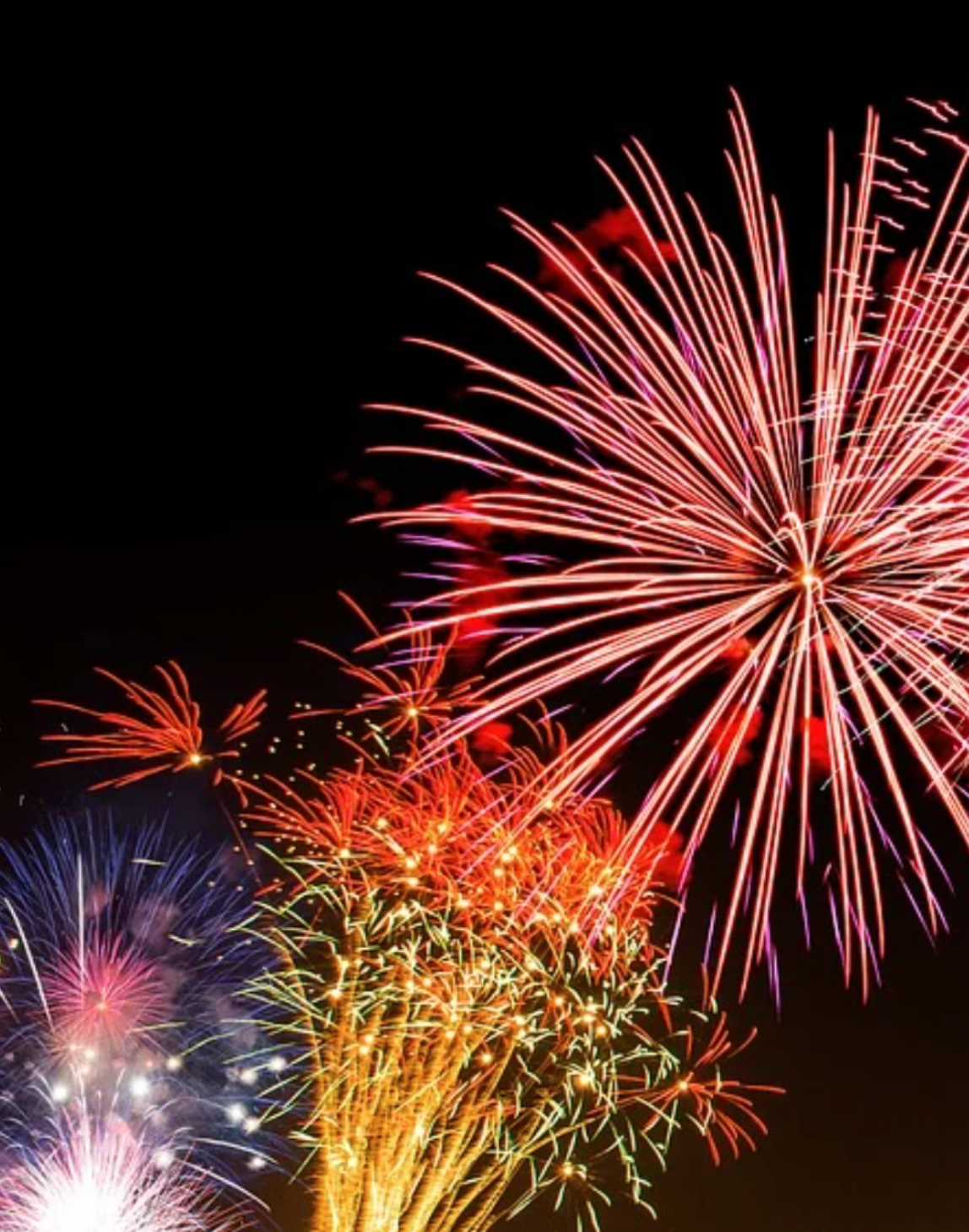
The skies over Manchester will light up once again, as free firework displays are set to return to several of the city’s parks.
You may remember that major fireworks events throughout the city had been paused following the COVID-19 pandemic, due to funding challenges, with Manchester City Council choosing to invest in a range of other community-focused events across throughout the autumn season instead, rather than one-off firework celebrations.
But now, once this November rolls around, all of that is set to change.
That’s because, on Saturday 7 November, free fireworks events will return to Heaton Park, Wythenshawe Park, and Platt Fields Park.
First up, there will be a reduced-noise, low-impact display at 5pm for families and SEND audiences, and a main fireworks display then to follow a little later at 8pm.
The Council has announced the return of free firework displays in Manchester parks / Credit: Unsplash
Each of the three parks will host lantern making workshops in the weeks leading up to the events too, with family-friendly lantern parades taking place ahead of the 8pm firework shows.
The Council says that the return of the free fireworks events reflects residents’ recent feedback about what they want to see in their community and how they want funding to be distributed.
“It’s a chance, at the start of the shorter days and beginning of the dark winter months, to come together and resume a much-loved annual tradition as well as enjoying an evening of safe entertainment and spectacular fireworks displays,” Manchester City Council said in a statement.
Councillor Basat Sheikh, who is the Executive Member for Neighbourhoods, added: “We are delighted to announce and welcome the return of our much-loved fireworks celebrations.
It’s the first time they’ve returned since the COVID-19 pandemic / Credit: Elisha Terada (via Unsplash)
“Our parks should be shared spaces that create opportunities for Manchester people to gather, which is why bringing back the fireworks displays was top of our agenda. And we also recognise the importance of community which is why we will also continue to invest in a wide range of activities in our parks throughout the year.
“The return of these events is a wonderful opportunity for families and communities to create lasting memories and enjoy the long-standing tradition of fireworks in our parks in a safe way.”
Additional entertainment will be announced for each park in the coming weeks too, so keep your eyes peeled for more.
Featured Image – Alex Jones (via Unsplash)
News
Stockport man admits to drugging and raping his wife without her knowledge for more than 20 years
Emily Sergeant
A man in his 60s from Stockport has admitted drugging and raping his wife in a ‘horrific’ 20-year campaign of abuse.
According to Greater Manchester Police (GMP), the man – who cannot be identified in order to protect the life-long anonymity of the victim – previously admitted five counts of rape, three counts of sexual assault, six counts of assault by penetration, and one count of sharing intimate photos or film.
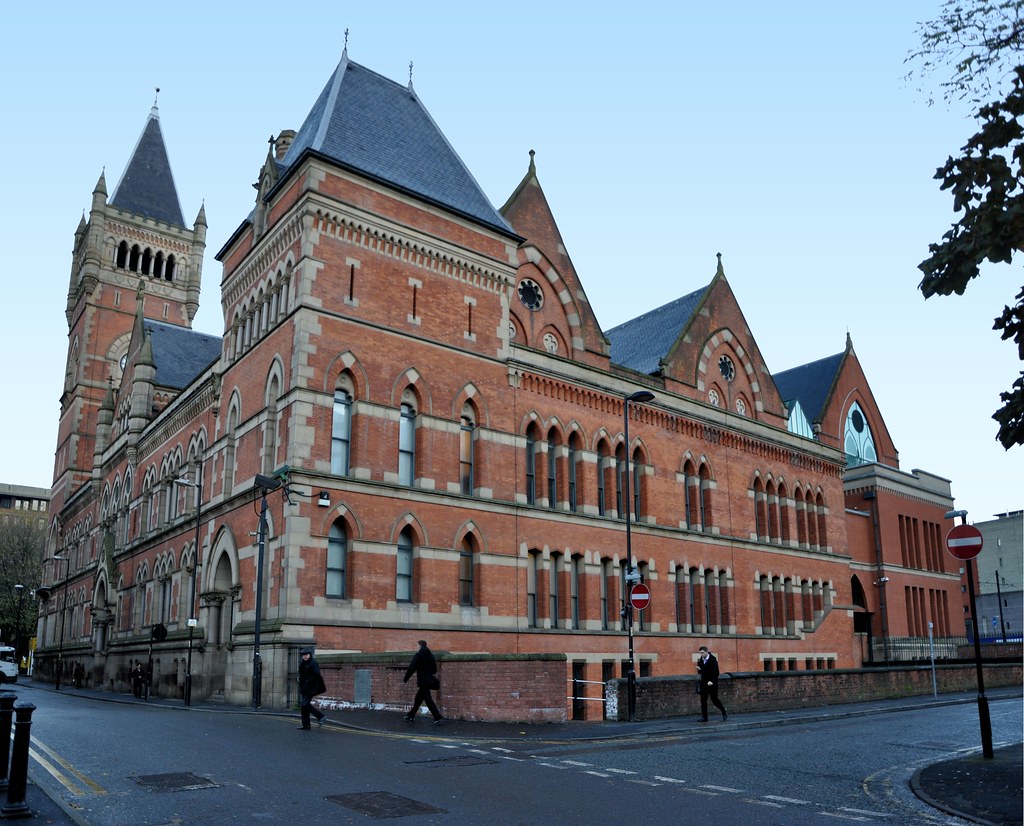
And now, during an appearance at Manchester Minshull Street Crown Court yesterday (14 September), he pleaded guilty to a further 45 charges.
This makes it 60 charges in total the man has now pleaded guilty to.
Some of the charges he pleaded guilty to yesterday include a further 16 counts of rape, nine counts of assault by penetration, seven counts of sexual assault, and four counts of attempted rape, amongst several others.
Speaking following the court appearance yesterday, GMP’s Assistant Chief Constable, Rick Jackson, said: “Our focus remains on supporting the victim of this horrific campaign of abuse through what is a very complex investigation.
“Specialist support continues to be provided to the victim at the centre of this case.
“If you are concerned you or someone you know may be affected by drug-facilitated sexual abuse, please know that you do not need proof, certainty, or a clear memory to be taken seriously.
“You are not expected to understand exactly what has happened or who was involved in order to be taken seriously. If you feel that something has happened, then please report it or ask for help.”
GMP reiterates that anyone who does choose to report sexual abuse does not need a full account or clear memory, can share as much or as little as they feel able, and will be supported by trained officers, as their ‘immediate’ safety and wellbeing will be the ‘priority’.
They may also speak to a support organisation first and decide later whether to involve police.
Saint Mary’s Sexual Assault Referral Centre – Services are available on a 24-hour basis, and can be accessed by calling 0161 276 6515.
Greater Manchester Rape Crisis – Call on 0161 273 4500 or email [email protected]

 Emily Sergeant -
19th September 2022
Emily Sergeant -
19th September 2022