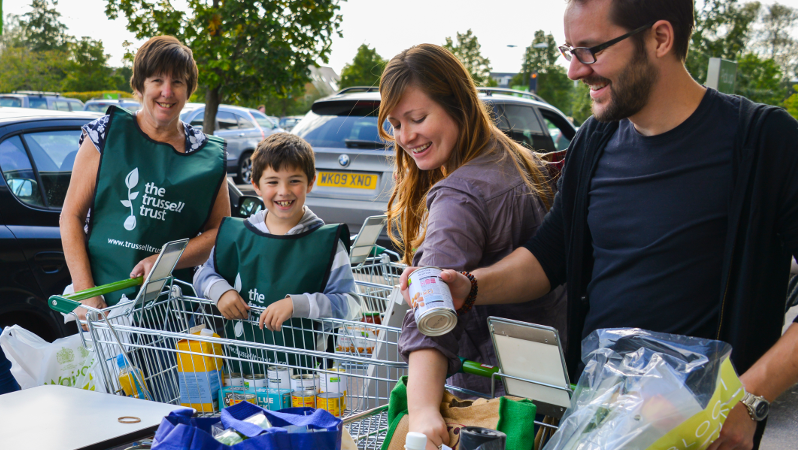
It has been confirmed this morning that a record 1.2 million emergency food parcels were handed out by Trussell Trust foodbanks in the six months of the coronavirus (COVID-19) pandemic.
According to the charity – which made the announcement across social platforms – from April to September, more than 470,000 of the food parcels were delivered to children, which on average came to around 2,600 every day.
The Trussell Trust says these figures show the scale of support needed during the pandemic.
The figures released however did not include people helped by community organisations, independent food banks, or local authorities.
In its latest report, The Trussell Trust – which runs a network of 1,300 centres across the UK – saw a 47% increase in support needed during the pandemic, and although it welcomed moves by the government to help those struggling, the charity has also called for longer-term action to be taken.
ADVERTISEMENT
Low income, benefit delays, and sickness or ill health were the top three reasons someone may have been referred to a Trussell Trust food bank between April and September this year.
Our new figures show #foodbanks in our network distributed more than 1.2 million food parcels between April and September. This marks a shocking 47% increase in need during the crisis, building on record need experienced during the same period last year > pic.twitter.com/62OIJ2ja3p
Emma Revie – Chief Executive of The Trussell Trust – said: “Throughout 2020, communities across the country have stepped in to provide vital support to people left without enough money.
ADVERTISEMENT
“Volunteers in food banks have been working hard under extremely difficult circumstances to make sure support is there for people struggling to afford essentials, but it’s not right that any of us are forced to a charity for food, at any time of year.
“In the last few weeks, we’ve seen incredible compassion and concern for people facing hunger following Marcus Rashford’s brilliant campaigning, and it’s hugely welcome to see the government build on steps already taken by providing significant new funding for local councils in England.
“This vital local support must work in co-ordination with a national welfare system that is strong enough to act as a lifeline to anyone struggling to afford the essentials.
ADVERTISEMENT
“This pandemic has shown the unexpected can hit us suddenly, with devastating consequences for people’s lives, but it’s also shown we can make huge changes to the way we live and look after each other.”
Still so much work to do… To all the selfless volunteers, thank you. We have to keep fighting to stabilise the households of our children… https://t.co/QZYvKaMfJw
The Trussell Trust has also said foodbanks in its network could see high levels of use over the winter as more and more people become redundant.
The charity is expecting to give out an emergency parcel every 9 seconds.
In response to the rising numbers and the projected figures ahead of winter, a government spokesman said: “We are committed to making sure that the most vulnerable in our society are protected and we’ve put in place a strong package of support to ensure children and their families do not go hungry during this pandemic.
“Our additional £400 million of funding includes £170 million to help families stay warm and well-fed this winter, a further £16 million to provide immediate support to frontline food aid charities, and a £220 million Holiday Activities and Food programme.”
You can find out more about The Trussell Trust’s campaign for a ‘Hunger Free Future’ here.
Trending
Both Manchester United and Manchester City named as teams with the least amount of local fans
Emily Sergeant
Both Manchester United and Manchester City have been identified as being teams with the least amount of local fans, according to a new survey.
We all know that supporting a local team can be seen as a mark of credibility among a certain kind of football fan, while on the flip side of that, not following a local team is often associated with being a ‘glory hunter’. But which Premier League clubs have the highest – and lowest – proportion of supporters living close to home?
Well, YouGov decided to use its profiles data to analyse the fanbases of all 20 Premier League clubs for the 2026-27 season to get the answer to this once and for all.
And it’s fair to say that it’s not looking the best for the Manchester teams.
The study found that, overall, Brighton & Hove Albion is the Premier League’s most local team – with 56% of fans based in the South East.
Sunderland (50%) and Nottingham Forest (49%) supporters are the next-most likely to live in the same region as their teams, followed by Aston Villa, Brentford, Ipswich, Leeds, Fulham, Hull, and Crystal Palace fans rounding out the top 10.
At the other end of the table, Manchester United has the second-lowest proportion of local supporters, with only a quarter based in the North West (23%), with one in six (17%) actually living in London instead.
And then as for Manchester City – who are widely considered to be the most successful team of the modern era – it has ranked fourth-bottom for local fans, as a quarter of the club’s supporters are based in the North West, with a fifth based in London (19%).
But although both United and City have found themselves towards the bottom end of the ranking, they are not the worst offenders.
That title, unfortunately, does belong to another North West team though – Liverpool.
Liverpool is the club with the lowest proportion of ‘local’ supporters, as just a fifth are based in the North West (21%) with the next highest concentration of fans can being found in London.
Featured Image – Johnny Gios (via Unsplash)
Trending
Data reveals Manchester hotel prices have ALREADY surged by 462% on rumoured Oasis tour dates
Emily Sergeant
Manchester hotel prices have apparently already surged by 462% on rumoured Oasis tour dates, some new data has revealed.
Of course, absolutely nothing is set in stone yet and we are still yet to receive any form of announcement.
But with rumours having been swirling for months now that Oasis will be touring again in 2027, and several videos shared on the band’s social media platforms this week also hinting at that, it’s been revealed that searches for ‘when are Oasis tickets going on sale?’ have soared by 5,000% in the last seven days alone.
After recent data has pointed towards soaring searches for tickets, the experts at SeatPick decided to analyse the average cost of accommodation in Manchester on the suspected concert nights in June 2027 to uncover if prices have surged along with the searches.
Data reveals that Manchester hotel prices have already surged by 462% on rumoured Oasis tour dates / Credit: The Manc Group | Simon Emmett (Press Picture)
And lo and behold, it appears that they have.
The ticketing platform has revealed that hotel prices have surged by up to 462% during Oasis’ rumoured concert nights in Manchester.
The rumoured weekend date of 19 and 20 June has experienced the most noticeable price surge – with a two-star hotel costing an average of £216 for just one overnight stay.
The data also reveals that the rumoured finale on the 27 June has just a £95 difference between two-star hotels (£200) and five-star hotels (£295).
“Our analysis uncovered an enormous markup for local accommodation on nights that Oasis is rumoured to perform in Manchester,” explained Gilad Zilberman, who is the CEO at ticket platform SeatPick.
“Being aware of these accommodation costs and additional expenses can help fans plan and avoid being caught off guard by inflated prices on concert nights.
“To find the best deals on hotels, concertgoers should scan budget chains in the city or look slightly outside of the centre in hotspots served by local bus routes or regional trains, such as Salford and Trafford.