Talks between union leaders and rail companies to end rail disputes are currently ongoing, but passengers across the UK have been told to still expect delays and cancellations all week.
The warning to all those travelling by train to brace for affected services comes as most railway lines will be closed during the nationwide industrial strike action – which started yesterday, and will commence on Thursday and Saturday – as workers take part in what is the biggest walkout in the industry for more than 30 years in a row over pay, jobs, and conditions.
The RMT Union officially confirmed earlier this month that over 50,000 railway workers will walk out on 21, 23 and 25 June due to what is said to be the “inability of the rail employers to come to a negotiated settlement” with the RMT.
Strike action comes after 71% of the RMT’s 40,000 members took part in a vote – with 89% voting in favour of strike action and only 11% voting against it.
The RMT Union said the strike action is because Network Rail and the train operating companies have subjected their staff to multiyear pay freezes, and plan to cut thousands of jobs – which will make the railways “unsafe”.
ADVERTISEMENT
Members of the RMT Union at Network Rail and 13 train operators – including Northern and Avanti West Coast – have subsequently made the decision to strike, with only around one in five trains expected to be running.
A special timetable will operate in England, Wales and Scotland from Monday 20 to Sunday 26 June inclusive.
The timetable – published on Friday – will aim to offer the best service possible despite industrial action planned next week by the RMT union:
Although today is not officially a strike day, only 60% of trains are expected to run across the UK, and Network Rail has said that this is mostly because of a delay to the start of services, as signallers and control room staff are not doing overnight shifts.
As strike action officially began yesterday following unsuccessful last-minute talks, much of Britain had no passenger trains for the entire day, including most of Scotland and Wales, the whole of Cornwall and Dorset, and other rural and coastal areas across the country.
Large swathes of Greater Manchester and the North West was affected, and will continue to be affected, by the strike action.
ADVERTISEMENT
Only 60% of trains are expected to run across the UK on non-strike days / Credit: Network Rail
Although many chose to work from home where possible after being told to “give up on trains for the whole week”, for those who did need to travel, when train services were running yesterday – which were in very limited numbers and unpredictable – many passengers’ journeys took several hours longer than normal.
Those who chose to take the bus or travel by car were impacted by a surge in traffic, which the AA and RAC said earlier this week was unfortunately “inevitable”.
Mick Lynch – General Secretary at the RMT Union – hailed the “fantastic” turnout at picket lines which “exceeded expectations” yesterday and has vowed to continue the campaign this week, adding that RMT members are “leading the way for all workers” across the UK.
“Now is the time to stand up and fight for every single railway worker in this dispute that we will win,” he said in a statement yesterday.
ADVERTISEMENT
RMT General Secretary Mick Lynch on today's rail strike: "@RMTunion members are leading the way for all workers in this country who are sick and tired of having their pay and conditions slashed by a mixture of big business profits and government policy."https://t.co/XWU43zdz8hpic.twitter.com/ikvMTGmLkt
In response to the first day of nationwide strike action, a Department for Transport spokesperson said: “Unions have shut down big parts of the rail network, hitting local businesses and unfairly cutting people off from hospitals, schools and work.
“However, early data shows that unlike in the past many people now have the opportunity to work from home, so we haven’t even a rush to the roads, as traffic has instead gone online.
“This means the unions aren’t having the overall impact they might have hoped.”
Featured Image – Network Rail
News
Met Office gives verdict on how Storm Boelo aftermath will affect Greater Manchester this week
Emily Sergeant
Storm Boelo is finally on his way out, and now the Met Office has given its verdict on what we can expect from the rest of the week.
In the aftermath of two successive storms, Storm Austen followed by Storm Boelo – the latter of which affected Greater Manchester – the UK is now able to begin recovering from the effects of the adverse weather.
But the Met Office has warned that, although there is no named storm, strong winds and heavy rain will continue to affect parts of the UK early this week, before high pressure brings calmer conditions.
Yellow national severe weather warnings are in place for parts of Scotland and western areas of the UK today (Tuesday 27 October), including areas of the North West, as gales and spells of rain bring the potential for ongoing disruption around the region, particularly on exposed coasts and higher ground.
“The continued winds could hamper recovery efforts in some places,” forecasters also unfortunately confirmed.
⚠️ Strong winds and heavy rain continue across parts of the UK early this week with a yellow weather warning in place, before high pressure brings calmer conditions for many from Wednesday ⛅
Read our news release to find out more 👇
https://t.co/EQU4vvaA3B https://t.co/hpvTd8v7EZ
As rest of the week pans out though, conditions will begin to settle down and showers are expected to become ‘less frequent’, while winds also ease for most, although gales could continue for a time in the far north.
Thursday is expected be ‘largely dry’ with lighter winds and variable cloud, with a touch of mist and fog likely across parts of England and Wales during the morning.
From Friday and into the weekend, light rain will team up to potentially affect northwestern areas of England, but for the most part, temperatures are expected to remain close to, or slightly above, average for the time of year.
“From Wednesday, high pressure will start to build which will ease the winds and bring a quieter and largely drier end to the week for many, although some rain is still possible in the North and West,” explained Met Office Deputy Chief Forecaster, Steven Keates.
“However, with wind warnings in place, those in warnings areas, particularly in northern Scotland and western high ground, continue to be exposed to strong winds and heavy rain before the more settled weather arrives.”
Featured Image – The Manc Group
News
Popular pumpkin patch attraction describes ‘catastrophic’ impact of Storm Boelo
Daisy Jackson
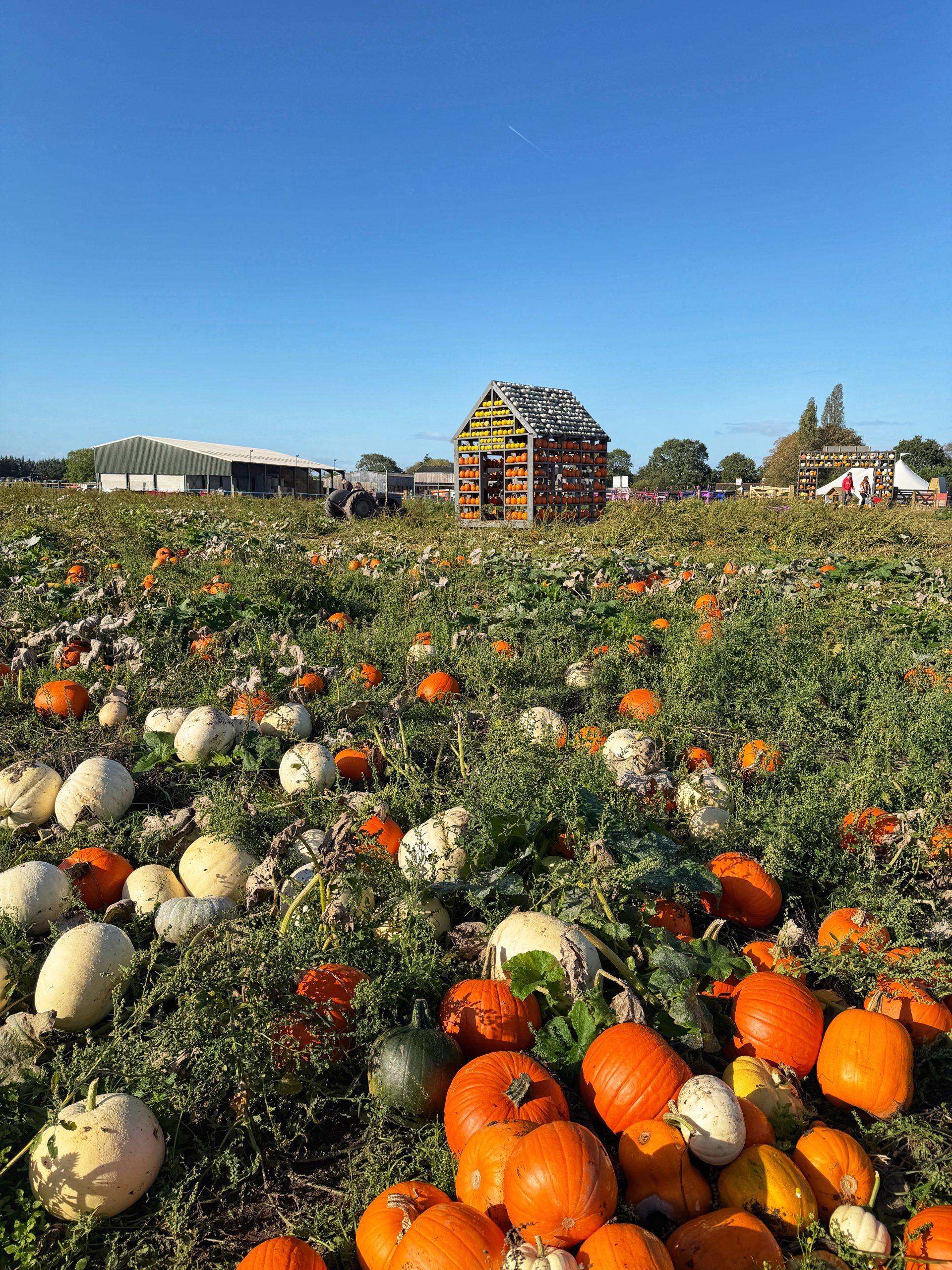
Bates Farm, one of the most popular pumpkin patch attractions in the North West, has shared its heartbreak after Storm Boelo forced its closure on the busiest day of the season.
The Warrington-based family farm said the financial impact has been ‘honestly catastrophic’, after they had to cancel all tickets for Sunday.
Sisters Ali and Fiona Wilshaw, who run the farm, said it was simply not safe to allow members of the public onto the farm in the storm, with ‘crazy’ gusts of wind.
They later shared a video that showed their marquee was badly damaged and many footpaths turned to deep mud.
The sisters said they were ‘heartbroken’ to have to close at such a busy time, but stressed to followers that ‘your safety and our integrity will always come first’.
On Saturday, as Storm Austen and Storm Boelo chased each other across the UK, several people shared videos of themselves getting battered by the weather at Bates Farm.
And it’s pretty clear from that why Ali and Fi decided to cancel all tickets and close for the day on Sunday.
They wrote: “We have put in so much love, energy and investment putting on this event at this scale. The cost to cancel and refund everyone today on our busiest day of the season is honestly catastrophic, but business aside, your safety and our integrity will always come first.
“To think last night we were running round Tesco trying to stock up on milk and now we are in the depths of recovering the site to go again tomorrow. All emails and enquiries are being responded to as quickly as possible and we are doing our best to open up more available slots next week.
“We are being tested like never before, but pulling together in true force. Huge shout out to the whole team and Farmer Fi the absolute queen in any crisis.
“Thank you all for your patience and especially thank you to those who have sent such kind words and support, we are so grateful to have customers like you.
“We will be back tomorrow to enjoy the remaining of this tough season, we are putting in so many provisions with wood chip paths, undercover seating and an indoor barn to make your visit as enjoyable as possible. Ali & Fi.”
Anyone who had tickets to visit Bates Farm on Sunday will be refunded, and can book in for another date.
Bates Farm has safely reopened its autumnal experience and pumpkin patch today.

 Emily Sergeant -
22nd June 2022
Emily Sergeant -
22nd June 2022