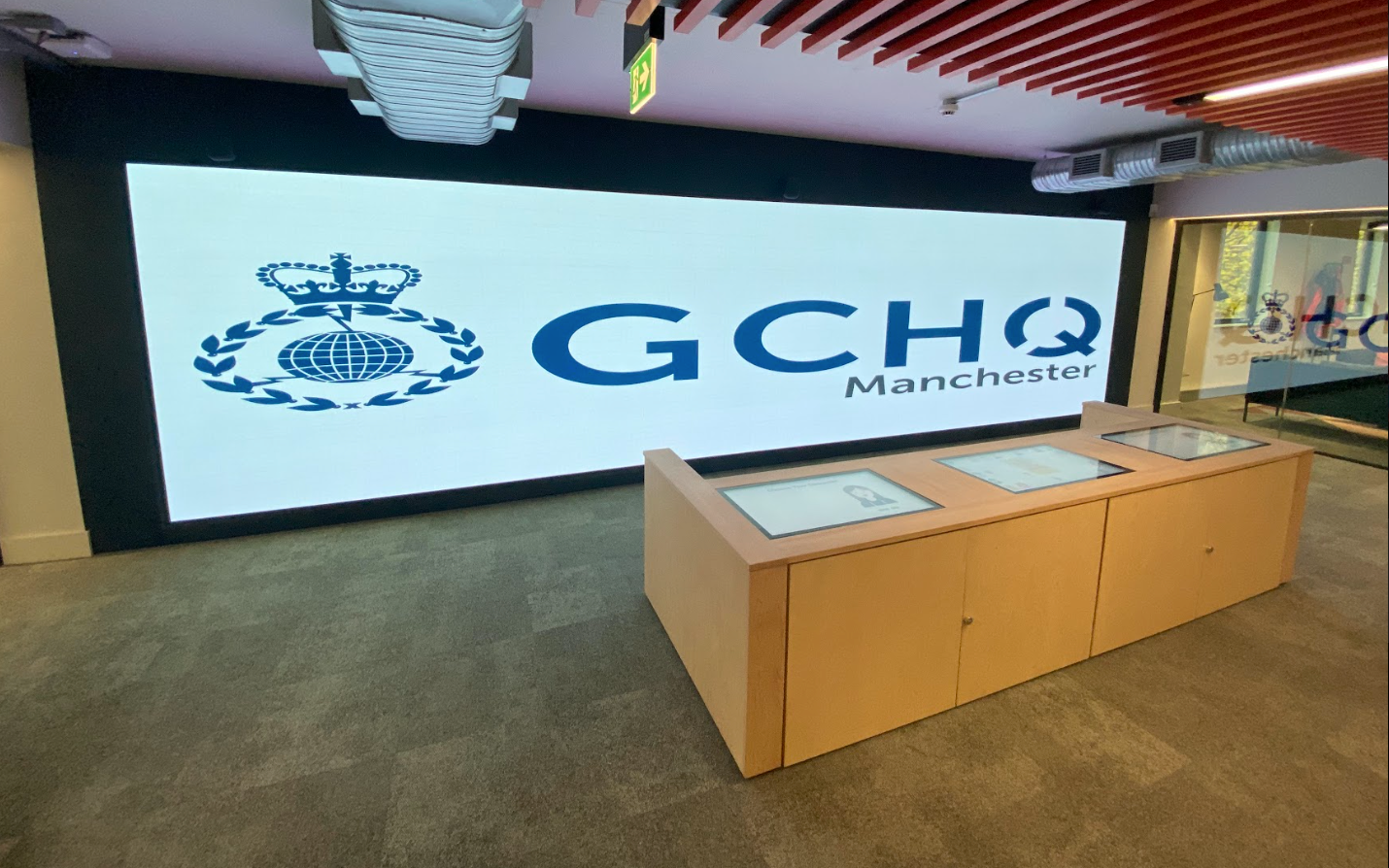
The Manc recently had the privilege of looking around GCHQ’s Manchester headquarters to meet the real-world spies, data analysts and security experts keeping us all safe. It was awesome.
For anyone unaware, GCHQ (Government Communications Headquarters) is the British intelligence agency that helps look after our nation’s security both at home and abroad, and back in 2019, the national security organisation set up its Manchester base in Heron House just off Albert Square.
Just last month, we were invited along to meet some of these silent heroes in person as part of a private and unprecedented press day, opening up their doors to select members of the public for the first time.
Invited inside the high-security facility along with around 60 kids from Whalley Range‘s St Margaret’s Primary School, we spent the day cracking codes, being upstaged by children much smarter than us and trying not to sweat through our clothes from nervousness.
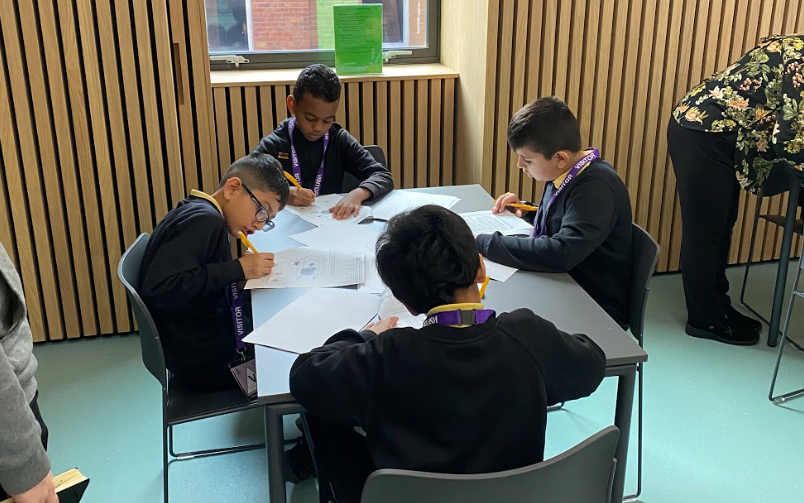
Credit: GCHQ Manchester (Credit: The Manc Group)
Welcome to Manc spy HQ
After being escorted through a strict entry procedure and chaperoned upstairs to the only floor we were allowed on, we were met by an admittedly unsuspecting team of people that you would never twig as working in espionage. It quickly put us at ease.
ADVERTISEMENT
We’re not joking when we say there were areas of this place we weren’t allowed anywhere near and even staff members have to their leave belongings behind before entering. However, what we did get to see was seriously impressive.
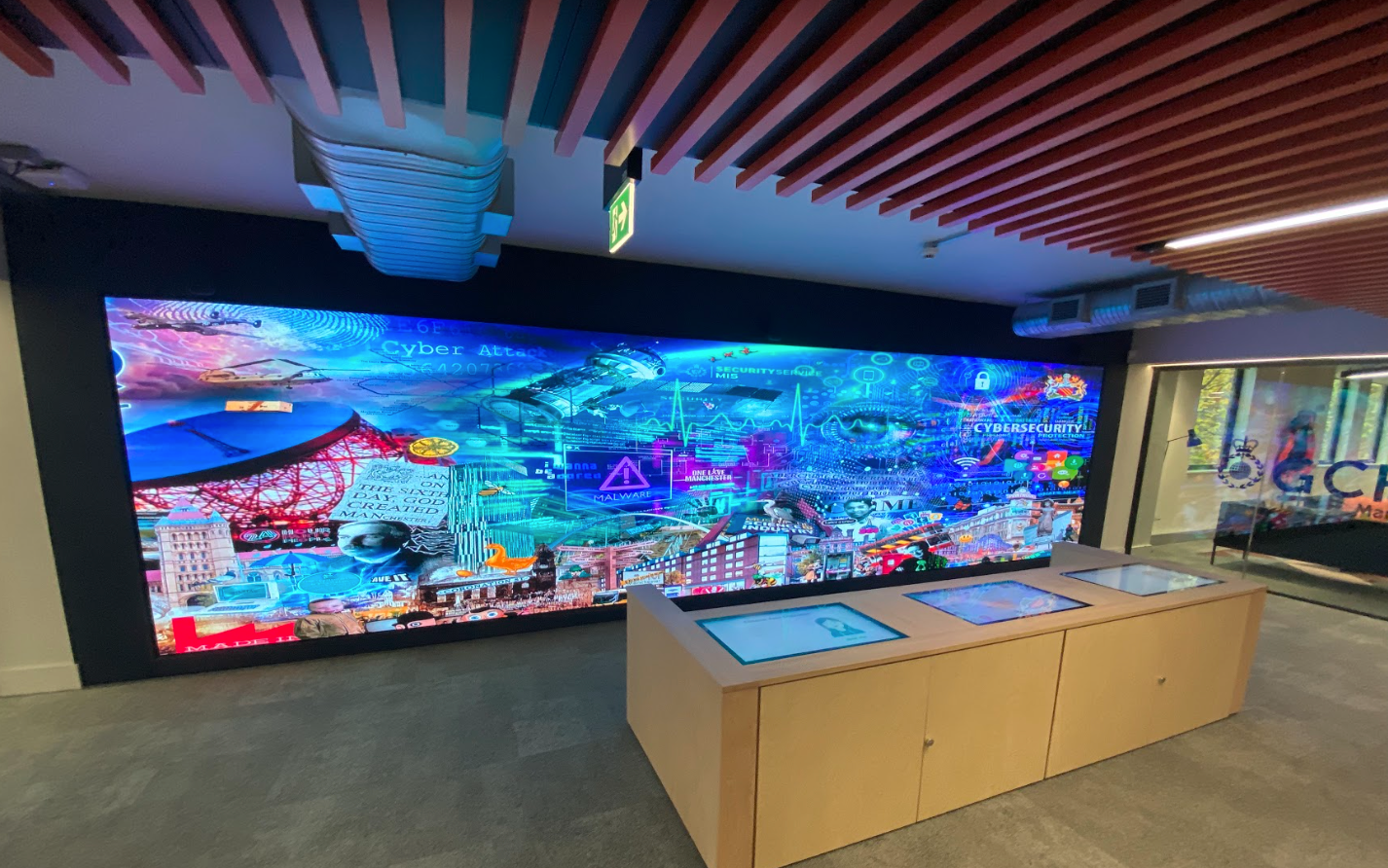
As well as immediate sights like the small drones being controlled by employees who could only give us their first names, we were also welcomed into a large briefing room with a high-tech display with screens that stretched across an entire wall and genuinely resembled something from a Bond flick.
ADVERTISEMENT
Not the big screen in question — we weren’t allowed to show you that… (Credit:”)
We then did our best to keep up with some of Britain’s brightest young brains, working through a series of code-cracking exercises inspired by the GCHQ’s new Puzzles for Spies book.
Making moves in Manchester
So why Manchester? Well, we spoke to Deputy Director Liz (yes, that’s all you’re getting) and she explained numerous appealing factors that drew the over-100-year-old institution to the city.
First off, they noted that not only is Manchester one of the fastest-growing cities in the UK and, indeed Europe, but thanks to city centre development and the likes of the ever-expanding Media City, Manchester has become a true “digital hub”.
ADVERTISEMENT
She also went on to state the roadmap for people joining the intelligence service is starting to change and while people used to join the likes of their Cheltenham HQ “at the age of 18 and stay for 40 years”, the demographic is changing and they want to seek out more diversity.
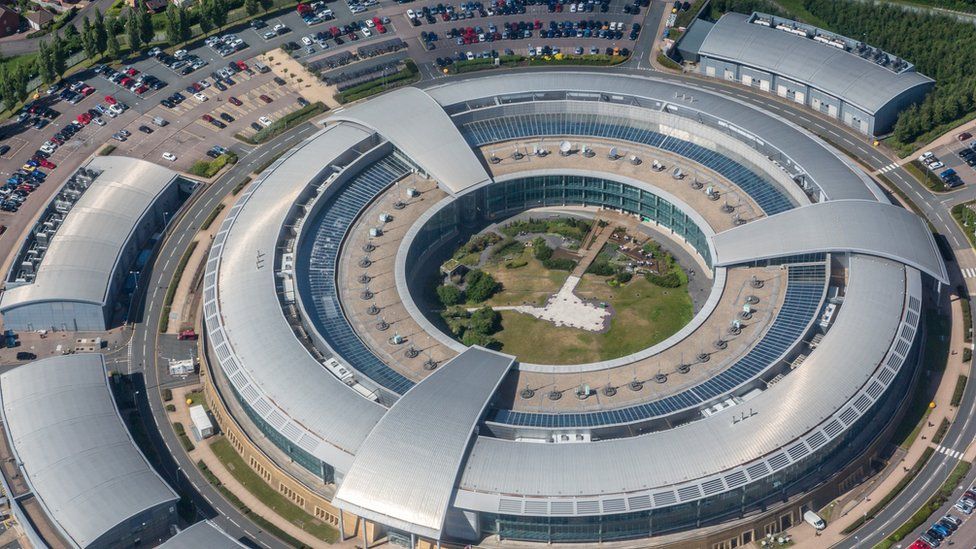
GCHQ Cheltenham (Credit: GCHQ.GOV.UK)
Part of the reason they invited the kids along is they wanted to show it’s more about “aptitude and skills, not just getting a degree”. It’s not just about reaching out further but adapting the recruitment process.
They also believe that as well as the uni and tech culture acting as a great feeder for GCHQ, the fact that Manchester is a huge melting pot of people from all walks of life will help them “evolve” as a group and they hope to start soaking up “untapped talent all across the North West“.
What’s it like being a spy?
It’s a question most people have wondered at one time or another — usually after a trip to the cinema or watching Line of Duty— but we wanted to know exactly how close to the movies working for GCHQ is and, thankfully, many of the people were more than happy to oblige.
Although most said being somewhat evasive becomes second nature when once you accept the job, it really is only your immediate family that you can reveal their roles to and even then, they can’t really divulge what they do on a day-to-day basis.
ADVERTISEMENT
Again, it’s worth reminding that, for all intents and purposes, these lot are spies and they genuinely have to keep up the lie. We especially enjoyed so many of them simply telling their friends they “work in marketing”.
On the other hand, despite having to withhold details even between certain colleagues with different clearance levels, Liz insists that they “don’t tend to moan about the nuts and bolts” of the job but things like the commute and how the price of Greggs keeps going up. Their office is above Greggs, for context.
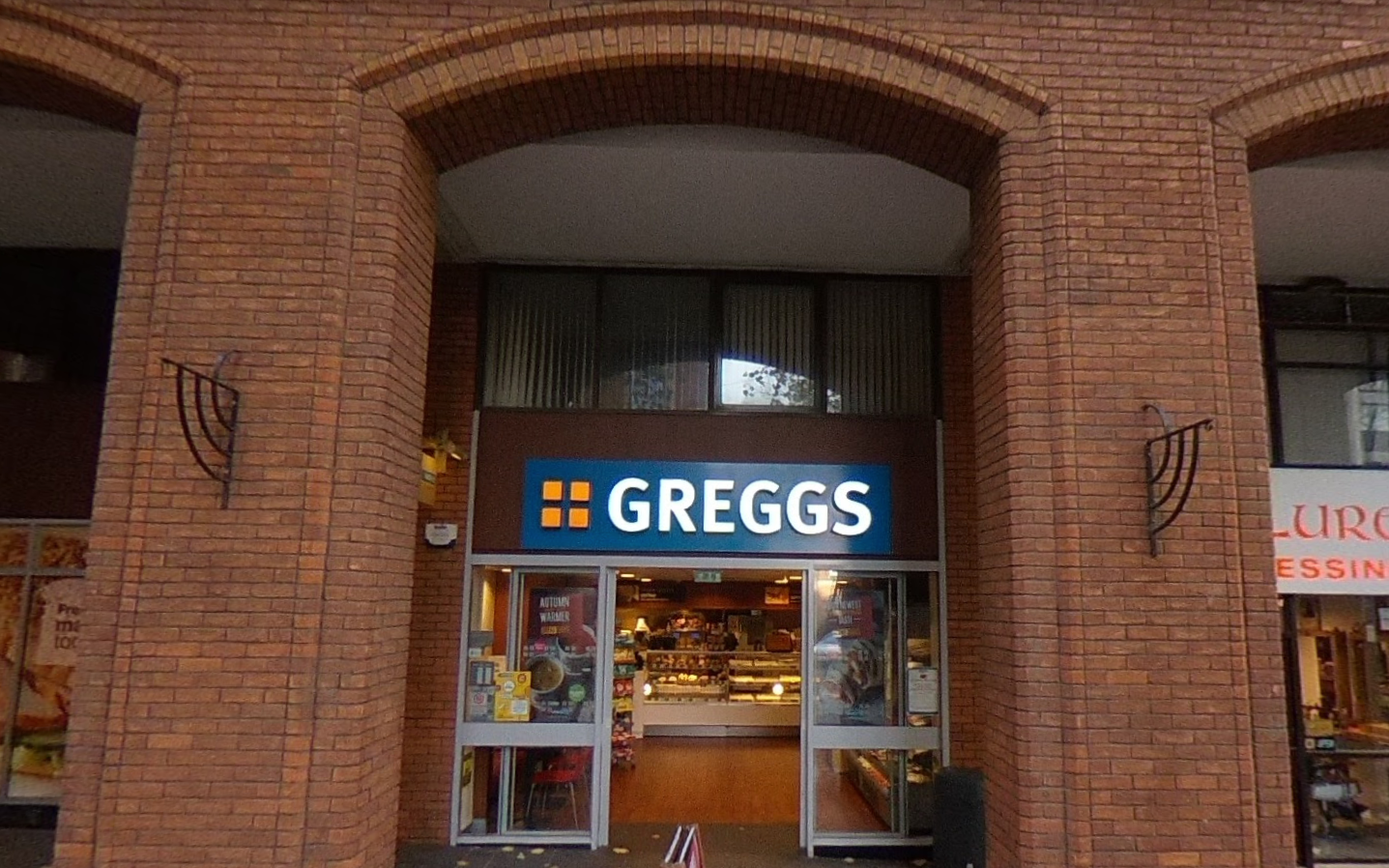
You’d never guess national security is being carried out above the Greggs on Brazennose Street (Credit: Google Maps)
She also admitted it’s “pretty exciting” to be able to do things that would be considered illegal for most people to do, not to mention immensely cool to be able to tell your kids “mums a spy”. Fair.
What are GCHQ working on right now?
Beyond trying to reveal “the human side” behind these otherwise faceless people, demystifying espionage and intelligence work, as well as trying to earn some trust through increased transparency, GCHQ also gave some insight as to what exactly it is they’re looking into at present.
Of course, we couldn’t talk about national security without asking them about Putin and the Russian invasion, which they confirmed is obviously top of the priority list, declaring the support of Ukraine as their “biggest task at the moment”.
ADVERTISEMENT
They also went on to explain that cyberattacks from the likes of China are also of concern, adding that they are carrying out counter-terrorism, software development and sweeps, as well as various routine security checks on a regular basis.
Liz also went on to assure that GCHQ as a whole is “working on all the missions, covering all the hostile states and pretty much covering everything you can think of”. It was genuinely a relief to know that we’re in safe hands.
If you think a career at GCHQ Manchester might be something you’re interested in, you can check out their vacancies down below and you also can also buy their Puzzles for Spies book HERE.
30 years ago, the IRA detonated a 1,500kg lorry bomb on Corporation Street in the heart of Manchester – here’s the story
Georgina Pellant
Today marks three whole decades since an explosion from the inside of a lorry parked on Corporation Street shattered windows and destroyed buildings across the city centre.
Causing an evisceration that stretched for miles, when the 1,500 kilogram IRA bomb went off in 1996, it was the biggest detonation in Great Britain since the Second World War.
Following the explosion, the city fell silent – leaving rack, rubble and ruin in its wake. Famously, one red post box was left standing – today fitted with a memorial plaque in remembrance of the tragedy.
It seems scary to think that back then, most people could only stand there, watch on and worry.
The bomb caused an estimated £700 million worth of damage to Manchester’s infrastructure and economy, and over a quarter of a century later, locals still tell the stories of where they were when it went off – and of the devastation it left behind.
Notably, one resident of the Cromford Court maisonettes on top of the Arndale – a 77-year-old RAF veteran suffering from the flu – didn’t even bother to get up when the telephone warning to evacuate hit, considering himself to have survived much worse feats during his time in military service.
Having been a rear gunner in a Lancaster in the war, he reportedly told police and authorities “he was buggered if he was going to let a small bomb affect him.”
In subsequent years, Danny O’Neill has become a part of an urban legend surrounding the bomb as his staggering story has been told time and time again.
Around 90 minutes prior to the detonation, the Provisional Irish Republican Army had telephoned in warnings – meaning that around 75,000 people were able to be evacuated from the area before the bomb went off from the back of a van.
However, the bomb squad were unable to defuse it in time, leading to over 200 injuries from people still left in the area.
Thankfully, despite those injuries, there were no fatalities, and many of those reported traumas came from the shattering of thousands of windows and other damage to buildings in which unsuspecting people were getting on with their days.
Several buildings near the explosion were damaged beyond repair and had to be demolished, while many more were closed for months for structural repairs, and this prompted the biggest regeneration of Manchester city centre ever – something that is still continuing to this day, arguably at a more rapid rate than ever.
The city lay dormant for days after the explosion, as people came to terms with what had happened and kept their distance. Many moved out of the centre for a period of time, while many more simply decided not to visit for fear of another incident.
It was a desolate place, eerily quiet, and in need of some serious TLC.
According to Home Office statistics, an estimated 400 businesses within half a mile (0.8 km) of the 1996 blast were affected, 40% of which did not recover.
Credit: Manchester Libraries
Market Street – near the explosion and at that time the second-busiest shopping street in the UK – was considered by some a “fearful” place, and one that was to be “avoided like the plague”.
The prospect of pulling Manchester’s bustling city centre out of its darkest depression was not casually approached by those in charge.
It was acknowledged as a mammoth task from the get-go, but Greater Manchester has never let anything get in its way. Despite how steep the hill is that we’re standing at the base of, we always manage to reach the peak, ready to go again.
Gig review | Lola Young’s Manchester comeback – A joyous return to stage at the O2 Apollo Manchester
Kristen MacGregor-Houlston
The excitement in the air is palpable in the O2 Apollo Manchester, the crowd is itching for her to make her way onto stage and is chanting her name – Manchester has missed you, Lola Young.
After an extended hiatus since she collapsed at the All Things Go festival in New York last September, Lola is back on a short tour to find her feet again. Whilst Manchester isn’t officially the first show, it is the headline performance for her comeback.
Lola’s break had come at a pivotal moment, with her third studio album, I’m Only F***ing Myself (2025), earning huge acclaim, performances across the globe, and endorsements from the likes of Elton John for her talent.
After cancelling all of her shows ‘for the foreseeable future’, Lola asked fans for their forgiveness, writing in an emotional statement: “I really hope you’ll give me a second chance once I’ve had some time to work on myself and come back stronger.”
Tough to handle for anyone, let alone a young rising artist.
It was clear to everyone that her hard work on herself had paid off, as this was a different Lola Young from the one I saw at Glastonbury last year: there was a calmness to her – she seemed more centred and more confident.
That calmness, however, did not mean a lacklustre performance: she is still a powerhouse; her stage presence is just magnetic, and it is clear to see how loved she is by her fans. The energy in the room didn’t falter the entire time she was on stage.
She kicked things off with ‘Sad Sob Story’, a song about moving on from a toxic relationship, which seemed fitting as she steps away from the drama and difficulties of last year into a fresh start. A wall-shaking opening number that set the scene for what was to follow with the rest of the show.
As part of her healing journey, Young stated that she has decided to write something special and specific for each show to tell herself if she’s worried or doubting her ability.
She shared her Manchester mantra with us: “When you are connected, when you express what you feel is true to you, when you open yourself up and share your very unique experience, remember you are electric… Those who want to listen will lean in, no matter your volume.”
Although she was clearly introspecting, she was also speaking to her audience, her fans, and expressing gratitude for them still being there. Shouts of support echoed out through the venue, her fans truly loving and supporting her as they have since day one, perhaps more so than ever.
Her performances of songs like ‘Big Brown Eyes’, ‘Not Like That Anymore’ and ‘Conceited’, showed just how much fun Lola was having on stage, being back and being surrounded by people who truly loved her.
At times, the crowd were singing along so loudly and passionately that she laughed and told the audience, “I can’t even hear myself in my own ears.” She had to occasionally take moments to step back and take it all in, seemingly overwhelmed with joy at the outpouring of love being reflected back to her.
Her band were also a stand-out, sharing in her energy and passion. It is clear that Young and her band could easily fill huge arenas with their talent and fervour, but this more intimate venue just seemed correct.
Lola continued to prove throughout the night why she was so deserving of her BRIT Award for ‘Breakthrough Artist of the Year’, and her Grammy nominations for ‘Best New Artist’ and ‘Best Pop Solo Performance’.
Her vocal talent, emotional depth and electric stage presence were showcased in songs like ‘why do i feel better when i hurt you?’, ‘Post Sex Clarity’ and the incredible ‘You Noticed’, showing an extremely vulnerable side to her that had many audience members tearing up.
We saw all sides of Young during this show, with her iconic songs ‘One Thing’, ‘d£aler’ and ‘Messy’ practically blasting the roof off of the O2 Apollo Manchester.
The fans could hardly contain themselves, screaming the lyrics back at her – it was truly a night to remember for everyone.
With another night in Manchester due to popular demand, Lola promised to be back soon. Could it be a bigger tour, bigger venues, new music?
Who knows, but for now we’re just glad to see her healthy and have her back in our lives again.