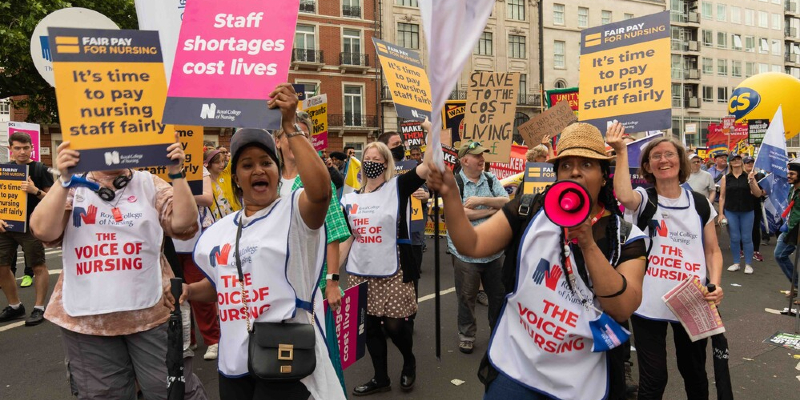
Tens of thousands of nursing staff are set to walk out today in what is one of the largest strikes in the history of the NHS.
The Royal College of Nursing (RCN) – which is the nursing industry’s largest union, representing over 300,000 nurses across the UK – announced last month that thousands of its members had voted to take industrial action for the first time ever in its 106-year history.
The announcement that nurses are to walk out came after the union urged its members to vote in favour of striking when the ballot first opened at the start of October, with RCN’s general secretary calling it a “once-in-a-generation chance” to make real change.
Nurses are striking today in objection to “years of real-terms pay cuts” and “concerns over patient safety”, the RCN said.
Up to 100,000 nursing staff are taking part in the strikes in England, Northern Ireland, and Wales today, with a further day of strike action is planned for Tuesday 20 December.
ADVERTISEMENT
Strikes are taking place at the NHS trusts or health boards that have met the relevant legal requirements, with the union confirming that many of the biggest hospitals in England will see action taken by its members, but others “narrowly missed” the legal turnout thresholds to qualify for action.
The RCN has always maintained it will ensure strike action is carried out “legally and safely at all times”.
ADVERTISEMENT
The union said in a statement on its website nurses are “campaigning for a pay rise to overcome years of real-terms pay cuts and to protect patient safety by allowing the NHS to recruit and retain the nursing staff it desperately needs.”
“Since strike action was announced last month, we have repeatedly asked Health Secretary Steve Barclay to open formal pay negotiations,” the RCN revealed.
“However, ministers have declined every offer – and have instead chosen strike action.”
ADVERTISEMENT
Tens of thousands of nurses walk out today in the largest strike in NHS history / Credit: Royal College of Nursing
Speaking ahead of strike action taking place today, Pat Cullen – General Secretary & Chief Executive at the RCN – said: “For many of us, this is our first time striking and our emotions are really mixed. The NHS is in crisis, the nursing profession can’t take any more, our loved ones are already suffering [but] it is not unreasonable to demand better.
“This is not something that can wait. We are committed to our patients and always will be.”
She continued: “I have tried to negotiate and get governments to act. They’ve had every chance but they chose to turn their back on us.
“As hard as this is, we won’t turn our backs on our patients.”
The RCN says today’s strike” could be the beginning of a longer period of action” if governments continue to refuse formal pay negotiations, or if pay talks don’t result in a “satisfactory outcome”.
ADVERTISEMENT
“The NHS is in a crisis, the nursing profession can’t take any more, our loved ones – your parents, children, friends and relatives – are the ones at stake here."
The mass walk out of nursing staff nationwide today comes amid warnings that nurses are leaving the profession in record numbers, and many are unhappy with working conditions, staff shortages, and ultimately, their pay.
A recent analysis by London Economics, as referenced by the RCN, found that pay for nurses in the NHS has declined at twice the rate of the private sector in the last decade, and that their real-terms earnings are said to have fallen by 6%.
The RCN wants nurses to be given a pay rise in line with the rate of inflation.
“Today, we strike for fairness,” Pat Cullen concluded.
“We strike for the future of our NHS. We strike because it’s our right – and our duty – to stand up for fair pay and for patient safety.”
Featured Image – Royal College of Nursing
News
Two teens arrested after stabbing of 14-year-old boy in Manchester city centre
Emily Sergeant
Two teenagers have been arrested following the stabbing of a 14-year-old boy in Manchester city centre over the weekend.
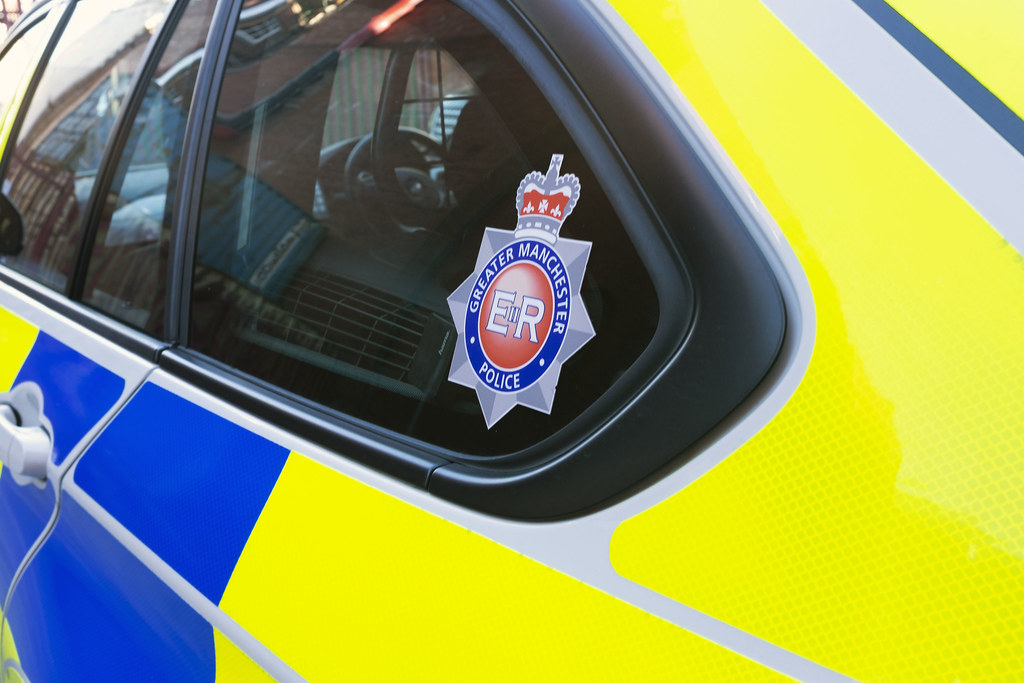
In case you need bringing up to speed first, at around 3:15pm this past Saturday afternoon (17 October 2026), officers from Greater Manchester Police (GMP) were called out to reports of a stabbing on the ninth floor of the Arndale carpark in Manchester city centre.
Emergency services attended the scene, and a 14-year-old boy was taken to hospital with injuries consistent with a stab wound.
Thankfully, the victim’s injuries are not believed to be life-threatening or life changing, but an investigation and enquiries are ongoing.
Police conceded that this will ‘understandably’ cause concern in the community, but has assured the public that they believe this to be an ‘isolated incident.
And now, it has been confirmed that two teenage boys, also aged 14, were arrested on Sunday night (18 October) on suspicion of grievous bodily harm, and tat this time, they are currently in custody for questioning.
“We’d like to thank the local community for their support during our investigation as well as the passersby who helped the victim following this incident,” commented Detective Inspector Sean McFadden, of GMP’s City of Manchester district.
“Your quick-thinking undoubtedly saved the victim from potentially life-threatening injuries.
“We appreciate that incidents of this nature can cause concern and we’d like to reassure the public that we understand this was an isolated incident and there is no wider threat to the community.
“Officers worked quickly and arrested two juveniles on Sunday, and they currently remain in custody for questioning.”
Anyone with information is asked to contact police on 101, quoting log 2050 of 17/10/2026, or via the LiveChat function. Alternatively, contact Crimestoppers anonymously on 0800 555 111.
Featured Image – GMP
News
UK Government announces £100 fines for ‘antisocial behaviour’ on public transport
Emily Sergeant
The Government has today announced plans to tackle antisocial behaviour on public transport.
In a bid to crackdown on loud music, littering, vaping, and other threatening behaviour on buses and trains, guidance was issued by the Government today for local authorities to prosecute and even issue fines of up to £100.
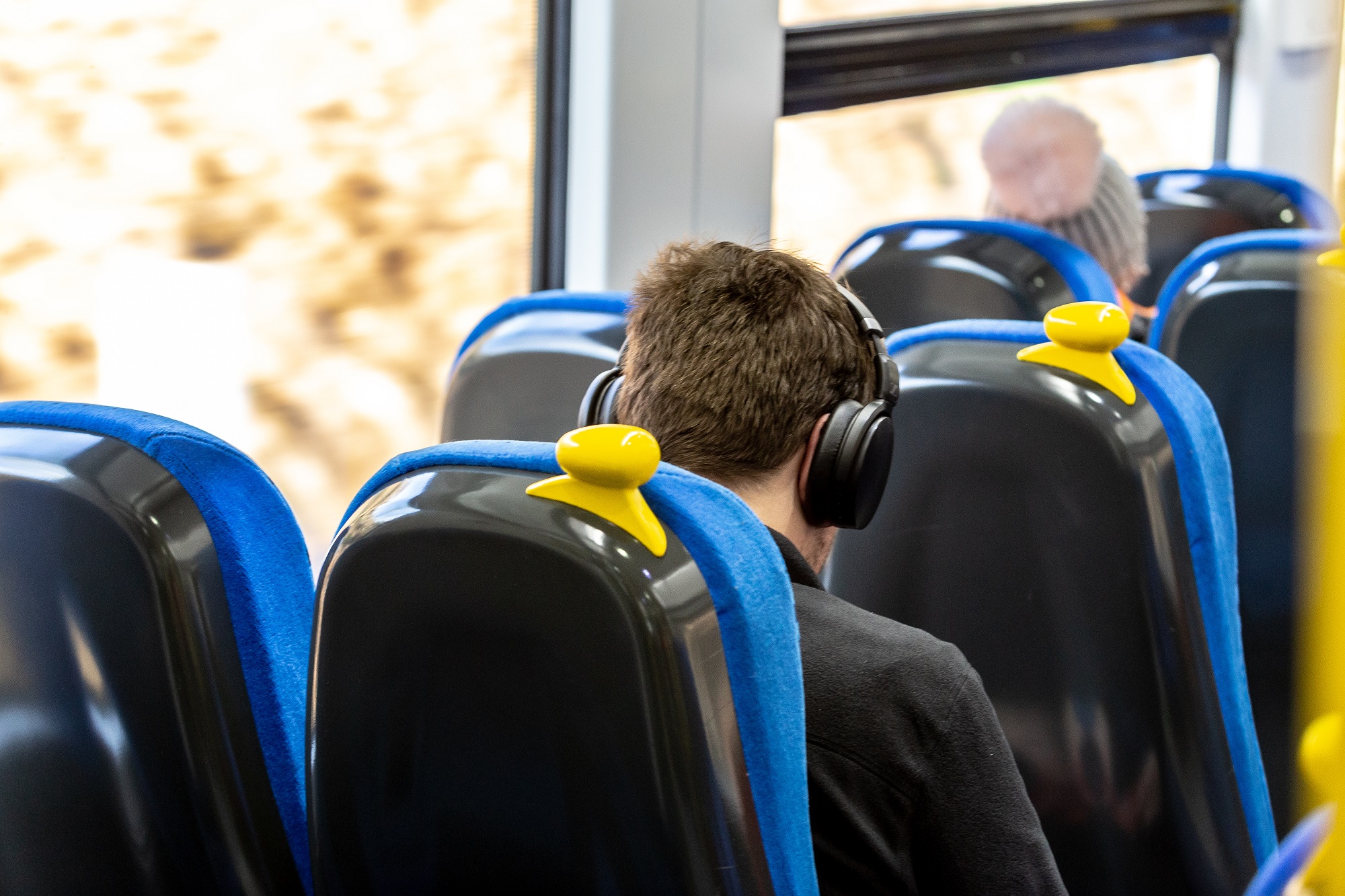
For many, playing audio out loud on public transport – also known as ‘loudcasting’ – has become one of modern life’s most irritating parts of the daily commute, but now, a new national campaign is aiming to encourage rail passengers, in particular, to ‘share the carriage, not the noise’ to improve the journey experience for all.
This will include reminders of the rules in place on the rail network and, if a passenger refuses to stop when asked by authorised rail staff, they can be removed from the train at the next station or face fines up to £1,000.
On buses, however, the powers for authorities were already made possible by the Bus Services Act 2025, meaning all local transport authorities in England are able to set and enforce their own rules.
Authorised officers – including transport safety officers and the police – will be responsible for enforcement, rather than bus drivers themselves, and they will be tasked with a three-step approach to deal with incidents. They will need to:
Engage with the person
Explain the rules and their impact on other passengers
Take enforcement action if they refuse to comply
“We’ve all been on the train when someone starts blasting music or videos from their phone,” commented Prime Minister Andy Burnham.
“It gets on your nerves and can quickly spoil the journey, so we’re launching a nationwide campaign reminding passengers to use headphones on trains. On top of that, we’re giving local leaders new powers to tackle loud music, vaping and littering on buses.
“It’s a simple thing, but one that will make journeys that little bit better for all of us.”
Ben Plowden, Chief Executive at the Campaign for Better Transport, added: “Antisocial behaviour is not just irritating, it can be a real deterrent to people using public transport – especially people with different accessibility requirements.
“If these new powers are properly and visibly enforced, they should help everyone feel safe and comfortable on public transport and enjoy the ride.”

 Emily Sergeant -
15th December 2022
Emily Sergeant -
15th December 2022