New reports have suggested that the Greater Manchester public are to be consulted on the latest Clean Air Zone (CAZ) proposals – but this won’t be done any time soon.
The Clean Air Zone was to initially hand motorists daily charges of up to £60 for some of the most polluting vehicles on Greater Manchester‘s roads, but many will remember that the deadline for the scheme had been put on hold until while the plan was referred back to the government for “urgent review” in January, following huge backlash and after Prime Minister Boris Johnson conceded that it was “completely unworkable” for the region.
The government agreed to delay the deadline for the scheme until 2026, but local leaders wanted to scrap all charges and help to fund vehicle upgrades instead.
Greater Manchester Combined Authority (GMCA) then set out evidence supporting an investment-led, and, crucially for residents and motorists, a non-charging Clean Air Plan back in June 2022 – which it said was “the best solution” to address the roadside nitrogen dioxide (NO2) problem.
But ministers are reportedly yet to respond to this latest plan.
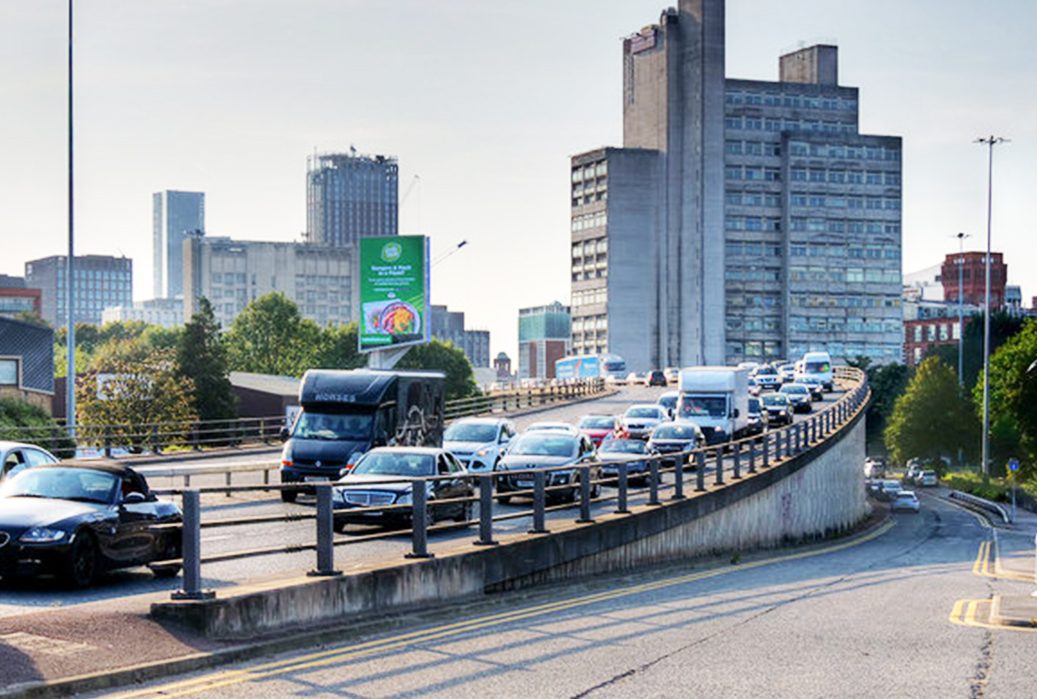
The case for a new “investment-led” non-charging Clean Air Zone (CAZ) plan in Greater Manchester has now been published / Credit: David Dixon (via Geograph)
The closest thing to a public response from the government on the plan was when environment secretary George Eustice said he believed there was “little robust evidence” that it will work effectively.
ADVERTISEMENT
Mr Eustace suggested that taxis, vans, buses, and lorries should still be charged in the city centre.
It’s now being reported that, ahead GMCA’s plan for a non-charging CAZ is to be formally-submitted to the government in its final form following a meeting on 16 August, ‘targeted engagement’ is currently taking place on the proposal and an online survey for some motorists is set to launch in a couple of weeks – but this will not go out to everyone.
ITV Granada reports that transport bosses have confirmed the wider public will not be able to have their say on the new proposals until early 2023.
🗣️ “Government wants us to charge Greater Manchester businesses at a time they can least afford it.”
The case for a new investment-led, non-charging Greater Manchester Clean Air Plan has been published by @greatermcr before being submitted to Government. https://t.co/8Qk7fsq4YN
— Mayor of Greater Manchester (@MayorofGM) June 29, 2022
This has already been met with criticism from industry leaders and campaign groups.
Prominently addressing the fact the public will not be consulted on plans until 2023, spokesperson for RethinkGM – a campaign group set up in opposition to the Greater Manchester Clear Air Zone – said: “It is extremely disappointing that leadership of Greater Manchester continue to ignore the public and residents of the region once again, by leaving public consultation on any CAZ scheme until early 2023.
“With a national cost of living crisis currently under way and residents now choosing between eating, heating and survival, GMCA still fail in their duty to residents and maintain their ill-advised attempt to impose further unnecessary limitations on livelihoods.
“It is quite clear that this scheme now needs scrapping in full and consideration given to the poor, low paid, business and those suffering above all else.”
Featured Image – The Manc Group

News
England head coach Shaun Wane quits ahead of 2026 Rugby League World Cup
Danny Jones
England head coach Shaun Wane has stepped down from his role as the national team setup after more than half a decade in the post.
His resignation comes as the Rugby Football League (RFL) looks to pivot and set out a long-term vision ahead of the World Cup later this year.
The Wigan-born former Warriors manager’s replacement is expected to be merely a part-time appointment as future planning begins.
Announced on Wednesday, 14 January, Shaun Wane’s tenure has ended “effective immediately”.
Sharing an official update online, the RFL wrote: “Wane, who has led England since February 2020, has taken time to reflect on the programme and believes the timing is right for new leadership to guide the team into the next phase, including the upcoming World Cup.
“During his tenure, Wane oversaw memorable series victories over Tonga in 2023 and a star-studded Samoa a year later, as well as a semi-final in the World Cup. He finishes with 14 wins from 19 matches.”
Crediting him as one of “a very small elite number of coaches to have won the full suite of domestic club honours and achieved World Club Championship success”, hailing his experience and longevity both as a player and as a coach.
As for Wane himself, he said: “It has been the honour of my life to coach England Rugby League over the last six years, but after careful reflection, I believe the time is right to step aside and allow the programme to move forward into its next chapter.
England are on the lookout for a new coach heading into the World Cup after being swept in the Ashes.
Coach Shaun Wane has reportedly resigned from the post after a disappointing 3-0 whitewash against Australia last year.
The 61-year-old ex-pro goes on to add, “The privilege of leading my country in a World Cup, an Ashes Series on home soil and securing victories over Tonga and Samoa will live long in the memory.
“I’m incredibly grateful to all the players, coaches and staff I’ve worked alongside during that time; their commitment and professionalism made those moments possible. I wish everyone involved with England Rugby League the best going forward and for the World Cup later this year.”
According to the latest reports online, St Helens boss Paul Rowley is now said to be the favourite to take over in the interim.
The 2026 Rugby League World Cup is still months away (scheduled to take place in October and November), but the governing body will want to get the new setup and coaching in place as soon as possible to prepare for the tournament.
Greater Manchester town named as one of country’s worst at fixing potholes
Emily Sergeant
A town in Greater Manchester has been named one of the worst in the country at managing roads and fixing potholes.
For the first time ever, drivers across England can now see how well their local highway authority is tackling potholes on their roads thanks to a new traffic light rating system published by the Government this weekend.
The new ratings grade local highway authorities as red, amber, or green.
The ratings – which have presented on a new interactive map – are based on current road condition and how effectively local authorities are spending the Government’s record £7.3 billion funding to fix potholes and investing in long-term measures to maintain roads.
The Government funding is meant to allow local authorities to repair potholes ‘effectively’ and move away from short-term repairs that work out to be more expensive – with these fixes meaning more money in drivers’ pockets, as the average repair bill from hitting potholes is said to be around £320.
We’ve launched a Red, Amber, Green rating system, so you can see how well your local highway authority (LHA) is fixing your local roads.
🟢 Green = best practice, long-term preventative plans 🟠 Amber = on the way, but room to improve 🔴 Red = support in place to raise… pic.twitter.com/gRwkEx5kdm
The condition of local roads, how much local authorities are spending on road repairs, and whether they are following best practice in maintaining highways are all key areas taken into account when deciding on an area’s rating.
Those that scored ‘green’, like Manchester, were able to demonstrate they are following best practice, while also maintaining good road conditions and investing significantly into improving local roads, and those that scored ‘amber’ – which the majority of Greater Manchester came under showed that there was room for improvement in individual areas.
However, one Greater Manchester town did not fare well at all, and ended up with an ‘red’ rating… and that town was Bolton.
The colour-coded map showing each local authority’s pothole rating / Credit: OS / Crown Copyright (via gov.uk)
Those local authorities that are rated ‘red’, like Bolton, are not yet meeting the expected standards in one or several areas measured, according to the Government, such as the current state of the roads, their plans for preventing potholes, or investment into maintaining their local roads more widely.
“For too long, drivers have paid the price because our roads were left to deteriorate,” commented Transport Secretary, Heidi Alexander.
“We’ve put our money where our mouth is, increasing the funding for local highway authorities with £7.3 billion to fix roads and given them the long-term certainty they have been asking for.
“Now it’s over to them to spend the money wisely, and for the first time, we are making sure the public can see how well councils are doing in delivering the improvements they want to see in their local area.”