A UK-first £1 million music therapy project is being rolled out to provide a “lifeline” for people with dementia in our region.
Thanks to generous funding from a number of regional and national sources, Greater Manchester is to become the first ‘Centre of Excellence for Music and Dementia’ in the UK, and it’ll be hosted by Manchester Camerata with support from the University of Manchester (UoM) and the Alzheimer’s Society.
More than £1 million of funding has been committed by Mayor of Greater Manchester, Andy Burnham, Sir Richard Lees, who is now the Chair of the NHS Greater Manchester, and the National Academy for Social Prescribing’s ‘Power of Music Fund’.
Due to be rolled-out from October 2024, the funding will support three years of direct musical support activities across all of the region’s 10 boroughs.
For the three-year project, Manchester Camerata will work in partnership with the Alzheimer’s Society and UoM to offer “research-backed” music cafes, for both its ‘Music in Mind’ programme and the Alzheimer’s Society’s ‘Singing for the Brain’ scheme.
ADVERTISEMENT
It’s hoped this will “help take pressure off frontline health and care staff” in the NHS.
Manchester Camerata’s internationally-renowned ‘Music in Mind’ programme – created in collaboration with UoM – uses the principles of music therapy to improve the wellbeing of people living with dementia, and was devised from the foundations of some of the world’s leading dementia experts and their research.
ADVERTISEMENT
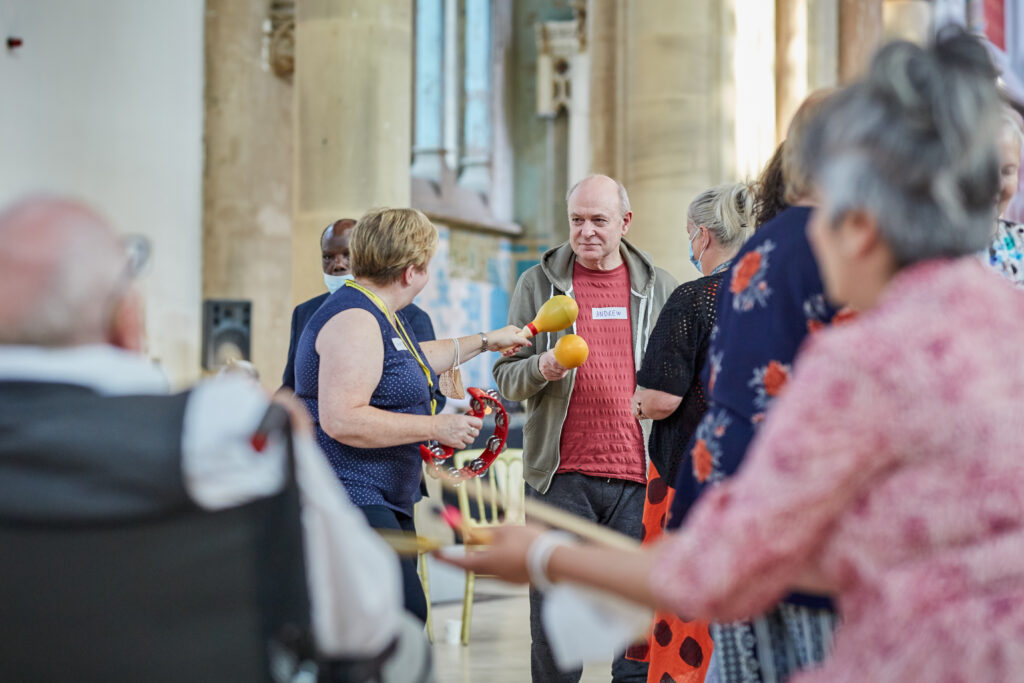
The Alzheimer’s Society’s ‘Singing for the Brain’ programme is based on key music therapy principles, and has already been massively successful in bringing people living with dementia together to sing a variety of songs they know and love in a fun and friendly environment – with sessions also including vocal exercises that help improve brain activity and wellbeing.
The UK’s first music therapy project for dementia patients is being rolled out across Greater Manchester / Credit: Manchester Camerata
The sessions also create an opportunity for people living with dementia and their carers to socialise with others, and experience peer support too.
Manchester Camerata and the Alzheimer’s Society will recruit a workforce of 300 volunteers over the next three years and train them to deliver the ‘Music Cafes’, which will help support thousands of people living with dementia in Greater Manchester.
ADVERTISEMENT
In addition to the Centre of Excellence in Greater Manchester, the National Academy for Social Prescribing’s ‘Power of Music Fund’ is also awarding small grants to 70 grassroots music and dementia projects across the UK, and this will support more than 5,500 people in total.
We are genuinely delighted by this news.👇🏻
We are proud of all our partners, particularly @MancCamerata, who helped bring it about.
We are a music city-region and will now work to unlock its full power for the benefit of our residents with dementia. 🙏🏻 https://t.co/1Xoeyf4ykN
Mayor Andy Burnham called said the project is “fantastic news for Greater Manchester”, and called it a “reminder of the power of music to shape our lives and our communities”.
He continued: “Manchester Camerata have played a key role in our Music Commission, and I’ve seen first-hand the transformational impact of what they do in our city region, so they are the ideal partner to pioneer the UK’s first Centre of Excellence for Music and Dementia and work with the Alzheimer’s Society to unlock the potential of music as therapy.
“This project will provide life-changing support to people with dementia and their carers in our 10 boroughs.
“It will also generate groundbreaking research that will influence health and care policy across the country while directly improving lives across Greater Manchester”.
Featured Image – Manchester Camerata
News
Millions of unmarried couples to get ‘stronger’ rights and more financial security
Emily Sergeant
Millions of unmarried couples in England are set to get ‘stronger’ rights and more financial security.
As the Government continues to prioritise tackling Violence Against Women and Girls (VWAG) and working people, and ultimately meet the needs of modern relationships, more than 3.5 million unmarried couples are to be given more financial security under a new consultation which launched last week (Friday 5 June).
Designed to ‘shape future law’ and ‘better reflect modern society’, the consultation is looking to strengthen rights and make the separation process less financially difficult for cohabiting couples and those who simply choose not to marry.
The Government says it recognises that, due to cost of living pressures, financial security is more important than ever and the current ‘outdated’ system offers unmarried couples who live together limited financial rights if their relationship ends.
The proposals will help couples – including survivors of domestic abuse – gain independence at the end of a cohabitating relationship, whatever their marital status.
The consultation will also explore whether courts should give greater weight to the impact of domestic abuse, including controlling or coercive behaviour or economic abuse, when assessing finances for married couples and cohabitants.
Protections for cohabiting couples will also be ‘levelled up’ by giving automatic rights to inherit if their partner dies without a will.
The Government is also proposing making pre-nuptial and post-nuptial agreements legally binding.
Deputy Prime Minister, David Lammy, says these reforms ‘strike an important balance’ between tradition and modernity.
“When a relationship comes to an end, each partner should have the support and certainty they need to rebuild their life,” he commented. “We’re launching this consultation to make sure our new family law builds a fair system that offers the most vulnerable protection in the event of a breakup, and at a time where the country is facing cost of living pressures.”
Justice Minister Baroness Levitt KC concluded: “Financial independence should “be afforded to everybody – not just those who choose to marry or enter into a civil partnership.”
You can have your say on the consultation on the Government website here.
Police give update after bomb squad descended on Fallowfield and evacuated residents
Emily Sergeant
Police have given an update after officers were called to investigate reports of two ‘suspicious items’ found in front gardens in Fallowfield.
Greater Manchester Police (GMP) were called out to Abram Close, in the Fallowfield area of Manchester, shortly after 6:05pm this past Saturday (6 June 2026) following a report of a ‘suspicious item’ being found in a front garden, and officers attended the scene alongside the Explosive Ordinance Disposal (EOD).
After the EOD made an assessment of the scene, around 20 nearby properties were advised by police to evacuate ‘as a precaution’.
As the investigation continued across the weekend, a second suspicious item was then found outside a property on Rostherne Avenue at around 2:45pm yesterday afternoon (Sunday 7 June), and once again, officers and partner agencies attended the scene to put a cordon in place.
As a precaution, several other houses in the area of the second property were also asked to evacuate while this work continues.
No arrests have been made at this time, but enquiries are ongoing.
“We thank everyone for their patience so far whilst we deal with this incident, as our investigation into the full circumstances continues,” commented Detective Chief Inspector Peter Morley, of GMP’s City of Manchester Division.
“Incidents such as these are likely to cause alarm in the local community, but please be reassured that there is no wider threat.
“Officers will be on hand to ensure the safety of people in the nearby area, so please speak to them if you have any concerns. As our work continues, it is vital that anyone who has any information, no matter how small, should report it to us and allow us to investigate.”
Can you help? Any information, CCTV, dash cam, or mobile phone footage can be shared with police online via the LiveChat service at gmp.police.uk, or by calling 0161 856 4259, quoting the log number 1948 of 07/06/26.
Details can also be passed anonymously to Crimestoppers on 0800 555 111.