In what was a genuinely touching moment earlier on today, one of Manchester’s most iconic cultural landmarks came to life.
Well, not quite – but it was recreated in a way that made for a truly sombre sight.
Stopping commuters in their tracks and drawing in crowds of on-lookers in their dozens just after 10:30am this morning, a military charity took the unique and memorable approach of marking the anniversary of a statue it installed in Manchester city centre five years ago with a special “living statue” display.
If you’ve been to Manchester Piccadilly station before, then there’s a good chance you’ve come across Victory Over Blindness before.
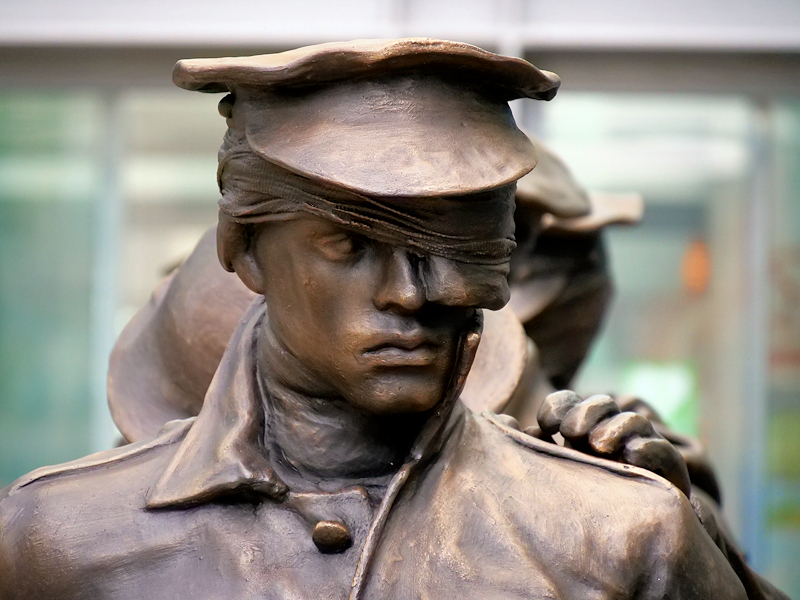
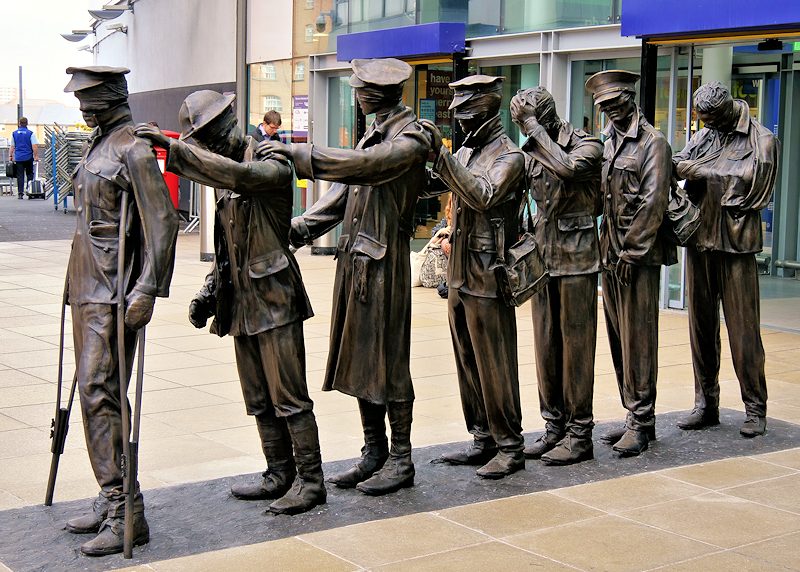
We’re of course talking about the bronze sculpture outside the front of the station that depicts seven life-sized soldier figures wearing blindfolds and guiding one another – which has been well-received by many for its “moving” subject matter since it was first erected back in October 2018, and has been described as “striking” for its interaction with passers-by at eye level.
ADVERTISEMENT
The ‘Victory Over Blindness’ statue outside Manchester Piccadilly station / Credit: Wikimedia Commons | David Dixon (via Geograph)
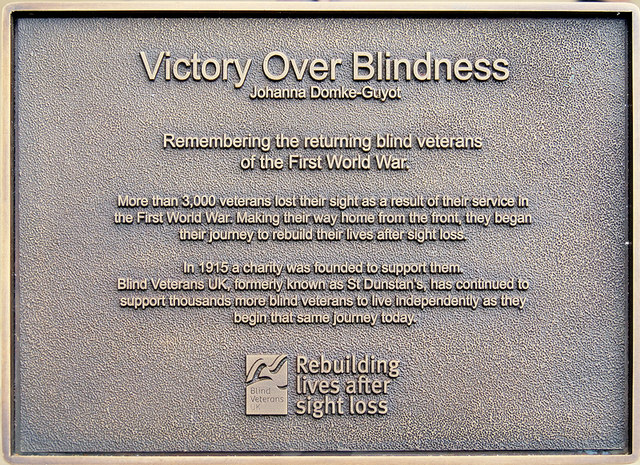
The now-iconic statue was unveiled half a decade ago by Blind Veterans UK – a national charity supporting the thousands of vision-impaired ex-Service men and women nationwide – to commemorate 100 years since the end of the First World War, but also serves as a monument to all the veterans the organisation has supported since then too.
The industrialised nature of WWI – which lasted from 1914 to 1918, and saw the deaths of an estimated 886,000 British and Commonwealth military personnel, as well as countless more injured – made for unfathomable human suffering.
ADVERTISEMENT
Around 30,000 of the wounded were discharged with damaged or defective eyesight, and of these, 3,000 were left permanently blinded.
Blind Veterans UK was then founded in 1915 in a bid to support those 30,000.
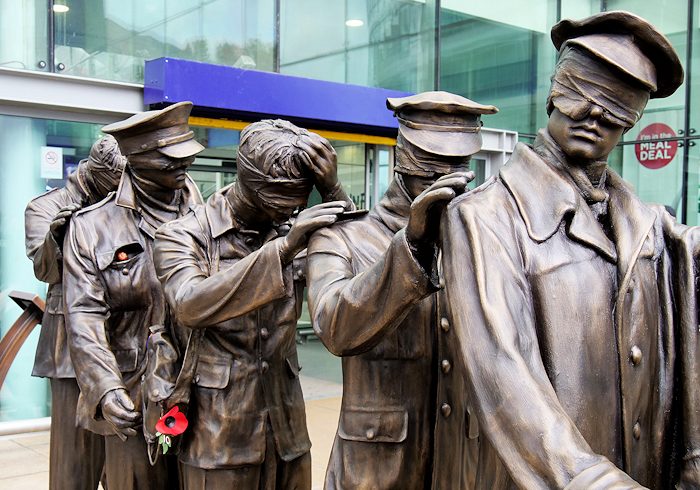
The sculpture was installed by charity Blind Veterans UK back in October 2018 / Credit: Flickr
The sculpture’s name, Victory Over Blindness, was a phrase used by the charity’s founder, Sir Arthur Pearson, and it’s a phrase the organisation says continues to guide its principles to this day.
ADVERTISEMENT
Conceived and designed by artist and sculptor Johanna Domke-Guyot, as mentioned, the sculpture shows seven blinded soldiers leading one another with their hands on their comrades’ shoulders – and this was exactly how it was recreated today.
After a symphony of trumpets and bagpipes sounded, the ‘living statue’ of actors dressed in WWI uniforms then made their way through the station and on throughout city.
Blind Veterans UK said it not only chose to recreate the sculpture as a ‘living statue’ today to mark the fifth anniversary of its installation, but also to highlight to that, although it currently supports thousands of blind veterans across the country, it knows there are thousands more who still need help to rebuild their lives after sight loss.
The charity hopes the ‘living statue’ display today showed the Greater Manchester public going about their day how important its support can be.
Know someone who served in the Armed Forces and is now struggling with sight loss? You can get in touch with Blind Veterans UK on 0800 389 7979 or via its website here.
Featured Image – The Manc Group
News
Andy Burnham announces ‘fundamental’ changes to the UK’s education system
Emily Sergeant
The Prime Minister will unveil a fundamental change to the education system today with the launch of new prestigious technical educational routes.
Andy Burnham says he is ‘determined’ to put technical education on an equal footing with the traditional academic path to ensure there are no so-called ‘dead ends’ for young people coming out of the education system by providing them high-quality alternative routes that are valued and respected by students, parents, and employers alike.
The new pathways will provide 14-year-olds with ‘valuable’ early access to technical skills, work experience, and connections with local employers.
Building on successful local initiatives – such as the MBacc, launched by Andy Burnham here in Greater Manchester when he was Mayor – the new technical routes will mean young people can develop the technical knowledge and skills needed to progress in areas like engineering, healthcare, and digital technology.
It will aim to ‘skill them up’ with the specific knowledge and capabilities that local employers need.
Andy Burnham has announced ‘fundamental’ changes to the UK’s education system / Credit: MChe Lee (via Unsplash) | Wikimedia Commons
So, how will it all work then? Well, when students enter Year 10, they will have the chance to combine core academic subjects – including English, Maths, and Science – with a high-quality technical education that’s linked to the jobs available in their area.
During these courses, students will be able to spend time with employers and gain valuable real-world experience.
Regional mayors, local leaders, schools, colleges, and employers will work together to shape these new technical education pathways, rather than relying on a one-size-fits-all system.
To support this, the Government says it will prioritise funding towards high-quality technical education and practical routes into work, and will also change the way school performance is measured so that inspectors recognise the schools support young people to develop the skills, experience, and confidence employers want.
This way, no matter whether young people choose university, an apprenticeship, further education, or direct entry into a skilled profession, they will able to see a clear route from education into employment.
“For too long in this country, students have been told that you must take the academic path to do well and to be respected,” explained Prime Minister Andy Burnham.
“The whole school system has been built around it and that has let down young people seeking technical qualifications.
“I want an education system based on parity between academic and technical which gives all young people a clear path in life.
“From today, Britain will value the hard hat every bit as much as the graduation cap.”
Featured Image – MChe Lee (via Unsplash)
News
When does the UK’s fourth heatwave of the year hit Greater Manchester?
Danny Jones
Brace yourselves: ANOTHER heatwave is set to hit the UK – the fourth in 2026 so far – and, understandably, Greater Manchester residents are already preparing for the latest blast of hot weather and wondering when it gets here.
Yes, in case you missed the news, more high temperatures are set to spread across Great Britain and Ireland this month and heading into August.
The increase will gradually build throughout this week, with Wednesday tipped to be the hottest day according to various meteorological sources.
Fortunately for us here in the North West, parts of the Midlands and the usual suspects down south are set to hit the highest numbers, but the thermometers are still on course to reach around the mid-20s over the coming days.
Temperatures are set to rise this week across some areas, bringing a return to hotter conditions 🥵
The heat looks to be fairly short-lived, however, with temperatures expected to fall again towards the end of the week 🌡️ pic.twitter.com/IKsunEdwhU
Estimates of 26°C have been predicted for this coming Tuesday, with the levels floating in and around 24/25 on the following Wednesday.
The heat is then due to drop off slowly, with top scores of no higher than 21°C on the cards for Thursday and Friday. Although the weekend forecast is less certain at present, one thing that has been announced is reduced rainfall.
Aside from a few more trickles today (Mon, 27 July), the showers or lack thereof cease rather soon, with some of the driest parts of the country already having various effects; for instance, parched parts of Wales have even revealed lost archaeological sites last Friday (24/7/2026).
It would be remiss if we didn’t mention the obvious moorland fires across our region, which were sadly exacerbated by hot weather earlier this month.
Following on from the hottest June on record, the Dovestone and Tinwhistle areas of Oldham and parts of Derbyshire saw hundreds of hectares turn into a deeply dangerous blaze for several days.
As per the latest statistics, it’s said that the equivalent of 1,250 football pitches were scorched following the alarming wildfire, which also raised concerns for wildlife and surrounding air quality.