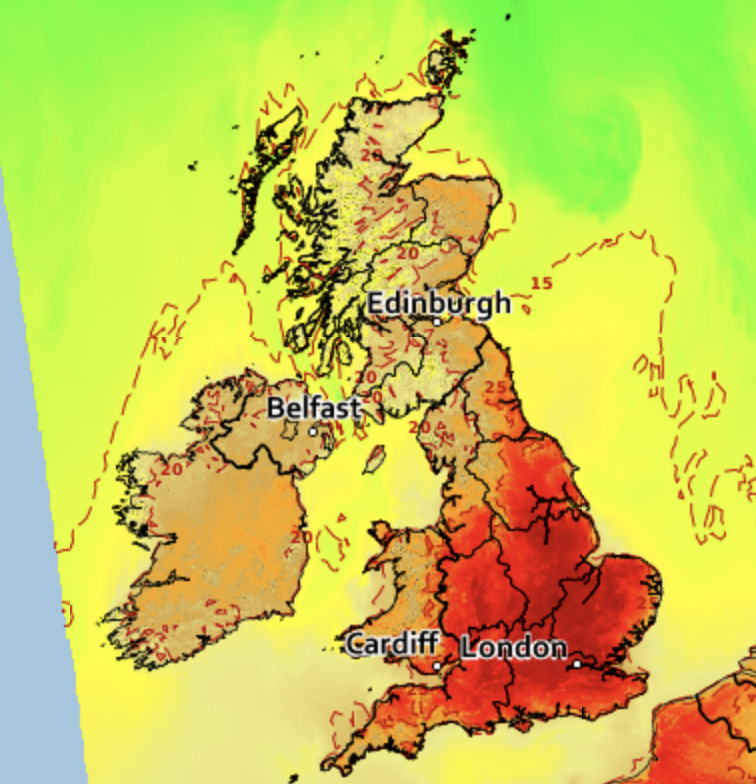
Dr Agostinho Sousa, Head of Extreme Events and Health Protection at UKHSA, said: “We want everyone to enjoy the hot weather when it arrives, but also to check in on their vulnerable family, friends and neighbours to make sure they are prepared for the warm conditions ahead.
“High temperatures are predicted for a prolonged period, so make sure to follow our simple health advice to beat the heat, such as covering windows exposed to direct sunlight and making sure that fridges, freezers and fans are working properly.”
ADVERTISEMENT
Here’s the weather forecast for Manchester for the week ahead.
Monday 11 July – There may be some spells of cloud in Manchester on Monday, but temperatures are set to hit 29 degrees by 3pm. It will stay warm through the night too, not dropping below 20 degrees all night. There’s a very high pollen count.
Tuesday 12 July – Tuesday will be cooler and cloudier, with highs of 24 degrees. Sunny intervals are expected by the evening and there’s practically no chance of rain.
Wednesday 13 July – The sunshine will be back on Wednesday – though with some cloud – but the weather will be cooler across Greater Manchester. Expect highs of 19 degrees and again, a very high pollen count.
Thursday 14 July – The Met Office is forecasting a sunny start to Thursday before the clouds return around lunchtime. Highs will be around 19 degrees and lows of around 13 degrees.
Friday 15 July – There are light rain showers predicted for Greater Manchester on Friday morning, before the sun pops back out in the evening. It will be a slightly warmer day again at 21 degrees.
ADVERTISEMENT
Saturday 16 July – And it’s back to the heatwave – Saturday is currently expected to be about 26 degrees and sunny by the afternoon, with a high UV index.
Sunday 17 July – Sunday will be even warmer – up to 27 degrees – with some patchy cloud in the afternoon.
Featured image: Unsplash
News
No trams to run on major Greater Manchester line for two weeks as part of £150m improvement works
Emily Sergeant
Major disruption is on the horizon, as no trams are set to run on a major Greater Manchester line for two weeks this month.
As the next phase of the ongoing £150m investment into Greater Manchester’s tram network gets under way this month, essential track replacement work is set to be be carried out in a bid to make the network ‘safer’ and ‘more resilient and reliable’ for years to come.
Due to improvement works on the Oldham-Rochdale line – which is being carried out between Monsall and Newton Heath & Moston – there will be no trams between Manchester Victoria and Rochdale town centre for two weeks, starting from this Saturday 16 May right through to Friday 29 May.
The work being carried out will involve replacing sections of track and improving drainage along the route.
The track foundation will also be replaced where needed, as well as work to correct the alignment and level of the track.
No trams will be running on a major Greater Manchester line for two weeks from this weekend / Credit: TfGM
Transport for Greater Manchester (TfGM) has conceded that this is a ‘big and complex job’ – with 290 new concrete sleepers and 2,000 tonnes of pea gravel being used, and more than 5,000 tonnes of ballast set to be replaced.
But, when the work is done, it’s aiming to make journeys ‘smoother and more reliable’ for passengers, while improving the condition of the track for the long-term.
While the work is being carried out and the line is closed, bus replacement services will be in place between Victoria and Rochdale Town Centre, and more frequent Bee Network bus services will also call at the bus stops near each tram stop too, however tram tickets will only be accepted on the replacement bus, not on numbered bus services.
Elsewhere, work at Derker will also take place at the same to ‘minimise disruption’.
The track was made safe following a landslip in summer 2024, but now, a longer-term solution will see teams drive steel sheets into the ground to hold it in place and prevent further movement, before further work will be needed later in the year to complete the job.
And to top it off, from Monday 25 to Friday 29 May, improvement work to update equipment that has been in place since the line opened in 1992 will also take place at Piccadilly Gardens, and that means no trams will run between St Peter’s Square/Market Street and Piccadilly during this time.
Customers may need to change trams, take a short walk, or hop on the free bus to continue their journey.
Tram services will resume as normal from the start of service on Saturday 30 May, and passengers travelling during this period are urged to ‘plan ahead’.
Everything you need to know about the planned works is on the TfGM website here.
Featured Image – Janus Boye
News
Rules around booking driving tests in UK change from today to make system ‘fairer’
Emily Sergeant
The rules around booking driving tests in the UK are officially set to change from today in a bid to make the system ‘fairer’.
The Driver and Vehicle Standards Agency (DVSA) has now introduced new rules for car driving test bookings, putting learners ‘firmly in control’ of their own booking, as it is now against the law for third parties – including unofficial test booking and cancellation finder services, as well as driving instructors – to make bookings for someone else.
It will also be a breach of DVSA’s terms and conditions for the booking service for third parties to change, swap, or cancel a driving test for someone else.
Learners should only ever pay the official DVSA fee – which is £62 on weekdays and £75 on evenings, weekends and bank holidays.
The Government says the new rules aim to make booking driving tests ‘fairer’ for learner drivers.
While driving instructors will no longer be able to book tests on behalf of of learners, they will still be able to advise learners on when they are ready to take a test, as well as set their available times to prevent learners from booking tests at times that do not work for them.
Following on from changes to test alterations which were introduced at the end of March, from 9 June 2026, further restrictions will come into force limiting learners to moving their test only to one of the three nearest driving test centres.
The DVSA has also pledged to continue increasing driving examiner capacity to help provide more tests for learners to book.
“Our priority is to stop learners being exploited by third parties, put them in control of their driving test, and make the process fairer by clamping down on businesses that resell tests at inflated prices,” commented Beverley Warmington, who is the DVSA Chief Executive.
“These new measures help bring a halt to a system where the use of bots and third parties increases the amount some learners pay for a test and blocks test availability for many others.