Mr Johnson addressed the nation in a televised press conference last week, alongside Professor Chris Whitty and Sir Patrick Vallance, to give the green light for pubs, shops, hairdressers, gyms and a raft of other venues to reopen from today, which would allow them to operate for the first time in three months.
He also stated that moving to the next stage of the government’s roadmap out of lockdown was “fully justified” by the success of the vaccine rollout and the drop in cases and hospitalisations.
COVID-19 Roadmap: Step 2
No earlier than 12 April (at least 5 weeks after Step 1)
The Prime Minister has previously stated that decisions on the easing of restrictions as part of the “irreversible” roadmap will be led by data rather than dates, as it takes around four weeks for the data to show the impact of easing restrictions, and the government will then provide a further week’s notice to the public and businesses ahead of any further changes, so for that reason, there will be at least five weeks between the steps in the roadmap.
Before taking each step, the government will review the latest data on the impact of the previous step against four tests, which are:
ADVERTISEMENT
The vaccine deployment programme continues successfully.
Evidence shows vaccines are sufficiently effective in reducing hospitalisations and deaths in those vaccinated.
Infection rates do not risk a surge in hospitalisations which would put unsustainable pressure on the NHS.
The assessment of the risks is not fundamentally changed by new Variants of Concern.
‘Step One’ of the roadmap was split into two, with the first restrictions eased on 8th March, followed by further changes on 29th March, but what’s in store for ‘Step Two’?
What are all the lockdown restrictions being lifted in England today?
Here’s everything you need to know:
ADVERTISEMENT
All non-essential retail stores, community centres, libraries, hairdressers and nail salons can reopen to the public.
Pubs, restaurants and cafes will be able to reopen to serve people outdoors only, with customers not required to order a “substantial meal” in order to have an alcoholic drink.
Gyms and other indoor leisure facilities are also to reopen, as well as outdoor attractions including zoos, theme parks, and drive-in cinemas.
Campsites, holiday lets and other forms of self-contained accommodation are due to reopen, providing that indoor facilities are not shared with other households.
Parent and child groups (not counting children under five) can resume indoors.
The number of guests allowed at a wedding will be able to increase to 15, and funerals will continue with the current number of guests limited to 30.
Care home residents will be allowed to have two regular visitors indoors.
With regards to travel, the “stay at home” order was lifted as part of the second phase of ‘Step One’ on 29th March, but people should continue to work from home where they can, minimise domestic travel and are encouraged to “stay local”.
International holidays are still illegal, and social distancing rules still apply across England.
What restrictions are being lifted from 17th May?
If the data allows it, further restrictions will be lifted on 17th May as part of ‘Step Three’ of lifting England’s lockdown, which are:
ADVERTISEMENT
Up to 30 people from different households will be able to gather outdoors.
Indoor hospitality will reopen, as well as indoor entertainment venues such as cinemas, hotels, children’s play areas and indoor group sports and exercise classes.
The limit on guests attending weddings, receptions and wakes will increase to 30.
The government has also said it will update advice on social distancing measures no later than this stage, and this will also be the earliest date at which international holidays may be able to resume.
This will all be subject to a prior government review.
___
For the latest information, guidance and support during the coronavirus (COVID-19) pandemic in the UK, please do refer to official sources at gov.uk/coronavirus.
#HandsFaceSpace
Featured Image – Mark Waugh | Flickr
News
A ‘legacy walk’ in memory of the Joe Thompson is taking place across Greater Manchester
Danny Jones
The ‘Walk With Me for JT’, a.k.a Joe Thompson ‘Legacy Walk’, is back next month, and Greater Mancunians are being encouraged to take part.
Returning this year following his tragic passing last April, the now annual charity walk has already raised thousands for charity and is set for another big turnout.
Joe Thompson, an ex-Rochdale AFC and Bury FC player, sadly died at just 36 following a long battle with lymphoma, having been diagnosed three different times in 12 years.
While the young husband and father of two’s story is a heartbreaking one, it has also become a source of inspiration for so many across the North West and, indeed, across the UK, with people once again gearing up to complete a fundraising walk in his name.
Set to honour him by making the journey from his adopted home of Rochdale all the way to Old Trafford, with Thompson having come through Man United’s youth academy, the 15-mile trek will start at his former club’s Crown Oil Arena and stop at Bury’s Gigg Lane as well as Salford City’s Peninsula Stadium.
First held in 2024 under the ‘Walk With Me for JT’ banner, the initial legacy walk saw the Bath-born footballer and countless others complete 21 miles in an effort to raise money for treatment.
Gone but never forgotten, the charity walk survives not only in the hearts and souls of his family, friends and other people’s lives he touched, but in the community spirit that his struggle and immense bravery in the face of illness helped spur on throughout the region and beyond.
Writing on social media, the Thompson family and the Foundation in his memory said, “Last year, he walked beside us. This year, we walk for him. This isn’t just a walk… It’s a promise. A promise to carry his strength, his belief, his light forward.
For every family facing illness. For everyone experiencing loss or hardship. For anyone who needs hope right now. Every step matters. Every mile has meaning. Whether you’ve walked before or this is your first time. You won’t walk alone.”
Join the annual Joe Thompson legacy walk on Saturday 2nd May 💙
Departing from the Crown Oil Arena, the 15-mile walk will finish at Manchester United's Old Trafford 🏟️
They signed off by adding: “Be part of something bigger. Be part of Joe’s legacy. Be part of the movement. Get a team together, invite your friends, colleagues and family and let’s raise funds to support The Joe Thompson Foundation.”
With the event beginning at 11am on Saturday, 2 May, there have already been numerous sign-ups, and you can expect even more to lace up their shoes and pay tribute to a local hero.
If you want to join in the effort and help do your bit, you can register for the 2026 Joe Thompson Legacy Walk right HERE.
Manchester rent is now ‘41% more expensive than five years ago, according to a recent study
Danny Jones
Yes, that’s right, as per some of the latest data on leased housing in central Manchester, it’s now approximately 41% more expensive to rent here than it was half a decade ago.
If you’ve lived in and around the city centre for long enough, chances are that you’ve already been feeling that difference, especially of late.
The ongoing cost-of-living crisis roughly began in 2021, following the economy and the world essentially opening back up after multiple lockdowns, so it’s little surprise that new research has shown affordability when it comes to renting has been on a slump ever since, too.
As well as the price of seemingly most things in everyday life going up post-pandemic, the average rental rate for even just a one-bedroom flat/apartment has jumped up significantly between 2020 and 2025.
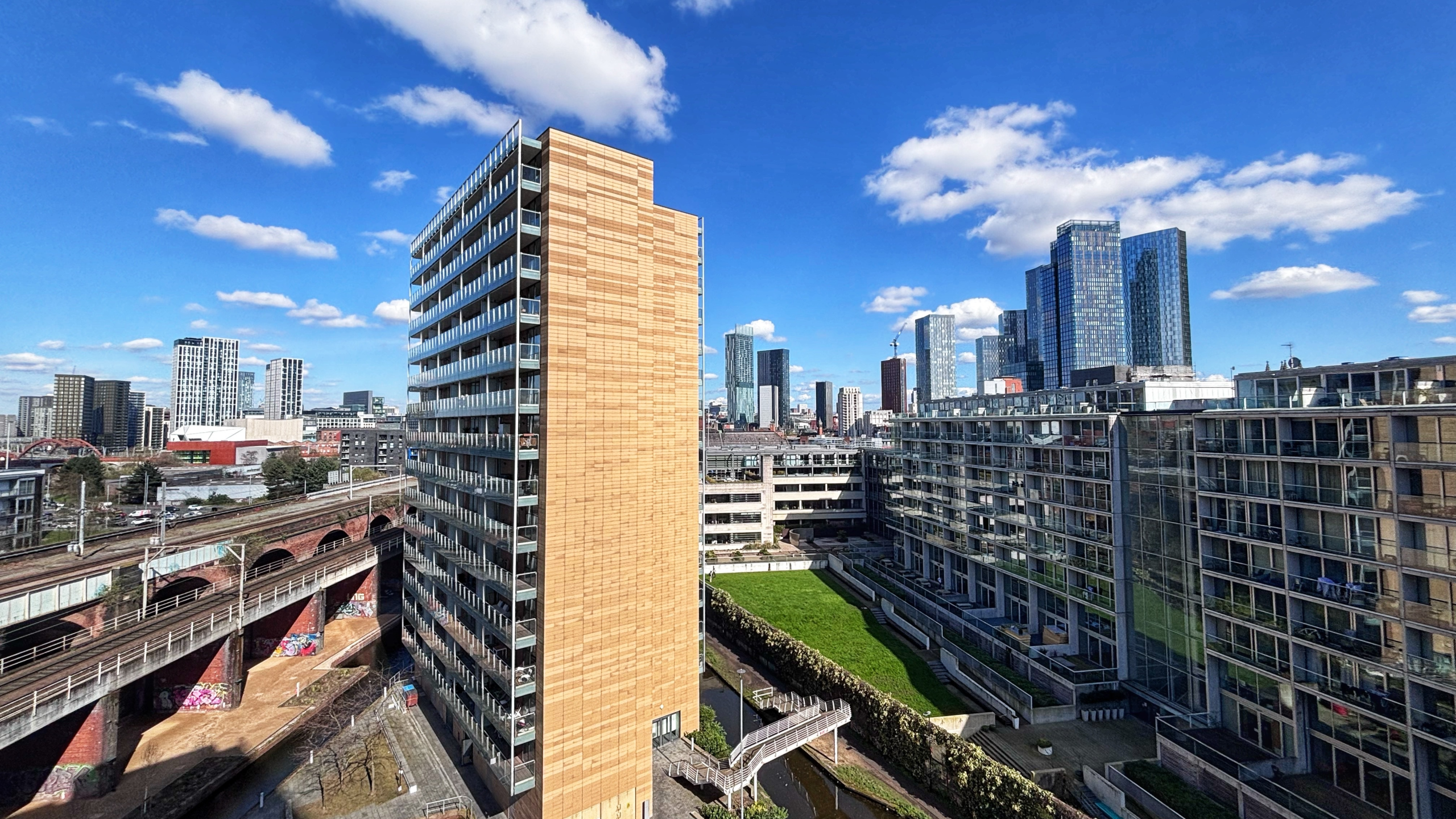
Even some ‘available’ housing in town is being hampered by claddin (Credit: Valienne via WikiCommons)
That’s according to the numbers crunched by credit card experts, Zable, anyway.
Not only did their recent report cite the rent prices going up even before the cost of living crisis – essentially following the outset of the Covid-19 outbreak – but if their figures, the rate of inflation and the unwaveringly high demand for housing are anything to go by, this trajectory is likely to continue in 2026.
As of February this year, around one in three UK households is now a single-person occupancy, which already comes with its challenges (the Manchester City Council tax discount being a thin lifeline for countless), not to mention energy bills and the cost of groceries continuing on an upwards trend.
Put in the simplest and most reductive terms, it’s now almost £300 dearer for most people to live on their own than it was back in 2020, and besides Liverpool clocking in as second on the list of increasingly expensive cities to live (a 42.12% increase), Manchester came in third.
You can see the full table down below:
Rank
City
% increase – 2020-2025
Difference from 2020 to 2025 in £
Average rental cost for a 1 bed 2025
1
Newport
47.39%
£2,611
£8,121
2
Liverpool
42.12%
£2,290
£7,727
3
Manchester
41.00%
£3,364
£11,569
4
Edinburgh
40.28%
£4,620
£16,090
5
Leicester
39.93%
£2,391
£8,379
6
Wolverhampton
39.22%
£2,049
£7,273
7
Nottingham
39.07%
£2,400
£8,543
8
Glasgow
38.02%
£2,679
£9,725
9
Colchester
37.63%
£2,617
£9,572
10
Cardiff
37.06%
£2,828
Average rental cost for a 1-bed 2025
Another fear is that with lots of people finding it hard to manage living in other major cities like London, even those moving to Manchester are also having an impact on how available affordable housing is here.
That’s why schemes such as the new ‘social rent’ development over in Wythenshawe are so important to the current generations of renters, with the possibility of owning your own property in the future becoming increasingly difficult for so many.
It’s also worth noting that Manchester ranked fourth among the British locations where the cost of living is said to have increased the most over the past five years, with the average difference in annual spend growing by an estimated 22.84%.

 The Manc -
12th April 2021
The Manc -
12th April 2021