The transfer window might be closed, but Manchester City have managed to secure an acquisition in time for next season as they have reportedly agreed a deal to bring La Liga star Savinho to the club in a few months’ time — but, technically, he’s already on the books at the City Football Group.
For anyone unaware of the City Football Group (CFG) structure, the Abu Dhabi United Group run the football-based holding company, which in turn operates 13 different clubs around the world, including Man City, Girona, New York City FC, Troyes AC and Palermo, just to name a few.
All that being said, Sávio – a.k.a. Savinho – who is currently on loan from the aforementioned French team Troyes, has lit up the Spanish league ever since he joined Girona back in 2022, of which the CFG currently own 47%.
With five goals and seven assists to his name and shining as one of the key players in the club’s remarkable title charge this season, having finished sixth in Spain’s second tier just a short while ago in 21/22 and only just managing promotion through the playoffs, City are now set to bring him to the Etihad.
🚨🔵 Manchester City will complete Savio deal by the end of February as documents are already being prepared between all parties.
Savinho will be part of City first team from July and he will start the pre-season under Pep Guardiola.
Since all three clubs are owned by the CFG and the overarching private equity company, very little money is likely to change hands.
While Blues will rightly be excited about the eventual arrival of the 19-year-old Brazilian winger, who claims he had lucrative offers from multiple clubs but refused as he knew “one day [he] would play for City”, football fans elsewhere are wondering if this is all kosher.
ADVERTISEMENT
As The Athletic‘s Nick Miller shared in a post via X: “A classic bit of multi-club nimble footwork this. Savinho was signed by City Football Group’s Troyes – their record signing, in fact – but has never played for them, was loaned immediately to City Football Group’s Girona, and is now being sold to City Football Group’s Manchester City.”
One commenter said, “This has to be illegal, there’s no way this is possible”, while another, particularly sarcastic remark read: “These negotiations must‘ve been incredibly difficult.” Given all three clubs are affiliated, any money exchanged will go back into virtually the same pot.
ADVERTISEMENT
The fact is, no matter how much you want to question how ‘fair’ moves like this are, it’s considered above board and is by no means the first. Former City fullback Angeliño joined in 2015 and was immediately loaned out to New York FC and Girona before eventually making just six appearances for his parent club in two years and being ultimately moved on.
Football regulators do not regulate, so clubs turn into pawns of ownership groups. Maybe City Football Group will eventually make Troyes successful. Maybe they won't. Either way, fans are entirely powerless and must accept their club is now just an extension of a business model.
Chelsea have been accused of similarly monopolising young talent for many years; Watford and Udinese have all used similar player-swapping methods too alongside the likes of the Red Bull football teams.
Jack Harrison’s case was similar only in reverse; he joined New York through their youth programme and was then officially sold to City in 2018 without playing a single game for them in three seasons after being sent straight to Middlesborough and then successive spells at Leeds United before joining them on a permanent deal.
As Miller went on to add, he wasn’t “even suggesting there’s anything wrong with this per se. Just that this is the reality of being in a multi-club group: the smaller teams are no longer independent entities whose success is the ultimate priority – just vessels through which the ‘parent’ club funnels things”.
ADVERTISEMENT
However, as many others online have noted, the implications this has on said smaller teams like Troyes could prove to be damning, especially when you take into account they were relegated from Ligue 1 last season and could potentially even slip into the French third division if their form continues.
City might be getting yet another extremely promising attacking squad member when Savinho joins in the summer — with the deal supposedly set to be complete by the end of this month — but he will remain with Girona for the rest of the season as they look to win the league for the first time in their history.
Meanwhile, Troyes, of whom City are still the majority shareholder, could go down yet again whilst watching their most expensive player ever move on without ever even pulling on the shirt.
The road to the Super League Grand Final at Old Trafford has been confirmed
Daisy Jackson
The road to one of the biggest nights in rugby league has officially been mapped out, with the 2026 Betfred Super League Grand Final set to return to Manchester’s Old Trafford this October.
Following the final round of regular-season action, the four play-off ties have now been confirmed as the battle for a place at the home of Manchester United enters its final stages.
And there’s plenty for Greater Manchester sports fans to get excited about.
Wigan Warriors have secured the League Leaders’ Shield after an emphatic 50-12 victory over Catalans Dragons, with Matt Peet’s side running in nine tries to finish top of the table.
The result keeps Wigan’s hopes of an incredible treble alive, having already lifted the Betfred Challenge Cup back in May.
They’ll now have a week off while the opening play-off ties take place, as will second-placed Leeds Rhinos.
The first eliminator sees Wakefield Trinity welcome Leigh Leopards on Friday 18 September, with kick-off at 8pm.
Then, on Saturday 19 September, Warrington Wolves take on Hull KR at 5.30pm.
The winners of those games will progress to the semi-finals, while the losing sides will face the two highest-ranked teams in the competition.
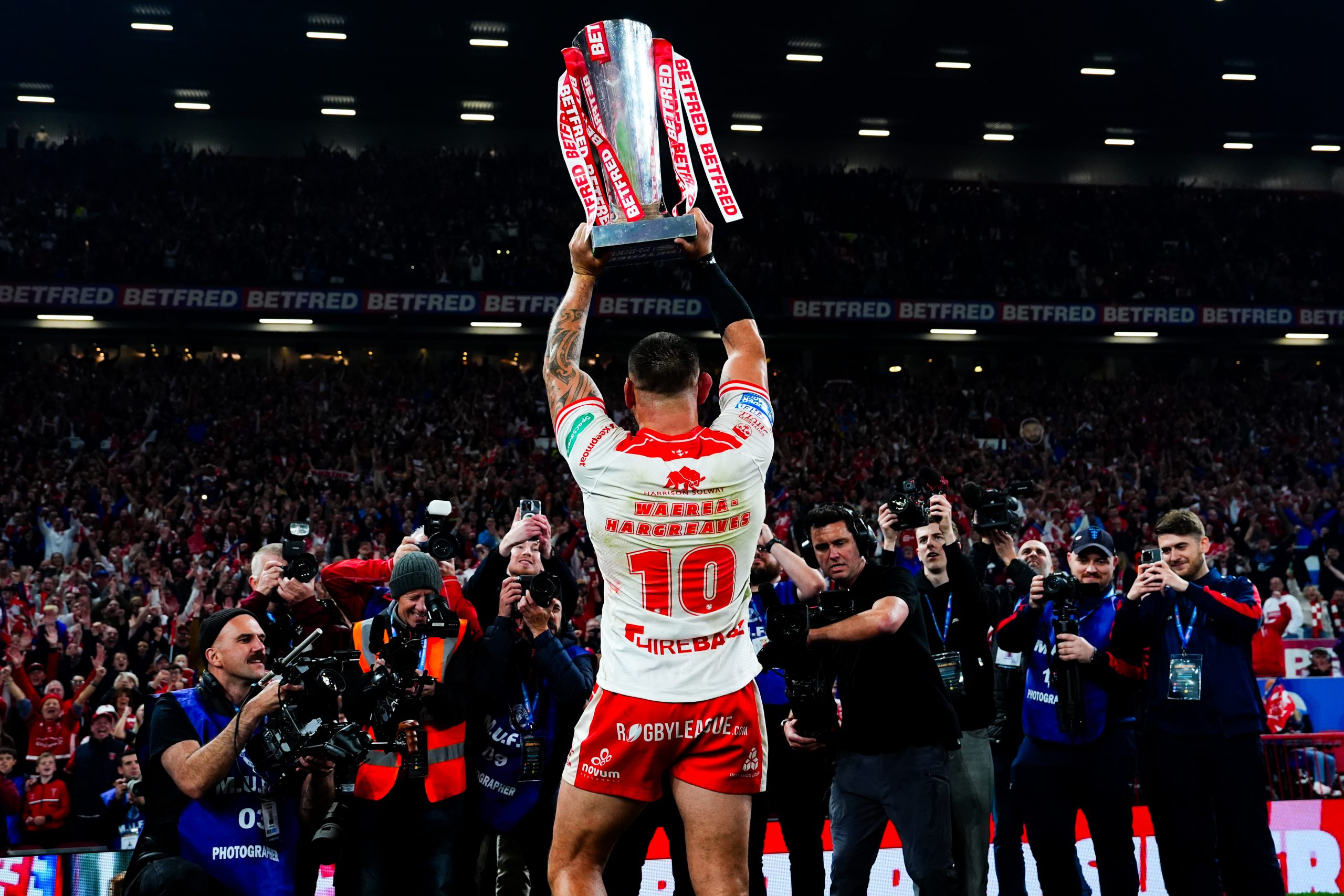
The road to the Super League Grand Final at Old Trafford has been confirmed. Credit: Simon Wilkinson/SWpix.com
Leeds will host the highest-ranked eliminator loser on Friday 25 September at 8pm.
Then, 24 hours later, Wigan will welcome the lowest-ranked loser to the Brick Community Stadium for their semi-final, with that one kicking off at 5.30pm on Saturday 26 September.
For Wigan, it represents a huge opportunity to take another step towards an historic treble – and ultimately a return to Old Trafford.
The Grand Final itself takes place on Saturday 3 October, with the action getting underway at 6pm.
As ever, the biggest prize in Super League will be decided under the lights at Old Trafford, with the two remaining sides battling it out in front of what is expected to be another huge crowd in Manchester.
Both Manchester United and Manchester City named as teams with the least amount of local fans
Emily Sergeant
Both Manchester United and Manchester City have been identified as being teams with the least amount of local fans, according to a new survey.
We all know that supporting a local team can be seen as a mark of credibility among a certain kind of football fan, while on the flip side of that, not following a local team is often associated with being a ‘glory hunter’. But which Premier League clubs have the highest – and lowest – proportion of supporters living close to home?
Well, YouGov decided to use its profiles data to analyse the fanbases of all 20 Premier League clubs for the 2026-27 season to get the answer to this once and for all.
And it’s fair to say that it’s not looking the best for the Manchester teams.
The study found that, overall, Brighton & Hove Albion is the Premier League’s most local team – with 56% of fans based in the South East.
Sunderland (50%) and Nottingham Forest (49%) supporters are the next-most likely to live in the same region as their teams, followed by Aston Villa, Brentford, Ipswich, Leeds, Fulham, Hull, and Crystal Palace fans rounding out the top 10.
At the other end of the table, Manchester United has the second-lowest proportion of local supporters, with only a quarter based in the North West (23%), with one in six (17%) actually living in London instead.
And then as for Manchester City – who are widely considered to be the most successful team of the modern era – it has ranked fourth-bottom for local fans, as a quarter of the club’s supporters are based in the North West, with a fifth based in London (19%).
But although both United and City have found themselves towards the bottom end of the ranking, they are not the worst offenders.
That title, unfortunately, does belong to another North West team though – Liverpool.
Liverpool is the club with the lowest proportion of ‘local’ supporters, as just a fifth are based in the North West (21%) with the next highest concentration of fans can being found in London.

 Danny Jones -
6th February 2024
Danny Jones -
6th February 2024