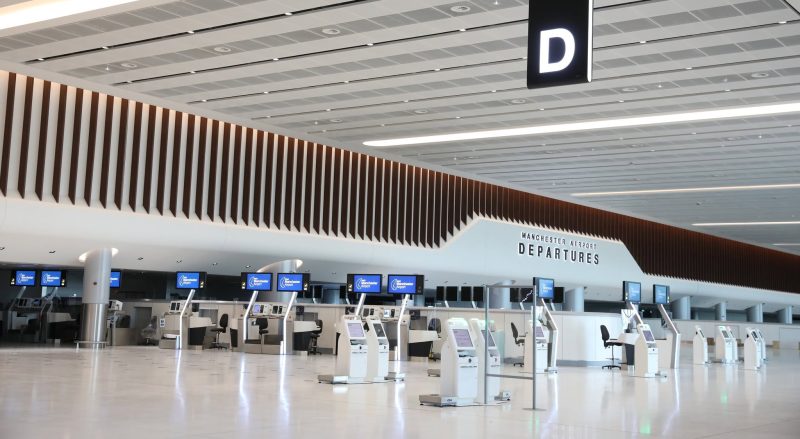
Manchester has been named the best city in the UK for anyone who works a full week in an office, a new study has revealed.
By now, a chunk of Brits may be very used to working from home or the remote working lifestyle, but according to new research by KPMG, two-thirds (63%) of CEOs in the UK predict workers will return to the office full-time by 2026.
But, which cities across the country are best for a five-day office week?
Well, in a bid to get to the bottom of this, online platform Business Name Generator has conducted a new study analysing 30 cities in the UK, and has looked at factors such as commute times and costs, the number of people who work mainly from home, the cost of a coffee, and the number of on-site jobs currently available in each city, to find out which one reigns supreme.

Manchester has been named the best city in the UK for full-time office workers / Credit: Mylo Kaye (via Pexels)
And according to the study’s findings, Manchester has earned itself the new title of being the best UK city for office workers.
ADVERTISEMENT
The study found out that our city currently has 432 office-based vacancies per 10,000 people on offer, which is the most of any city analysed, while a third (32%) of Manchester residents work mostly from home, which means the majority of people are heading into the office in some capacity.
On the flip side though, because of this, commute times into Manchester city centre are relatively high, at 39 minutes for a one-way journey, and a monthly travel pass will also set workers back anywhere from £80 – which is the third-highest amount of any UK city in the study.
ADVERTISEMENT
Top 10 UK Cities for Office Workers
Rank
City
Avg. cost of a coffee
Avg. commute times (mins)
Avg. commute costs
% of people that work from home
No. of on-site jobs per 10,000 people
1
Manchester
£3.34
39
£80
32%
432
2
Bradford
£2.28
44
£57
25%
308
3
Milton Keynes
£3.04
23
£63
26%
163
4
Southampton
£2.94
28
£60
26%
185
5
Stoke-on-Trent
£2.97
21
£65
15%
69
6
Preston
£3.03
26
£52
25%
133
7
Hull
£2.55
29
£56
13%
77
8
Coventry
£2.57
29
£50
26%
143
9
Edinburgh
£3.33
29
£60
20%
120
10
Plymouth
£3.13
26
£56
21%
81
Top 10 UK Cities for Office Workers / Credit: Business Name Generator
In second place on the top 10 list is Bradford, with 308 on-site jobs per 10,000 people being advertised in the northern city, while Milton Keynes has come in third place.
But what about on the other end of the spectrum then? Which UK city has claimed the less-than-coveted title of being accommodating to office workers? And what makes it so unfavourable?
Perhaps it’s no shock that London has found itself at the bottom.
The study found that the capital is worst city in the UK for spending five days a week in the office, with a travel pass costing an average of £181 per month, and a one-way journey to work taking 46 mins on average.
Wetherspoons introduces new phone rule at all UK pubs after customers are ‘driven nuts’
Emily Sergeant
JD Wetherspoon has announced a major new phone rule in all its sites across the UK after customers complain of being ‘driven nuts’.
The pub chain – which has nearly 800 branches across the UK – announced earlier this week that it has made the decision to ban people from playing music or videos out of their phones, and from taking calls on loudspeaker.
The ban, which has been introduced effective immediately, follows a rising number of complaints from customers about the noise – with owners saying sounds from smartphones and tablet computers had become an ‘increasing problem’ in recent years.
Wetherspoon founder and chairman, Tim Martin, says he wants Wetherspoon pubs to be ‘an oasis of tranquillity and contemplation’.
Wetherspoons has introduced a new phone rule at all its UK pubs after customers are ‘driven nuts’ / Credit: Allan Rohmer (via Unsplash)
A formal statement from the company announcing the ban reads: “Following complaints from customers, who are being driven nuts by other people’s videos and amplified phone conversations, Wetherspoon has asked customers to switch their phones to silent or to use earphones.”
Tim Martin added: “In order to avoid customers being driven chicken jalfrezi by a cacophony of sound, we are kindly asking phone users to pipe down.”
Wetherspoon’s ban follows a YouGov poll conducted last year questioning public opinion on a proposition made by the Liberal Democrats of introducing fines of up to £1,000 for ‘headphone dodgers’ who play music out loud on buses and trains.
62% of people, on average, said they would back this move if it was introduced.
The poll, which surveyed 6,815 British adults, found that almost three-quarters of those over 65 would support the fines, while those aged between 18 and 24 were split 47% to 43% in favour of it.
Early public reactions to Wetherspoon’s ban appears to be overwhelmingly positive.
Featured Image – Jonathan Borba (via Unsplash)
Business
Trainline and Virgin Atlantic among companies being investigated for ‘misleading’ pricing
Emily Sergeant
A number of companies are currently under investigation for ‘misleading’ pricing practices.
The Competition and Markets Authority (CMA) has launched three new consumer protection investigations into Trainline, Virgin Atlantic, and RED Driving School over concerns that customers were not shown the total price upfront when buying things like train and coach tickets, holidays, or even driving lessons.
The investigations are part of a wider CMA clampdown on misleading pricing practices – in this instance, where mandatory charges are separated from the headline price, or added later in the buying process, which is known as drip pricing.
These practices leave consumers facing ‘unexpected’ costs or having to calculate the so-called true cost themselves.
Such practices can also impact competition between businesses, as a firm using drip pricing may falsely appear to be cheaper than a competitor pricing correctly, and therefore attract more customers.
Trainline and Virgin Atlantic are among the companies being investigated for ‘misleading’ pricing / Credit: Northern | Aric Cheng (via Unsplash)
Trainline is being investigated over whether all mandatory fees have been included in the upfront prices displayed to consumers buying tickets in advance on its app and website, while Virgin Atlantic’s investigation will focus on whether mandatory resort fees and local taxes have been included in the upfront prices shown to customers buying package holidays.
RED Driving School is being investigated over how a mandatory booking fee and ‘digital’ fee have been displayed to people booking driving lessons – specifically whether these fees have been included in the total upfront price.
“At a time when many households are watching every pound they spend, it is important that people are not surprised by extra fees,” commented Emma Cochrane, who is the Executive Director for Consumer Protection at the CMA.
“Clear pricing helps people compare offers confidently and choose the option that works best for them.
“Unexpected mandatory charges make this much harder, which is why the CMA initially put these firms on notice over concerns about their pricing practices and is now opening formal investigations.”
The CMA says it’s at the beginning of its investigations and has reached no conclusions about whether these firms have broken the law.
If it finds there has been an infringement of the law, the CMA can order businesses to pay compensation to affected customers or be charged up to 10% of global turnover.