Living on top of the city: How Manctopia’s Sarah Lomas sees Manchester differently from above
The BBC's 'Manctopia' documentary covered every kind of character and story in modern Manchester - but it was Sarah’s rise from below the poverty line up to a penthouse that struck the biggest chord.
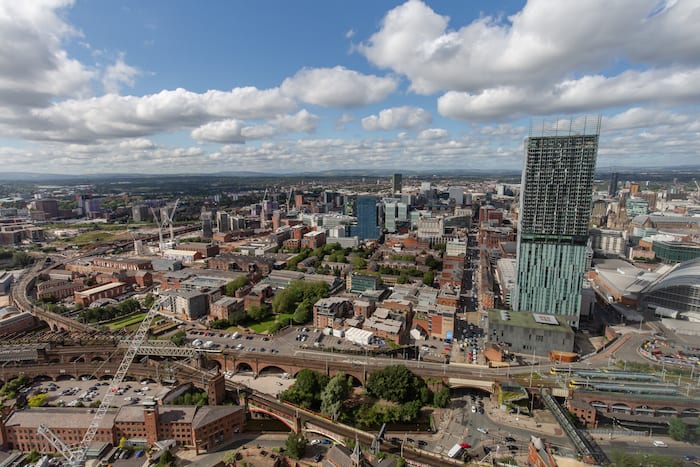
Dazzled interior designer Sarah Whatmore is stood on top of Manchester, gawping at the city below her feet.
She’s been tasked with kitting out a luxury penthouse in West Tower – one of Britain’s tallest skyscrapers outside the big smoke – but the view is distracting her.
During a conversation with the building’s general manager, she gazes through the floor-to-ceiling windows at the concrete labyrinth wriggling away into the sunset.
The two women look out at Manchester and share a moment of silent awe.
ADVERTISEMENT
“… great place to live,” Sarah eventually mutters, still in half a trance.
Even after days spent dedicated to this building, they’re still taken aback.
ADVERTISEMENT
This scene plays out during BBC’s Manctopia – a property boom documentary that dedicates much of its final episode to teasing the arrival of a new penthouse owner in the Deansgate Square development.
For almost an hour, the episode keeps its cards close to its chest. All we’re told is that the new buyer is an international businesswoman who’d spent so much on fittings that the designers won’t even reveal the numbers on screen.
“Very expensive,” is all they’d give away.
ADVERTISEMENT
Then, around the 50 minute-mark, the owner appears.
It turns out to be Sarah Lomas, a born-and-bred northerner who’d spent her early twenties just a few miles away in Denton – completely broke and living on inflatable furniture.
Now the CEO of global health brand REVIV, Sarah recites a truncated version of her rags-to-riches story in Manctopia, calling it an “incredible feeling” to be standing in the best apartment in Manchester after her upbringing on a council estate.
It’s only a forty-second cameo. But after the credits rolled, Sarah’s social media inbox was almost set ablaze.
More 3,000 messages poured in from viewers who wanted to know how she’d done it.
ADVERTISEMENT
Manctopia covered every kind of character and story in modern Manchester – but it was Sarah’s rise from below the poverty line up to a penthouse that struck the biggest chord.
Nonetheless, Sarah isn’t convinced her tale is worth talking about too much.
“There’s not a really interesting story there,” Sarah tells The Manc.
“Other than the fact it was bloody hard work.”
In Sarah’s eyes, there’s a much bigger narrative in play here: The one that’s shaping Manchester’s future.
ADVERTISEMENT
According to the REVIV owner, Manc still isn’t being taken seriously as it should – despite all these brand new glistening buildings bumping their heads against clouds.
Relentless urban development aside, Sarah believes that London still sees Manchester as being behind the pace.
But it’s not so much the wealth divide. Apparently, it’s the way we talk.
According to Sarah, there’s been no bigger hindrance to her corporate career than her northern twang.
“I was working as a single mum in a male-dominated environment, but the largest obstacle wasn’t being a parent or even a female – it was my northern accent,” she explains.
ADVERTISEMENT
“To get further up the ladder, I was actually told to go for elocution lessons.”
Imagine that.
You’re a single mother with no qualifications. You sell all your furniture to pay your bills. You work night shifts to put food on the table. You spend years upskilling and studying in your spare time. You earn a long-term deal with one of the world’s biggest banks. You rapidly rise through the ranks and enjoy an enormously successful two decades in finance.
But then… you’re told that none of that really matters.
What’s really important is that you speak proper.
ADVERTISEMENT
“In the end, I went to work in countries where my accent didn’t matter,” Sarah admits.
“I was the only British person in an international group; so nobody detected the Manc. They just thought I was from the UK.”
Whilst Sarah accepts the corporate scene has changed a lot since the nineties, she believes accent discrimination remains rife and is holding fellow businesspeople back as we speak.
“It still exists, 100%,” she asserts.
“I can see it’s still out there by the sheer volume of people coming to me.
ADVERTISEMENT
“Most of the messages I get are from people feeling held back by their accent. And interestingly, about 65% of them are men.
“Perhaps you could say I took the easy way out – I left the country.
“But others are still having problems with it right now – and I think that’s something we need to address.”
Despite its archaic, prejudicial nature, accent discrimination did lead to Sarah opting to go her own way and build a company on her own terms.
It’s the business that ended up buying her the flat in West Tower: REVIV (a health organisation that offers intravenous (IV) vitamin hydration and wellness therapy).
ADVERTISEMENT
The company’s global hub and flagship clinic is operating right here in Sarah’s hometown – with the service being rolled out to a staggering 41 countries around the world.
Big names like Hap Klopp – the founder of Northface – are on the company board, and the service has proven unsurprisingly popular with the cultural elite – from pro athletes to actors and actresses.
But what’s intriguing about REVIV is that services are also accessible for the everyman.
Product prices start at just £25 – and their IV Therapy has now been commissioned for public use for the very first time.
But most amazingly of all, REVIV can offer customers a personalised diet and supplement plan based on their own genetics that ensures the best possible levels of health; with an app in development that lets users scan an item and reveal how beneficial it is for their body.
ADVERTISEMENT
Sarah says she wants to change ideas and understanding of wellbeing in Britain – whilst making these treatments – typically considered exotic – available for all.
“The reality is, everyone is different,” Sarah states.
“Coffee is good for some people, bad for others. A glass of red wine is beneficial for some, but can do real damage in some cases.
“It’s all down to the individual.
“There are millions of variables and you need to be able to understand your own blueprint to stay healthy.”
ADVERTISEMENT
REVIV has also weighed in to provide support with COVID testing services since the pandemic took hold – and Sarah believes that the emergence of coronavirus has forced people to reevaluate the way they look at their own health.
“We’ve got work to do; but this situation [COVID] is a brilliant opportunity to make something positive out of negative,” she says.
“The World Health Organisation is starting to make this connection of nutrition being key to our ability to fight off viruses such as this.
“We’ve heard a lot about how people without underlying conditions are being even affected by the virus. But having no underlying conditions is very different to actually being healthy.”
Sarah’s in her West Tower penthouse when we talk – and as she scans the city from thirty flights above, she’s conflicted.
ADVERTISEMENT
“Whichever side of this house you go to, you get an incredible view,” Sarah muses.
“I can see everything in the city. I find that quite inspiring.”
But something is eating away at her. An itch no skyline could scratch.
“I’m worried about Manchester,” Sarah admits.
“I’ve got concerns about the economics of the city. I’ve got concerns for small businesses that aren’t able to recover.
ADVERTISEMENT
“I’m also aware that many people still aren’t recognising us for the city we truly are.
“I want to play my part in helping wherever I can.
“I want to work on that.”
Sarah has already inspired hundreds of Mancs and now runs a company that’s dedicated to creating a healthier city for tomorrow.
It’s safe to say that ‘work’ has already started.
Feature
30 years ago, the IRA detonated a 1,500kg lorry bomb on Corporation Street in the heart of Manchester – here’s the story
Georgina Pellant
Today marks three whole decades since an explosion from the inside of a lorry parked on Corporation Street shattered windows and destroyed buildings across the city centre.
Causing an evisceration that stretched for miles, when the 1,500 kilogram IRA bomb went off in 1996, it was the biggest detonation in Great Britain since the Second World War.
Following the explosion, the city fell silent – leaving rack, rubble and ruin in its wake. Famously, one red post box was left standing – today fitted with a memorial plaque in remembrance of the tragedy.
It seems scary to think that back then, most people could only stand there, watch on and worry.
The bomb caused an estimated £700 million worth of damage to Manchester’s infrastructure and economy, and over a quarter of a century later, locals still tell the stories of where they were when it went off – and of the devastation it left behind.
Notably, one resident of the Cromford Court maisonettes on top of the Arndale – a 77-year-old RAF veteran suffering from the flu – didn’t even bother to get up when the telephone warning to evacuate hit, considering himself to have survived much worse feats during his time in military service.
Having been a rear gunner in a Lancaster in the war, he reportedly told police and authorities “he was buggered if he was going to let a small bomb affect him.”
In subsequent years, Danny O’Neill has become a part of an urban legend surrounding the bomb as his staggering story has been told time and time again.
Around 90 minutes prior to the detonation, the Provisional Irish Republican Army had telephoned in warnings – meaning that around 75,000 people were able to be evacuated from the area before the bomb went off from the back of a van.
However, the bomb squad were unable to defuse it in time, leading to over 200 injuries from people still left in the area.
Thankfully, despite those injuries, there were no fatalities, and many of those reported traumas came from the shattering of thousands of windows and other damage to buildings in which unsuspecting people were getting on with their days.
Several buildings near the explosion were damaged beyond repair and had to be demolished, while many more were closed for months for structural repairs, and this prompted the biggest regeneration of Manchester city centre ever – something that is still continuing to this day, arguably at a more rapid rate than ever.
The city lay dormant for days after the explosion, as people came to terms with what had happened and kept their distance. Many moved out of the centre for a period of time, while many more simply decided not to visit for fear of another incident.
It was a desolate place, eerily quiet, and in need of some serious TLC.
According to Home Office statistics, an estimated 400 businesses within half a mile (0.8 km) of the 1996 blast were affected, 40% of which did not recover.
Credit: Manchester Libraries
Market Street – near the explosion and at that time the second-busiest shopping street in the UK – was considered by some a “fearful” place, and one that was to be “avoided like the plague”.
The prospect of pulling Manchester’s bustling city centre out of its darkest depression was not casually approached by those in charge.
It was acknowledged as a mammoth task from the get-go, but Greater Manchester has never let anything get in its way. Despite how steep the hill is that we’re standing at the base of, we always manage to reach the peak, ready to go again.
Gig review | Lola Young’s Manchester comeback – A joyous return to stage at the O2 Apollo Manchester
Kristen MacGregor-Houlston
The excitement in the air is palpable in the O2 Apollo Manchester, the crowd is itching for her to make her way onto stage and is chanting her name – Manchester has missed you, Lola Young.
After an extended hiatus since she collapsed at the All Things Go festival in New York last September, Lola is back on a short tour to find her feet again. Whilst Manchester isn’t officially the first show, it is the headline performance for her comeback.
Lola’s break had come at a pivotal moment, with her third studio album, I’m Only F***ing Myself (2025), earning huge acclaim, performances across the globe, and endorsements from the likes of Elton John for her talent.
After cancelling all of her shows ‘for the foreseeable future’, Lola asked fans for their forgiveness, writing in an emotional statement: “I really hope you’ll give me a second chance once I’ve had some time to work on myself and come back stronger.”
Tough to handle for anyone, let alone a young rising artist.
It was clear to everyone that her hard work on herself had paid off, as this was a different Lola Young from the one I saw at Glastonbury last year: there was a calmness to her – she seemed more centred and more confident.
That calmness, however, did not mean a lacklustre performance: she is still a powerhouse; her stage presence is just magnetic, and it is clear to see how loved she is by her fans. The energy in the room didn’t falter the entire time she was on stage.
She kicked things off with ‘Sad Sob Story’, a song about moving on from a toxic relationship, which seemed fitting as she steps away from the drama and difficulties of last year into a fresh start. A wall-shaking opening number that set the scene for what was to follow with the rest of the show.
As part of her healing journey, Young stated that she has decided to write something special and specific for each show to tell herself if she’s worried or doubting her ability.
She shared her Manchester mantra with us: “When you are connected, when you express what you feel is true to you, when you open yourself up and share your very unique experience, remember you are electric… Those who want to listen will lean in, no matter your volume.”
Although she was clearly introspecting, she was also speaking to her audience, her fans, and expressing gratitude for them still being there. Shouts of support echoed out through the venue, her fans truly loving and supporting her as they have since day one, perhaps more so than ever.
Her performances of songs like ‘Big Brown Eyes’, ‘Not Like That Anymore’ and ‘Conceited’, showed just how much fun Lola was having on stage, being back and being surrounded by people who truly loved her.
At times, the crowd were singing along so loudly and passionately that she laughed and told the audience, “I can’t even hear myself in my own ears.” She had to occasionally take moments to step back and take it all in, seemingly overwhelmed with joy at the outpouring of love being reflected back to her.
Her band were also a stand-out, sharing in her energy and passion. It is clear that Young and her band could easily fill huge arenas with their talent and fervour, but this more intimate venue just seemed correct.
Lola continued to prove throughout the night why she was so deserving of her BRIT Award for ‘Breakthrough Artist of the Year’, and her Grammy nominations for ‘Best New Artist’ and ‘Best Pop Solo Performance’.
Her vocal talent, emotional depth and electric stage presence were showcased in songs like ‘why do i feel better when i hurt you?’, ‘Post Sex Clarity’ and the incredible ‘You Noticed’, showing an extremely vulnerable side to her that had many audience members tearing up.
We saw all sides of Young during this show, with her iconic songs ‘One Thing’, ‘d£aler’ and ‘Messy’ practically blasting the roof off of the O2 Apollo Manchester.
The fans could hardly contain themselves, screaming the lyrics back at her – it was truly a night to remember for everyone.
With another night in Manchester due to popular demand, Lola promised to be back soon. Could it be a bigger tour, bigger venues, new music?
Who knows, but for now we’re just glad to see her healthy and have her back in our lives again.