Four motorways across Greater Manchester have been named among the top 10 slowest in England, according to new data.
While the country’s extensive network of motorways are to be credited with keeping us all moving and connected, there’s no denying they can also be massively frustrating, especially when we find ourselves stuck in stationary traffic or facing heavy delays that are out of our control.
Some motorways are definitely more prone to delays than others though, and prove to be routes that regular road users dread travelling on.
But which of England’s motorways are actually the slowest?
Leading car insurance comparison platform, Comparethemarket, decided to get to the bottom of it by carrying out some research using Department for Transport (DfT) congestion statistics data to reveal which routes across the country have the slowest average speeds, and where drivers can expect to experience the longest delays too.
ADVERTISEMENT
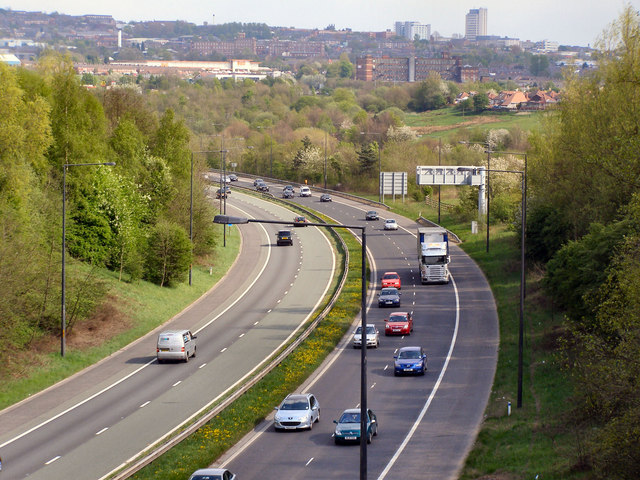
The A627(M) in Greater Manchester / Credit: David Dixon (via Geograph)
Probably unsurprisingly, London has the slowest collection of motorways in the country, with average speeds of 50.8 miles per hour, and also has the longest delay times across its multiple motorways, with average delays are around 13.8 seconds per vehicle per mile.
The highest-ranking Greater Manchester route on the slowest motorways list is the A627(M) at fifth place, which runs between Chadderton and Rochdale – with an average speed of 49mph.
This is then closely followed by the M602 – which is a four-mile route leading traffic into Salford towards Manchester by-passing Eccles – at number seven on the list with an average speed of 53mph, and the M67 – which heads east from the M60 motorway passing through Denton and Hyde, before ending near Mottram in Tameside – at number eight with an average speed of 53.8mph.
Top 10 Slowest Motorways in England
A308(M) Maidenhead – 30.8mph
A38(M) Birmingham – 44.2mph
M32 Bristol – 48mph
M181 Scunthorpe – 48.6mph
A627(M) Greater Manchester – 49mph
M621 Leeds – 49.8mph
M602 Greater Manchester – 53.3mph
M67 Greater Manchester – 53.8mph
M606 West Yorkshire – 53.9mph
M60 Manchester – 54.5mph
Closing out the list at 10th place is arguably the region’s most major motorway route – the M60.
ADVERTISEMENT
The M60 motorway, along with the Manchester Ring Motorway or Manchester Outer Ring Road, is an orbital motorway passing through most of Greater Manchester’s boroughs and encompassing most of Manchester – with an average speed of 54.5mph.
The slowest motorway is the A308(M) in Maidenhead, which is also considered one of England’s shortest at just 0.6 miles long, with average speeds of just 30.8mph.
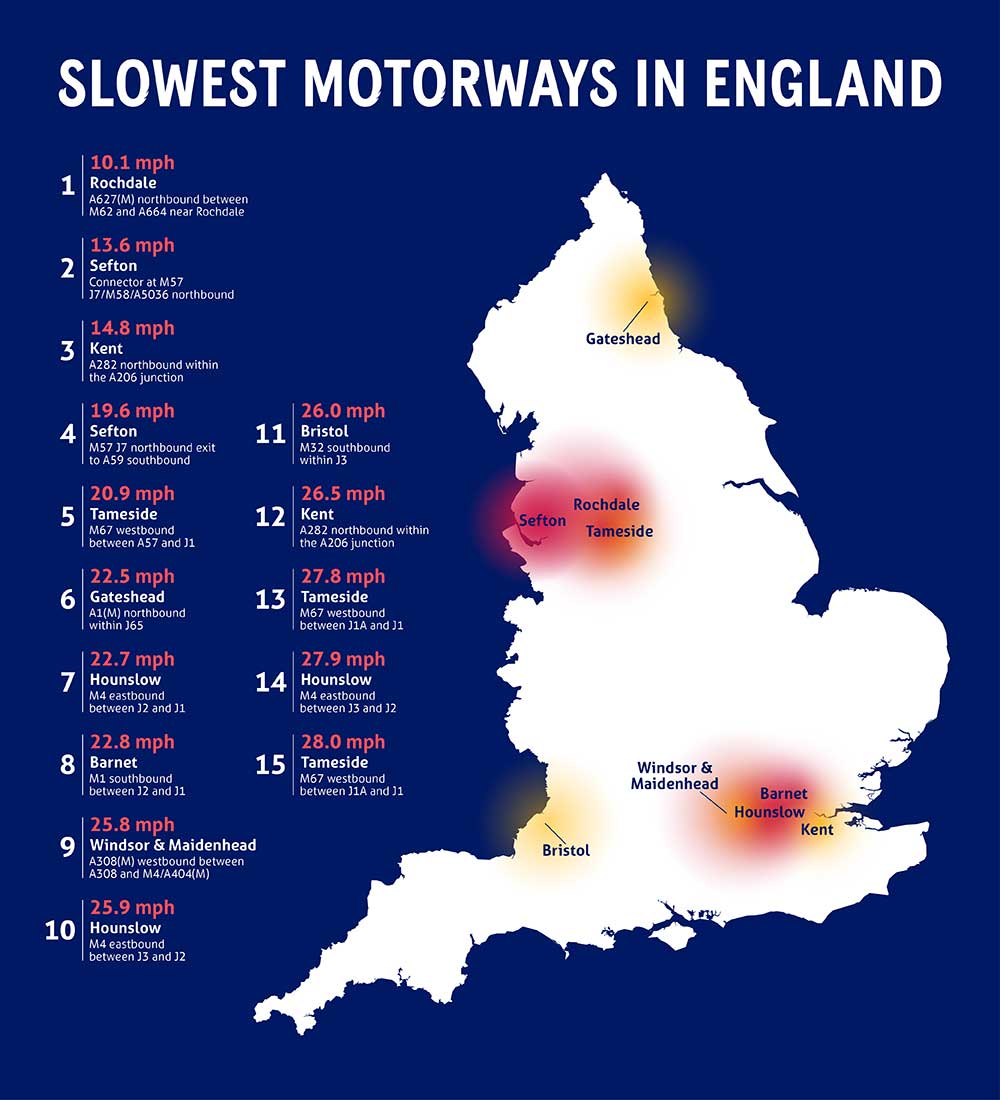
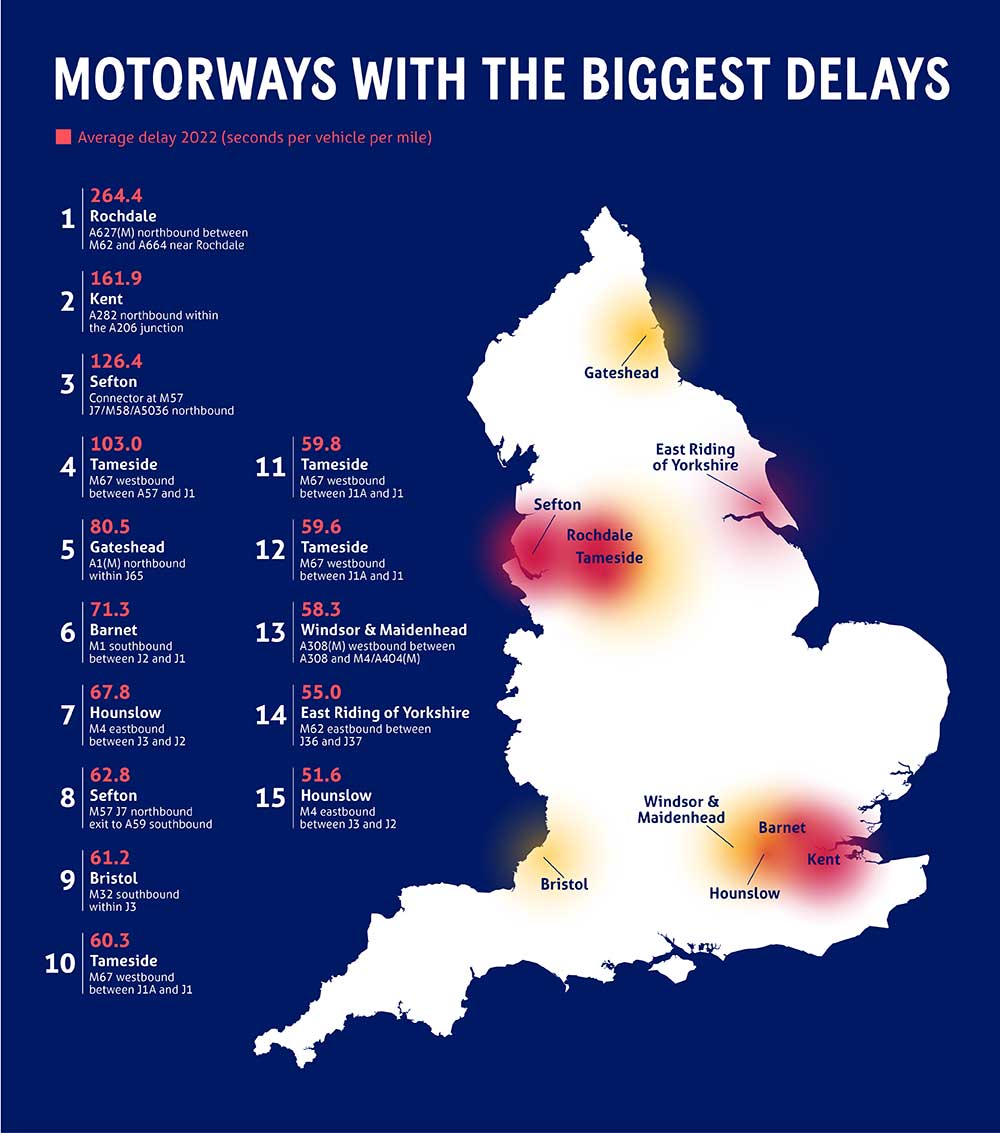
Four Greater Manchester motorways rank in the top 10 slowest in England / Credit: Comparethemarket
Overall, when the average speed is combined with the longest delay times, the North West ranks as the fourth most affected region in England.
Winter months October, November, and December came out as the slowest months for motorway traffic, and also have the longest delay times – which Compare The Market says is because weather can have a big impact on driving conditions, with fog, icy roads, and heavy rain leading to increased risk of accidents, and therefore delays.
Drivers also tend to be more cautious with speeds during adverse weather conditions, which will bring down overall speeds on the road.
ADVERTISEMENT
April and May are the fastest months on England’s motorways, and also have the shortest delay times.
This is perhaps because the Spring months tend to offer better driving conditions and are also outside of the school summer holidays, which means less chance of holiday traffic.
Manchester’s historic Portico Library secures £6.4m funding grant towards its transformation
Emily Sergeant
Manchester’s Portico Library has secured a whopping £6.4 million grant from The National Lottery Heritage Fund.
In case you missed it, ambitious plans to transform the historic Grade II-listed building on Mosely Street were already unveiled last October… but now, The National Lottery Heritage Fund has announced it is committing £6.4 million of funding towards the project, hoping that the building thrives as the UK’s most sustainable historic library for generations to come.
The grant is being described as a ‘major milestone’ in the approximately £12 million Portico Reunited project.
The Portico Reunited project will look to ‘reunite’ the historic building’s three floors for the first time in over a century, creating a fully-accessible and sustainable cultural library.
Founded all the way back in 1806, The Portico Library played a central role in Manchester’s rise as the world’s first modern city, and since then has been serving as a window into the past and a providing a place of inspiration for anyone who needs it.
The Portico Library has secured a £6.4m funding grant towards its transformation / Credit: Purcell Architecture (Supplied)
Crucially, plans will see a step-free entrance and lift installed to make the library accessible to all.
There’ll also be new exhibition and event spaces introduced as part of the scheme to explore the stories of Manchester’s communities and the city’s heritage. There will a Northern Bookshop, showcasing regional and emerging writers, and independent publishers, as well as a creative Portico Kitchen, which will celebrate the city’s food culture, writing, and history.
A place for school groups, families, and all people to explore Portico’s collection and experiment creatively also forms part of the plans.
Dr Thom Keep, Librarian and CEO of The Portico Library, called the funding grant a ‘landmark moment’ in the Portico’s ‘rich and complex history’, and a ‘huge achievement’ for its staff, trustees, volunteers, and partners.
“Thanks to National Lottery players, we can reunite this extraordinary building and make room for people to discover, learn and create together,” he added.
“We have listened to thousands of people about what the Portico could become, and their ideas and experiences have helped shape these plans.
“Our ambition is a library that belongs to the whole city – a place to discover remarkable collections, question the stories we have inherited, and create new possibilities together.”
Manchester City Council has granted planning permission and listed building consent for the project, and the building is expected to close for construction in late spring 2028 and reopen once again in early March 2030.
Following reopening, the transformed library is expected to welcome around 95,000 visitors each year.
Featured Image – Purcell Architecture (Supplied)
News
New data estimates that 7.3m Oasis fans are set to miss out on 2027 tour tickets
Emily Sergeant
New data has revealed that as many as 7.3 million Oasis fans could be set to miss out on tickets to the band’s 2027 tour.
In case you need bringing up to speed a little, it was announced earlier this week that, following the unprecedented success of the reunion tour, Oasis Live ’25, last year, including five nostalgia-drenched gigs at Manchester’s Heaton Park, Oasis would be hitting the road once again in 2027, and this time around, they’re going BIG.
We’re talking 11 nights at the Etihad Stadium and a return to the iconic grounds of Knebworth for four special shows there too, kind of ‘big’.
The iconic Manchester band will also be taking to a range of other world-famous stages across the globe, including five nights at Glasgow’s Celtic Park, and major cities like Barcelona, Amsterdam, Paris, Rome, and Las Vegas.
But despite the elevated number of dates the Gallaghers and co will be performing, some new data has unfortunately revealed that millions of fans may still not be lucky enough to snag a ticket.
The ticketing system for Oasis Live ’27 is not what it was for the last tour, nor will it be similar to many other tours of a similar scale in the past either, as this time, the band and their promotors are taking necessary measures to ensure ‘genuine fans’ get their hands on the tickets and that dynamic pricing doesn’t creep in.
Instead of going into detail on that now though, you can read our full guide on how to get tickets for the Manchester and Knebworth shows here.
Experts at online ticketing platform TicketSource have analysed the scale of demand for Oasis tickets by comparing the 10 million fans worldwide who queued for the initial release of 1.4 million tickets for their 2025 tour, with the newly announced 2027 tour dates and stadium capacities.
With an estimated 2.67 million tickets available across 38 dates and 11 locations between 21 May and 19 September 2027, Oasis could still face huge demand from fans hoping to see them live.
But research reveals the band would need to play 112 Wembley-sized shows to accommodate everyone who tried to get a ticket in 2025.
The 2027 tour would accommodate just 26.7% of those who tried to get tickets last time, meaning almost three-quarters (73%) of them could miss out, leaving a shortfall of more than 7.3 million fans.
Fingers crossed you’re among the lucky lot that secure tickets, though.
Featured Image – Joshua Halling (Press Image – Supplied)