These changes will take effect at 0.01am on Thursday 31st December.
Announcing the new classifications, Mr Hancock said: “Unfortunately, this new variant is now spreading across most of England and cases are doubling fast [and] it is therefore necessary to apply Tier 4 measures to a wider area, including the remaining parts of the South East, as well as large parts of the Midlands, the North West, the North East and the South West.”
Lancashire, Cheshire, Warrington, Blackpool and Blackburn with Darwen will also move from Tier 3 restrictions into Tier 4.
ADVERTISEMENT
Liverpool City Region will move from Tier 2 restrictions into Tier 3, while Cumbria will from Tier 2 into Tier 4.
BREAKING: Health Secretary Matt Hancock says that three quarters of the population of England are now going to be in Tier 4 due to the spread of the second COVID variant.
The government decides which tier applies in each area based on a range of indicators, including:
ADVERTISEMENT
Analysis of cases across all age groups
Analysis of cases in the over 60s
The rate by which cases are rising or falling
The percentage of those tested in local populations with COVID-19
Pressures on the NHS
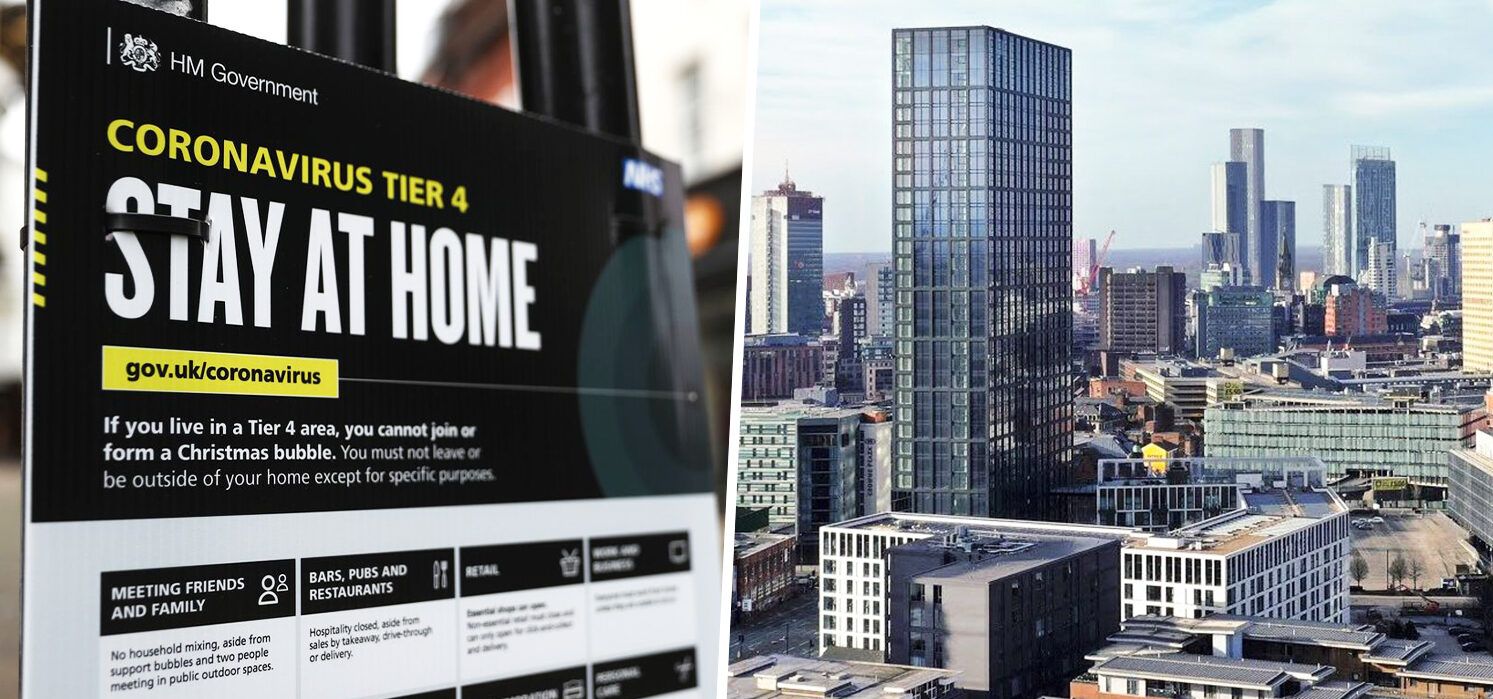
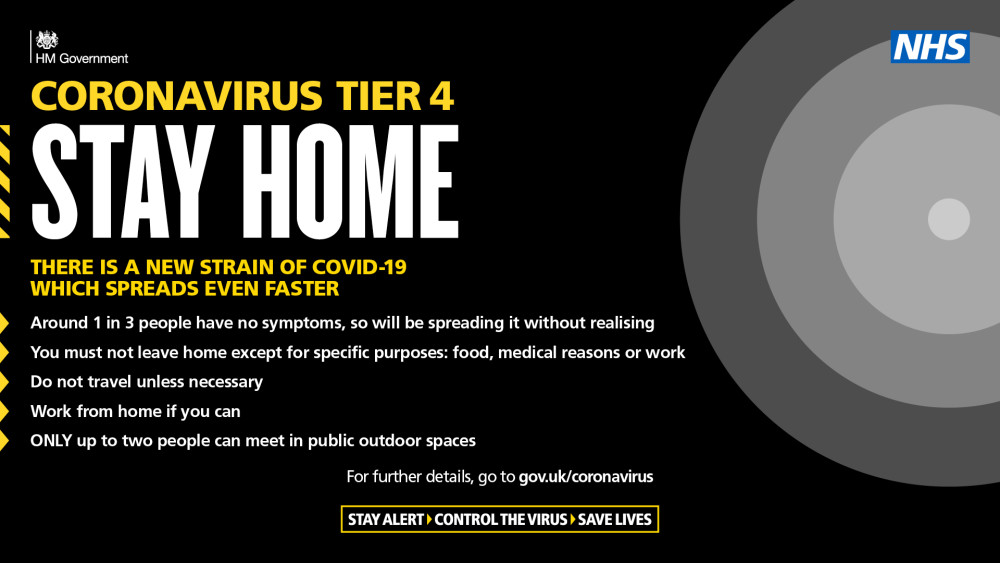
The new restrictions will see Greater Manchester residents told to “stay at home”, but what exactly does tier 4 mean for the region?
What are we permitted to and not permitted to do when restrictions take effect from tomorrow?
Tier 4
People must not leave their home or garden unless they have a ‘reasonable excuse’, including where reasonably necessary for work, education, exercise or open air recreation, and essential activities such as medical appointments and to buy food.
People must not meet socially indoors, in a private garden or most outdoor public venues with anybody they do not live with or have a support bubble with.
Everyone who can work from home should do so.
People can see only one other person that they do not live with (or do not have a support bubble with) in certain public outdoor places – such as parks, public gardens, or outdoor sports facilities.
Weddings and funerals can go ahead with restrictions on the number of attendees – six people can attend wedding ceremonies, wedding receptions are not allowed, 30 people can attend funeral ceremonies, and six people can attend linked commemorative events.
Accommodation such as hotels, B&Bs, campsites, holiday lets and guest houses must close, other than where very limited exceptions apply.
Hospitality settings, such as bars (including shisha bars), pubs, cafes, restaurants, and social clubs must close except for takeaway, delivery, drive-through and click and collect services. Takeaway must cease between 11pm and 5am, but delivery, drive-through and click-and-collect may continue during this period. This includes restaurants and bars within hotels or members’ clubs.
Indoor entertainment venues, such as casinos, bowling alleys, and bingo halls must close, and cinemas, theatres, and concert venues must also close.
Certain outdoor venues, such as botanical gardens, heritage sites, and zoos and other animal attractions may stay open, although indoor elements at these attractions must also close.
All indoor leisure and sports facilities must close, except where a legal exemption exists, such as for the training of elite sportspersons.
The changes will move an additional 20 million people into Tier 4, meaning a total of 44 million people (78% of England’s population) will be in the toughest tier.
ADVERTISEMENT
You can find more information regarding Tier 4 restrictions here.
___
For the latest information, guidance and support during the coronavirus (COVID-19) pandemic in the UK, please do refer to official sources at gov.uk/coronavirus.
#StayHome
News
The Premier League is keeping its crucial cap on away game ticket prices – for now
Danny Jones
The Premier League has announced it is extending its crucial price cap for away games, as the general cost of match tickets continues to creep up all over the country.
Most season card holders, be they here in Greater Manchester or elsewhere, are likely looking at their annual spending going up simply, so steps like these are key in keeping first division football as affordable as possible.
And that’s just the ongoing cost of living, let alone the clubs that are continuing the trend of charging more each year and, unfortunately, even pricing some supporters out entirely.
With that in mind, the news of England’s top-flight sides voting unanimously to keep the £30 cap intact for at least another two years comes as relief to those who spend most of the year putting their hard-earned cash towards following their team home and away.
BREAKING: The Premier League extend £30 cap on away tickets for another two seasons 🚨 pic.twitter.com/L336aZwmn3
Now confirmed to remain in place until the end of the 2027/28 campaign, travelling fans obviously still spend plenty of money on transport and so on every year, but at least they don’t have to worry about rising general admissions.
At least not for the time being…
Writing in a statement, the Premier League said: “Away fans help create the incredible atmosphere Premier League matches are renowned for. Since the cap’s implementation in 2016, it has contributed to attendance at away games increasing from 82% to 91%.”
They also acknowledged the significant and regular funds that supporters still spend on these trips, with plenty of people online also praising the Football Supporters’ Association (FSA), which helped spearhead the campaign over a decade ago.
With so many other obstacles still getting in the way of fans making it to games either at their usual stadium or on an away day – not least of all the constant and increasingly frustrating rescheduling of fixtures – it’s good to see this isn’t an area the Prem are trying to target.
As always, the multi-billion-pound business can always seek out other, newer money spinners, and we’re absolutley certain they will. For instance, there’s at least one happening over in Spain that we’d happily see carried over here.
Following the news, this now means that fans will ultimately have enjoyed 12 back-to-back seasons of the benefit, and long may it continue.
Nevertheless, the biggest barrier for people to watch the beautiful game at its highest level in the UK remains the cost of standard tickets.
The likes of Manchester United, Arsenal, Leeds and more have already let matchgoers know that their season ticket prices will be going up, and the likes of Man City have already seen backlash for increasing rates amid the expansion of the Etihad Campus.
Greater Manchester’s fire service officially rated ‘outstanding’ following inspection
Emily Sergeant
Greater Manchester’s fire service has officially been rated ‘outstanding’.
His Majesty’s Inspectorate of Constabulary and Fire & Rescue Services (HMICFRS) has awarded published its latest inspection report, and has awarded Greater Manchester Fire and Rescue Service (GMFRS) two ‘Outstanding’ ratings for the first time in the service’s history.
One ‘outstanding’ rating was given for the preventing of fire and emergencies, and one for values and culture.
Some of the areas of strength noted in the report include outstanding prevention work, acknowledging the service’s innovative partnership activity and targeted risk reduction programmes, and a ‘strong, positive, and inclusive’ culture, with strong communication and a clear focus on values, staff voice, and transparent decision making.
The service was also commended for having high levels of operational preparedness, and ‘effective’ governance and scrutiny, with ‘clear’ performance reporting and strategic direction.
In addition to the two ‘Outstanding’ ratings, inspectors also rated GMFRS as ‘Good’ in seven of the eight other inspection categories – including responding to fires and other emergencies, training and developing the right people with the right skills, and ensuring fairness and diversity across the workplace.
Inspectors also acknowledged the ‘significant capacity pressures’ on fire safety regulation across the UK, and the unique challenges posed by Greater Manchester’s complex and fast-changing urban environment.
“Greater Manchester has a fire and rescue service we can be proud of,” commented Mayor Andy Burnham, as the inspection report was published this week.
Greater Manchester’s fire service has officially been rated ‘outstanding’ following its latest inspection / Credit: GMFRS
“I’ve often said that GMFRS is one of the best services not just in this country, but anywhere. The inspectors’ findings reinforce this belief. I’m pleased that this strong inspection report recognises its outstanding prevention work as part of Greater Manchester’s Live Well approach, its outstanding culture and values, and consistently good performance across almost every other area.”
Chief Fire Officer, Dave Russell, added: “I am really pleased that the inspectors have recognised our progress towards this goal, by awarding us ‘Outstanding’ ratings for the first time in our service’s history.
“I am particularly pleased to have been awarded these for our nation-leading work on prevention, helping us to use our resources in the most effective way, and in our service’s culture, which I made my number one priority when joining the service.”