The Kellogg’s factory in Trafford Park could be closing down in the next couple of years after their parent organisation said they don’t see a “long-term future” for it.
A fixture in the Trafford industrial complex and the Stretford area for nearly 90 years, the Greater Manchester Kellogg‘s site produces around a million boxes of popular ranges like Corn Flakes, Rice Krispies and Coco Pops every day and provides jobs for approximately 360 locals.
However, as a subsidiary of the multinational Kellanova — which manufactures cereal, noodles, snacks like Pringles, Pop Tarts Nutri-Grain bars and more — the location could now be shutting down by 2026, with the Union of Shop, Distributive and Allied Workers (USDAW) describing the news as “devastating”.
Citing their reasons, Kellanova’s managing director Chris Silcock said that the layout of the site “made sense in the 1930s”, but changes in industrial design in the decades since mean that “you just wouldn’t lay out a factory like that nowadays”.
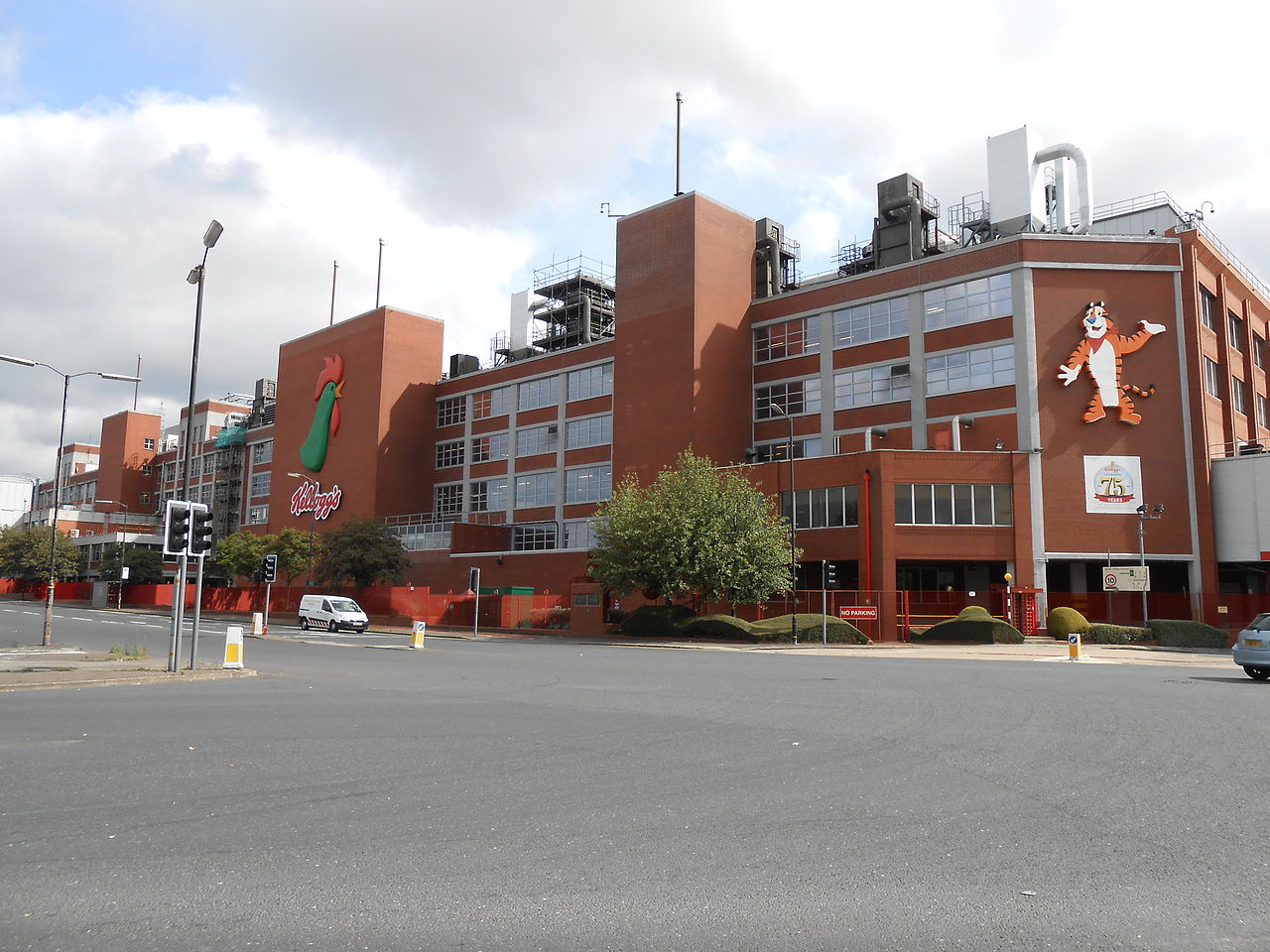
Kellogg’s could be closing the lifeblood of many locals for more than nine decades if Trafford Park goes. (Credit: Wikimedia Commons)
For context, cereal at the 27-acre Trafford Park factory travels up and down six floors before finishing its production cycle and, as he went on to explain, employees “only use half the space in the buildings and the investment required to maintain the factory in the coming years is simply not viable”.
ADVERTISEMENT
With thousands of Mancunians and employees from around the North West having worked at the buildings ever since it was opened by the Kellogg Company back in 1938, not only would the closure mark the closing of a long chapter in local industry but could see hundreds seriously suffer.
As per The Grocer, Kellanova has now started formal talks with factory staff and union representatives which are expected to last about three months, although they have insisted that Greater Manchester will remain the company’s British home.
ADVERTISEMENT
Labour MP for Urmston and Stretford issued the following statement regarding the potential closure of Kellogg’s Trafford, noting that the brand “has a long and proud history in the constituency and the site has been an iconic part of our community for decades – with generations of local families working there.”
My full statement on the deeply worrying news announced today that Kellogg’s are considering closing their Trafford Park site. https://t.co/XhiogZv8Q4
Silcock added, “We know this will be difficult for many to hear”, assuring that they will allow staff to liaise with representatives and “support them in the right way, should this change happen”, insisting that the plans have “nothing to do with the dedication of the outstanding people who work there”.
As for USDAW, area organiser Mick Murray has confirmed they will now enter into “meaningful consultation talks with the company, where we will interrogate their business case and seek the best possible outcome for staff impacted by the proposed closure.
ADVERTISEMENT
“We are providing our members with the support, advice and representation at this difficult time”.
Kellogg’s also has roughly 520 staff employed over the bridge at its HQ and tech hub in MediaCity although they are thought to be unaffected by the announcement, as are staff at their other UK factories and distribution centres.
Passengers urged to ‘plan ahead’ as Manchester Piccadilly prepares to close for nine days next week
Emily Sergeant
Passengers are being urged to ‘plan ahead’ as Manchester Piccadilly prepares to close for nine full days from next weekend.
In case you hadn’t heard, it was announced last November that Manchester Piccadilly train was going to have to shut in February 2026 for what is described as being a ‘once-in-a-generation upgrade’… and now, we are less than two weeks away before that officially becomes a reality and very few train services run in or out of the station.
Network Rail is investing £7.9m into the major upgrade at Manchester Piccadilly station – with the main points of action being to improve tracks, points, and signalling systems on the southern approach to Manchester Piccadilly station.
Teams are due to replace 11 sets of points, renew timber sleepers with modern, concrete equivalents, and alsobring lineside equipment ‘bang up to date’ across six lines to improve future journeys for passengers and freight.
Investment in this apparent ‘critical stretch’ of track has been long awaited, as any issues with the ageing infrastructure can disrupt all trains running in and out of Manchester.
Passengers are being urged to ‘plan ahead’ as Manchester Piccadilly prepares to close for nine days next week / Credit: Network Rail
The nine-day closure, although expected to cause commuting chaos, is tipped to ultimately deliver ‘better and more reliable journeys’ for passengers in the long run.
The main work takes place over nine days during February half term, from Saturday 14 through to Sunday 22 February 2026.
And what does this mean for anyone travelling exactly? Well, the scale of the work spanning all main lines means no trains from the south and east of the city will run into Manchester Piccadilly for the full nine days, while trains from the north will also be heavily impacted, as will direct connections to Manchester Airport station.
There will be a limited service westbound from Platforms 13 and 14.
⚠️ Major changes to services this February half term ⚠️
🛠️ We're upgrading the Piccadilly corridor.
📆 From 14-22 February there will be no trains from platforms 1-12. A limited service will terminate at platforms 13&14.
The train shed (Platforms 1-12) will also close for the full nine days, but Manchester Piccadilly station’s concourse will remain open to the public.
“During this time, we are advising passengers to travel light, allow extra time for their journey, and be prepared to queue, as stations and rail replacement services are expected to be very busy,” National Rail said in its statement issued ahead of the closure next week.
“We have worked with train operators, Transport for Greater Manchester (TfGM) and Manchester City Council to develop an alternative travel plan during the closure, to keep passengers moving smoothly to their destination.”
You can plan your journey on the Northern Rail website here.
Featured Image – Network Rail
News
Work begins on new £500m ‘culture hub’ with a cinema and performance spaces in Manchester
Emily Sergeant
Work is finally beginning on a new £500 million culture hub in Manchester.
The first phase of plans to transform Wythenshawe Civic has entered an exciting new chapter, with Manchester City Council and placemaker Muse officially commencing construction of the new Culture Hub – which is tipped to provide a ‘major boost’ for budding artists, and creative groups and organisations in the area.
The hub is set to include space for food and drink on the ground floor, while the first floor is home to a mix of artist studio spaces and flexible areas for workshops, exhibitions, classes, and community events.
Locals can also expect a brand-new 40-seater cinema, which has been included following feedback given during a public consultation, and 200-seater performance space for a diverse range of performances.
Everything from dance and drama, to music and modern art will fill the performance spaces once the hub opens.
Expected to be completed in 2027, the Culture Hub sits within the first phase of a wider plan to ‘refresh’ Wythenshawe Civic, and will come to life thanks to £20 million of funding from the UK Government and a further £11.9 million from the Council.
What Wythenshawe Civic Centre looks like currently, before being transformed / Credit: Wikipedia Commons
“Listening to local people over the last year and more, we know that Wythenshawe residents want more from their town centre – more things to do, opportunities to spend time in Civic and night time attractions that give the area a lift and attract visitors,” explained Cllr Bev Craig, who is the leader of Manchester City Council.
“This is the drive behind the Culture Hub – a place for local people with an interest in the arts to take part in creative activities, see a show, or enjoy the cinema space, right in the heart of their community.
“This is another exciting chapter in the transformation of Wythenshawe town centre.”
Joe Stockton, Development Director at Muse, called the construction of the new Culture Hub an ‘exciting moment’ for Wythenshawe.
He added: “Our aim is to create a space for the town’s talented artists and creatives to come together and give them the facilities and the space they’ve asked for, to put on amazing shows, live performances, and workshops.
“It’s all part of the wider plan to create opportunities for residents, new homes and jobs, as well as a thriving high street for people to spend time in.”