Motorists are, once again, being urged to plan ahead as Mancunian Way is set to close in both directions this weekend.
Closures will be put in place so “planned maintenance” and “safety inspections” can be carried out.
As Manchester‘s busiest road, and one of the main thoroughfares in and out of the city centre, it stands to reason that, from time to time, maintenance work and annual safety inspections have to take place to Mancunian Way to make sure journeys are as seamless as possible for everyone in the future.
This is why the local authorities claim they have worked together to “identify the weekend” where it’s likely there would be “least disruption to plans”.
ADVERTISEMENT
🚧 The Mancunian Way is closed this weekend [9/10 Sep].
Plan your weekend: – Avoid traffic and simply park and travel by tram into the city. – Use the M60 for faster cross-city journeys – Roads will be quietest before midday 👉 https://t.co/BZwUPbfSm6pic.twitter.com/62UtIMaepU
During this weekend’s closures, some of the works due to be carried out will include safety inspections, road repairs, lighting inspections, street sweeping, drainage clearance, and general work to improve any defects, while the overall integrity of the structure will also be assessed.
Traffic is set to be affected by the closures, as you’d probably expect, but TfGM has confirmed that signed diversions will be put in place to “keep you moving”.
ADVERTISEMENT
So, where exactly will the closures be? And for how long can you expect to be affected?
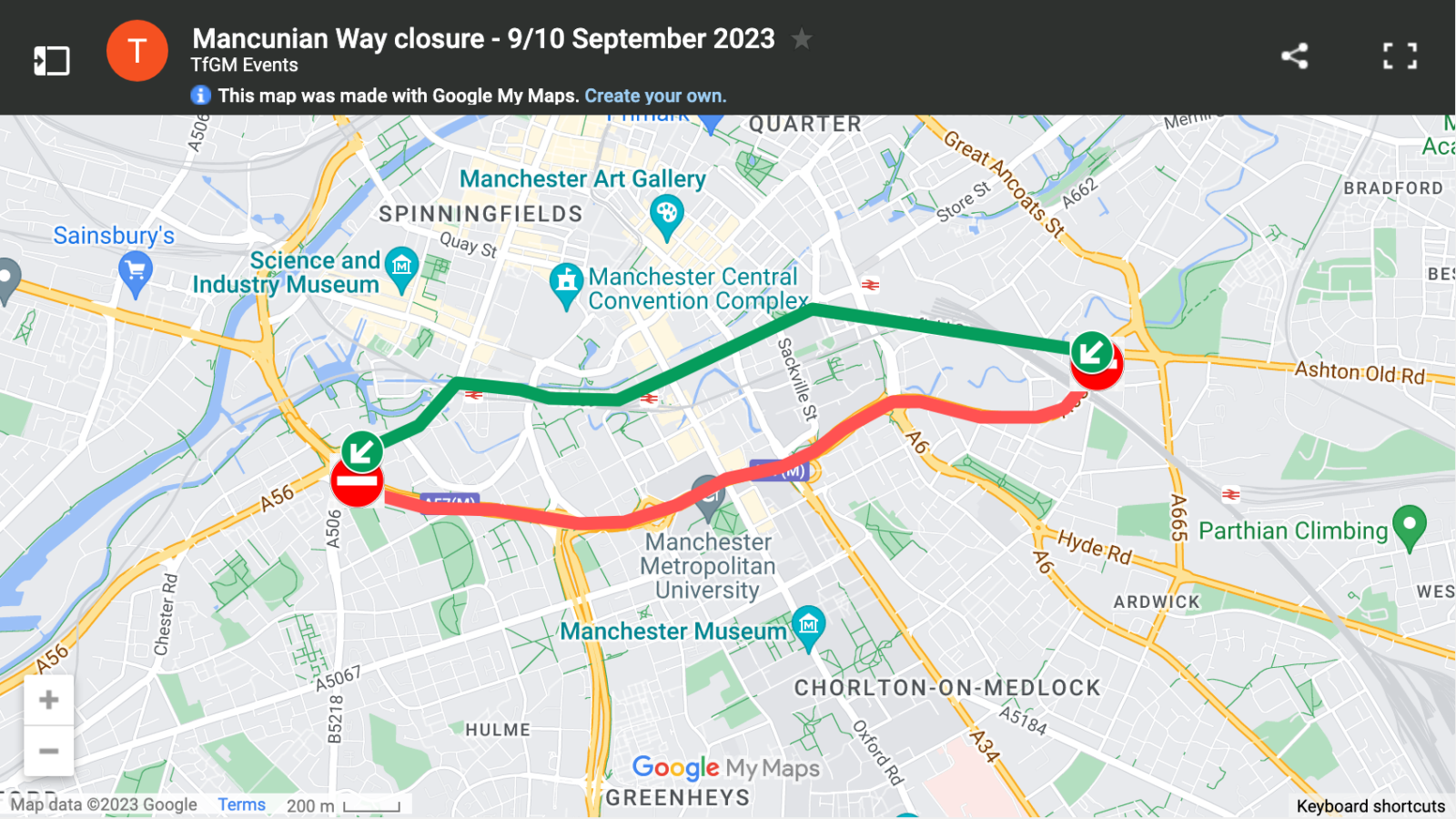
TfGM has confirmed that from 5am on Saturday 9 September until 7pm on Sunday 10 September, the Mancunian Way will be closed in both directions from the Chester Road roundabout to Fairfield Street for said “planned maintenance works and safety inspections”.
Traffic will be diverted via Chester Road, Bridgewater Viaduct, Whitworth Street West, Whitworth Street, Fairfield Street, and vice versa.
ADVERTISEMENT
/ Credit: TfGM
Based on data from previous closures, TfGM says the quietest time to travel will be before midday, as traffic evels will be higher from 12pm -with the busiest time likely to be between 4pm and 7pm on Saturday and 3pm and 6pm on Sunday.
Chester Road, Regent Road, Whitworth Street, Fairfield Street and the Inner Ring Road approaching the Mancunian Way are likely to be the most impacted roads.
Using the M60 and the motorway network will likely be the fastest way to get from one side of the city to the other, but if you’re already in the city centre and looking to make a journey, then you’ll want to use the northern sections of the Inner Ring Road (Trinity Way and Great Ancoats Street) to avoid being caught in congestion on the Whitworth Street diversion route.
The Metrolink network will be your best option to “avoid expected congestion”, TfGM says, while making the most of ‘park and ride’ services is also advised.
Find out more about the planned closures on the TfGM website here.
Featured Image – Ocean Outdoor
News
70% of North West residents think Andy Burnham has ‘done well’ as Greater Manchester Mayor
Emily Sergeant
A new survey has revealed that 70% of North West residents think Andy Burnham has ‘done well’ in his job as Greater Manchester Mayor.
It this point, it’s hardly a secret that Andy Burnham’s run in the upcoming Makerfield by-election is about more than just becoming an MP, with expectations that – if he wins, of course – he will go on to challenge Keir Starmer for the position of Prime Minister.
But do Brits believe Burnham has what it takes for the top job? Well, YouGov has set out to answer this question with a new survey, seeing how much people think he’s succeeded in his role as Mayor of Greater Manchester.
The survey found that Brits tend to believe Burnham has ‘done well’ in his current job as Mayor, with 44% of survey respondents nationwide saying so, in comparison to just 12% who’ve gained the impression he’s done poorly and a further 44% saying they are unsure.
70% of North West residents think Andy Burnham has ‘done well’ as Greater Manchester Mayor / Credit: GMCA | Mylo Kaye (via Unsplash)
Although this poll is, admittedly, not a large enough sample to examine Burnham’s reputation in Greater Manchester alone, it was discovered that an impressive 71% of those in the wider North West region think he’s done a good job, while just 14% believe the opposite.
The most interesting part about this statistic is that Burnham’s reputation as an effective Mayor appears to be spread across political parties – even somewhat conflicting one.
It includes 66% of those who voted Labour in 2024, as well as 56% of those who backed the Lib Dems and 51% of those who voted Green. Conservative voters also tend to believe Burnham has been a good Mayor, by 41% to 19%, while Reform UK voters are split 33% to 31% on his effectiveness.
Britons tend to think it's unclear what Andy Burnham stands for, even if more feel it's clear what he believes than what Keir Starmer believes
Around four in 10 Brits (39-43%) describe Burnham as being competent, likeable, and decisive, and around 27% see him as trustworthy.
Whether he is ready for a promotion to Prime Minister in the future though, now that divides the public.
According to YouGov’s findings, a third of Brits (33%) believe Burnham looks like a leader ‘in waiting’, but this is then matched by the same amount who feel he doesn’t look like a Prime Minister at present.
While the public might not be sold on Burnham as a Prime Minister just yet, what can be seen is that opinion on whether he is up to the job compare favourably to current opposition leader, Kemi Badenoch.
Featured Image – TfGM
News
Transfers: Manchester United reportedly in the race for Rafael Leao as asking price is revealed
Danny Jones
In the latest transfer news coming out of Manchester, Man United are reportedly set to make the first move in an effort to sign Serie A star Rafael Leao after AC Milan are said to have ‘offered’ the wantaway winger to Premier League rivals Arsenal.
After being linked with MUFC on and off in the past, this could shape up to be a tasty tug of war if all rumours are to be believed.
But a recent interview by Leao may have pricked up ears over at Old Trafford and Carrington:
Do you think there are some hints being dropped here?…
Speaking to London-born and now Manchester-headquartered (interesting…) streetwear and jewellery brand Cernucci on their new podcast, the Portuguese international confessed to presenter Fred Buckley that he spent much of his childhood watching Man United, and still does to this day.
While he also admitted he likes Arsenal, adding even more fuel to the fire of the links with the Gunners, he also named Cristiano Ronaldo as his idol; either way, the ‘Rossoneri’ are believed to be asking for between £43-50 million for the former Sporting and Lille player.
A teammate of his with the national squad and having starred for major European sides, winning silverware – a Serie A title and Italian Super Cup, as well as a UEFA Nations League with Portugal – he’s evidently looking to try and emulate his fellow compatriots’ success moving forward.
Now 26 years old, he’s at a crucial juncture in his career, and despite being criticised for his work rate and efforts off the ball at times, not to mention blowing somewhat hot and cold in and around a fair few injury problems, the next big money move feels almost inevitable as he approaches his ‘prime’ years.
As you can see, many Milan fans have seemingly turned on him already after he made his plans to depart rather publicly, which has also seen him pop up on the radar of several other Champions League competitors this summer.
One such alternative suitor outside of English football is Galatasaray, with multiple Italian and Turkish outlets claiming that the club are the only team to be drawing up a ‘formal proposal’ thus far.
Journalist Matteo Moretto does state, however, that no official offer has been made as yet.

 Emily Sergeant -
7th September 2023
Emily Sergeant -
7th September 2023