England prepares to take its biggest step out of coronavirus restrictions on Monday 17 May as the country moves to the third stage of the government’s lockdown exit roadmap.
Rules on hugging, meeting indoors, and gathering in bigger groups are all changing from this date – returning many freedoms which have been banned for over six months in some parts of the country.
The current national lockdown has been lifted gradually since March 8 – proceeding smoothly with a steady decline in national cases accompanied by a mass vaccination campaign.
April 12 saw the return of non-essential retail, outdoor hospitality, gyms, personal care premises, outdoor attractions and self-contained accommodation.
But mounting concern over the spread of a more infectious strain of COVID-19 had begun to cast doubt as to whether more restrictions could be lifted as intended on May 17.
ADVERTISEMENT
Testing and vaccinations have been ramped up in towns where cases are spiking such as Bolton, and local lockdowns are not yet being ruled out – with infection rates set to be closely monitored in the coming weeks to determine if different action is required in future.
But crucially, ministers have agreed to “cautiously” proceed with the roadmap as planned – with May 17 marking a memorable day on the 2021 calendar for everyone in England.
ADVERTISEMENT
Here’s what’s set to change.
Social contact
Some restrictions on social contact are being removed from May 17 / Image: Priscilla Du Preez via Unsplash
Restrictions on social contact are being removed from May 17.
Six people or two households can meet indoors from this date, whilst overnight stays are also allowed.
ADVERTISEMENT
Care home residents can also have up to five named visitors.
Gatherings of up to 30 people are now allowed outdoors.
Attendance numbers allowed at funerals are determined by the size of the venue.
Pubs, restaurants and cafes
Indoor hospitality is reopening from May 17 / Image: cottonbro via Pexels
Bars, restaurants, pubs and cafes right across the country are welcoming back customers this month.
ADVERTISEMENT
The hospitality sector is allowed to serve indoors from May 17 – having been operating on an outdoor-only basis since April 12.
Night Time Economy Adviser for Greater Manchester Sacha Lord embarked on a campaign to see the rules lifted earlier, and despite some initial success in helping convince judges to drop the substantial meal rule in pubs, his latest efforts to get indoor hospitality reopened sooner than May 17 were shut down in court.
Indoor service can resume from May 17 – although customers still have to order, eat and drink while seated.
Holidays can resume
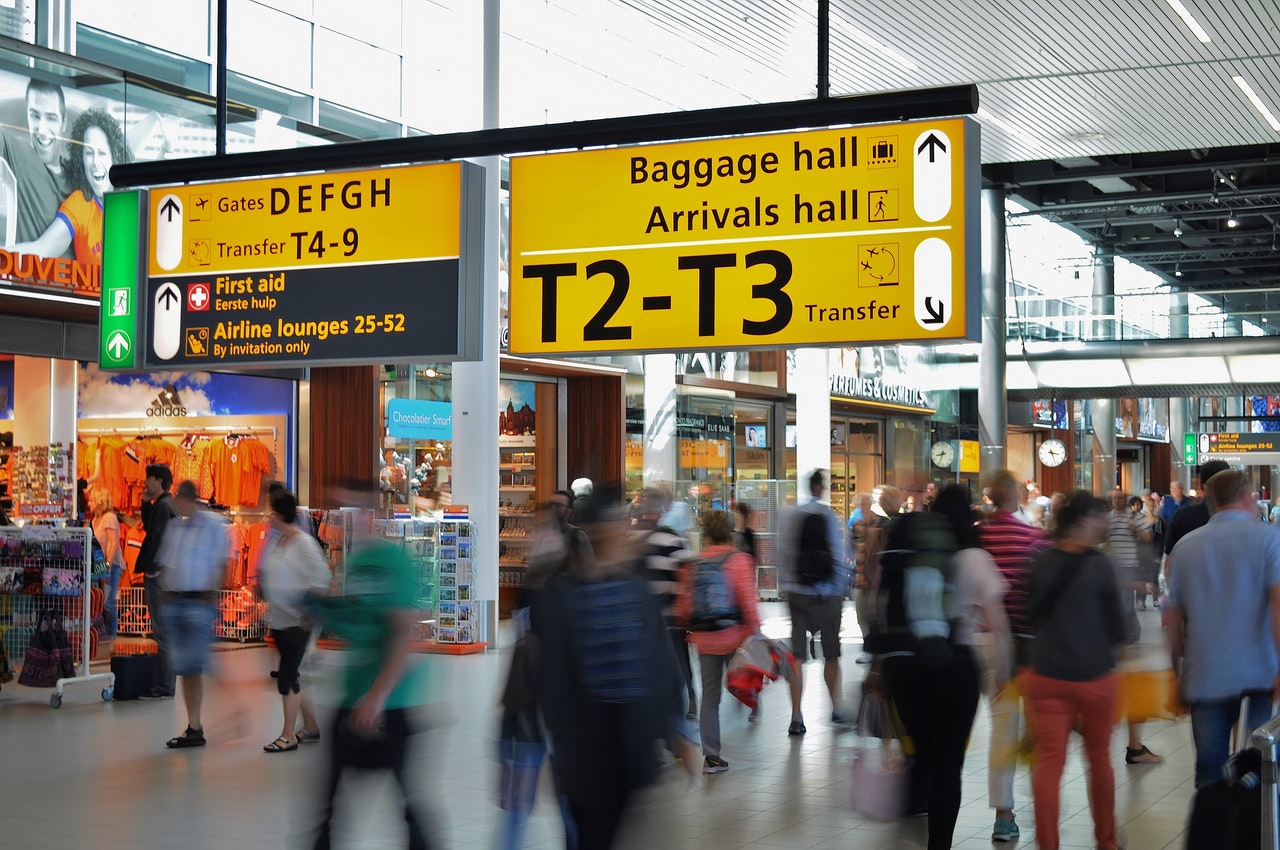
Overseas travel and holidays will be permitted from May 17 / Image: Pexels
The door has reopened from domestic and international travel from May 17.
Hotels, hostels and B&Bs in England can take bookings for leisure purposes.
ADVERTISEMENT
Overseas holidays are also allowed again, but with restrictions. The government has introduced a travel system that categorises nations as ‘red’, ‘amber’ or ‘green’ depending on a number of risk factors – such as infection rates and the presence of variants.
The traffic light system is as follows:
Green: Arrivals will not need to quarantine when they arrive in England.
Amber: Arrivals must quarantine for 10 days when they arrive in England.
Red: Arrivals in England must stay for 10 days in a managed quarantine hotel.
Currently, a handful of countries have been added to the ‘green list’ – including Australia, New Zealand, Gibraltar, Iceland and Portugal.
Indoor culture and entertainment venues such as museums, theatres and cinemas all reopen from May 17 – with a big campaign launched in Manchester to welcome people back after 200 days of closures.
ADVERTISEMENT
Indoor adult group sports and exercise classes are allowed to recommence – with steam rooms and saunas also permitted to reopen.
Larger performances and sporting events with a reduced number of spectators will take place following a number of trial events this month.
From May 17, indoor venues can welcome up to 1,000 people or operate half-full (whichever is a lower number).
Outdoor venues can hold up to 4,000 people or operate at 50% capacity (whichever is a lower number).
In the largest outdoor seated venues, where crowds can be spread out, up to 10,000 people will be able to attend (or a quarter-full, whichever is lower).
ADVERTISEMENT
The roadmap to exiting lockdown can be found in full on the government website.
Featured image: WelcomeBackManchester
News
Niall Horan at Co-op Live, Manchester – tickets, times, and more for UK tour
Thomas Melia
Former One Direction member now-soloist Niall Horan is making his return to Co-op Live as part of his UK shows: ‘Dinner Party Live On Tour’.
Known for his work alongside One Direction bandmates Harry, Louis, Liam and Zayn, Horan has since started a solo career and continued to have a large fanbase.
His singles include ‘Nice To Meet Ya’, ‘Heaven’, ‘Drive Safe’ and ‘This Town’ with the latter amassing over 1 billion streams since its release in 2017.
Collaborating with the likes of pop artist Anne-Marie, Myles Smith, Maren Morris, the Irish-born musician’s style fuses both acoustic and country sounds.
Niall’s most recent LP Dinner Party dropped earlier this summer with the album title inspired by his initial encounter with his long-time girlfriend.
Gig guide – Niall Horan at Co-op Live, Manchester
Niall Horan UK tour dates
Tue 22 September – Birmingham, UK – Utilita Arena
Wed 23 September – Newcastle, UK – Utilita Arena
Fri 25 September – Manchester, UK – Co-op Live
Mon 28 September – Glasgow, UK – OVO Hydro
Tue 29 September – Sheffield, UK – Utilita Arena
Fri 2 October – London, UK – The O2
Sat 3 October – London, UK – The O2
Are there any tickets left for Niall Horan at Co-op Live in Manchester?
If you’ve got ‘Slow Hands’ then you better get booking tickets to Niall Horan’s upcoming concert at Co-op Live in Manchester now as they’re selling pretty quickly.
You can find tickets for both seated and standing options starting from £50.75 HERE.
Although the official setlist for Niall Horan’s upcoming Dinner Party Live On Tour is yet to be revealed, here’s the tracklist for his most recent LP of the same name:
Tastes So Good
Dinner Party
Monochromatic
She Gets It From Her Mother
Better Man
Little More Time
Flowers
Boys Are Fun
Fighting Over Nothing
Pretty
Die If I Don’t
End of an Era
What are the stage times for Niall Horan in Manchester?
Doors for Niall Horan open from 6.30pm and expect to fall in love with singer-songwriter flowerovlove who will take to the stage just before.
Co-op Live has a strict curfew of 11pm meaning you have a ‘Little More Time’ to lie in before the clock hits twelve.
How to get to Co-op Live
Tram
For those of you heading to Co-op Live, you’ll be glad to know it’s right next door to a rather famous big blue stadium and its integrated Metrolink stop.
Head along the light blue or orange lines directly to the Etihad Campus or Ashton-under-Lyne, and you can get off the tram literally spitting distance from the arena. You can find the full map HERE.
Trams run frequently on the Ashton-Eccles line to the Etihad stop, with services leaving every six minutes from the city centre and until 1am on Fridays and Saturdays.
Bus
You can find the full list of bus routes HERE, with the one in closest proximity to the venue being the 53 bus, which runs from Cheetham Hill through to Higher Crumpsall, Old Trafford and Pendleton, leaving just a two-minute walk to Co-op Live.
If you’re driving, there is limited parking available at the venue, but this must be pre-booked ahead of time, and there are designated drop-off areas.
The postcode is M11 3DU, and you can follow the signs towards the wider Etihad Campus as you get closer; directions to the adjacent drop-off points will also be signposted.
Keep in mind that congestion on the roads close to the stadium is expected to gather around two hours prior to any event, so if you are travelling on the road, these are the suggested times they provide on event day, though estimates will obviously vary:
Alan Turing Way (both directions): plan an additional 20 minutes into any journey by road.
Hyde Road (eastbound): expect an additional 15 minutes to be added to your journey.
Mancunian Way (westbound): plan for an extra 10 minutes of travel time.
There are also three park-and-ride facilities near Co-op Live, but be advised that the Velopark and Holt Town stops will be closed post-event to help safely manage crowds:
Ashton West (Ashton line) – 184 spaces and 11 disabled spaces
Ladywell (Ashton-Eccles line) – 332 spaces and 22 disabled spaces
Walk/cycle
Lastly, Co-op Live is only a half-hour stroll from Manchester Piccadilly, and you could even walk along the canal all the way to the front door if you fancy taking the scenic route.
Greater Manchester now also offers the option to hire bikes on the Beryl app, with riders able to locate, unlock, get to their destination and then safely lock up the bike all through an easy-to-use app. There are hire points just near the south-west corner of the Etihad Stadium on Ashton New Road.
For more information on all travel options, you can check out the enhanced journey planner.
Featured Images – Publicity Picture (via Supplied)
News
Opening date finally confirmed for new Uniqlo store at the Trafford Centre
Emily Sergeant
Uniqlo is preparing to open its second store in Greater Manchester, and the official launch date has finally been confirmed.
The popular Japanese high street fashion retailer currently operates 24 stores in the UK, with its first British store having opened its doors all the way back in 2001, and its first European flagship store opening on Oxford Street in London in 2007 – but it was revealed earlier this year in April that Manchester was set to get a second helping.
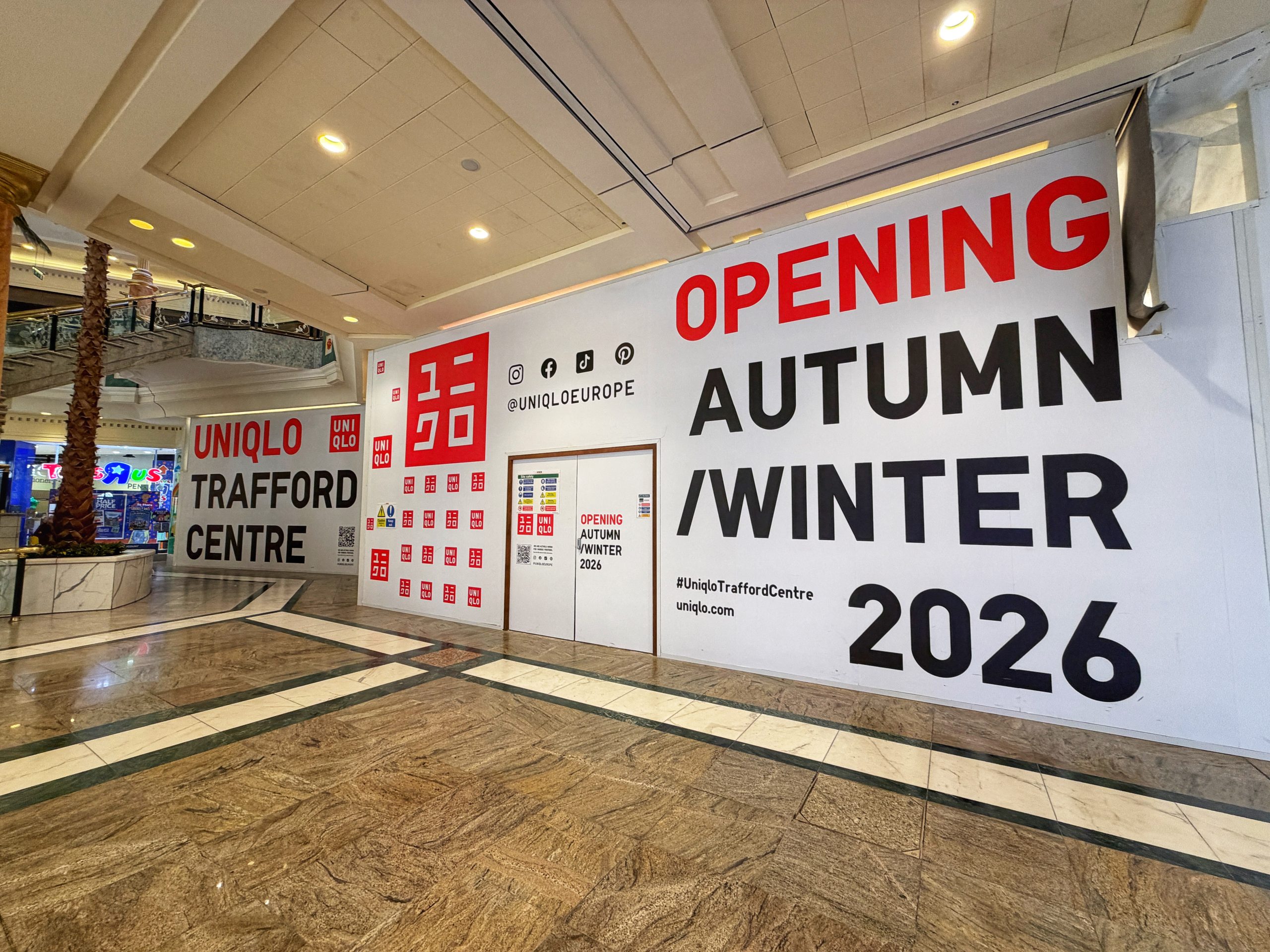
Uniqlo announced that it would be opening its second Greater Manchester inside the Trafford Centre this autumn, following the huge success of its city centre store opening on Market Street in 2019.
The Trafford Centre store is set to make Manchester the first location outside of London to have two Uniqlo stores.
When news broke that the hoardings had officially gone up inside the shopping centre, elated shoppers raced to the comments to say things like: “No way! I’ve been waiting years for this.”
Uniqlo is preparing to open second its Manchester store inside the Trafford Centre next month / Credit: | The Manc Group
“Uniqlo in Trafford Centre would be a dream come true,” another person said on Instagram, while a third added: “I will never have to step foot on Market Street again,” and plenty others chimed in with comments like ‘finally’ and ‘can’t wait’.
And now, we officially have an opening date to share with you.
Uniqlo will open in the Trafford Centre for the first time on Thursday 15 October, with plenty of events happening across its extended opening weekend.
Traditional Japanese Taiko drumming performances will be happening throughout the day on Thursday 15 and Saturday 17 October, while the first 300 customers to spend over £69.90 in store on the Thursday (15 October) will get a special Uniqlo Manchester goody bag.
Uniqlo’s arrival at the Trafford Centre follows the opening of several other high-profile stores in recent months, like Urban Outfitters, White Company, Stradivarius, and many more.

 The Manc -
17th May 2021
The Manc -
17th May 2021