One of Greater Manchester’s many train stations has been named the ‘worst’ in the UK, according to a new analysis.
And unfortunately, it’s joined in the top 10 by a handful of others in the region too.
It’s pretty fair to say at this point that the country’s rail network, train services, and stations have been far below the standards that passengers expect for quite some time now – with constant delays, last-minute cancellations, short-formed services, and ongoing strike action, by both station staff and train drivers, being commonplace for the past few years.
Most-recently, a new analysis named Avanti West Coast as Britain’s most ‘unreliable’ train operator, as it was found to have a massive 15.36% of its trains cancelled or delayed, on average – but now, it’s the train stations that have found themselves in the firing line.
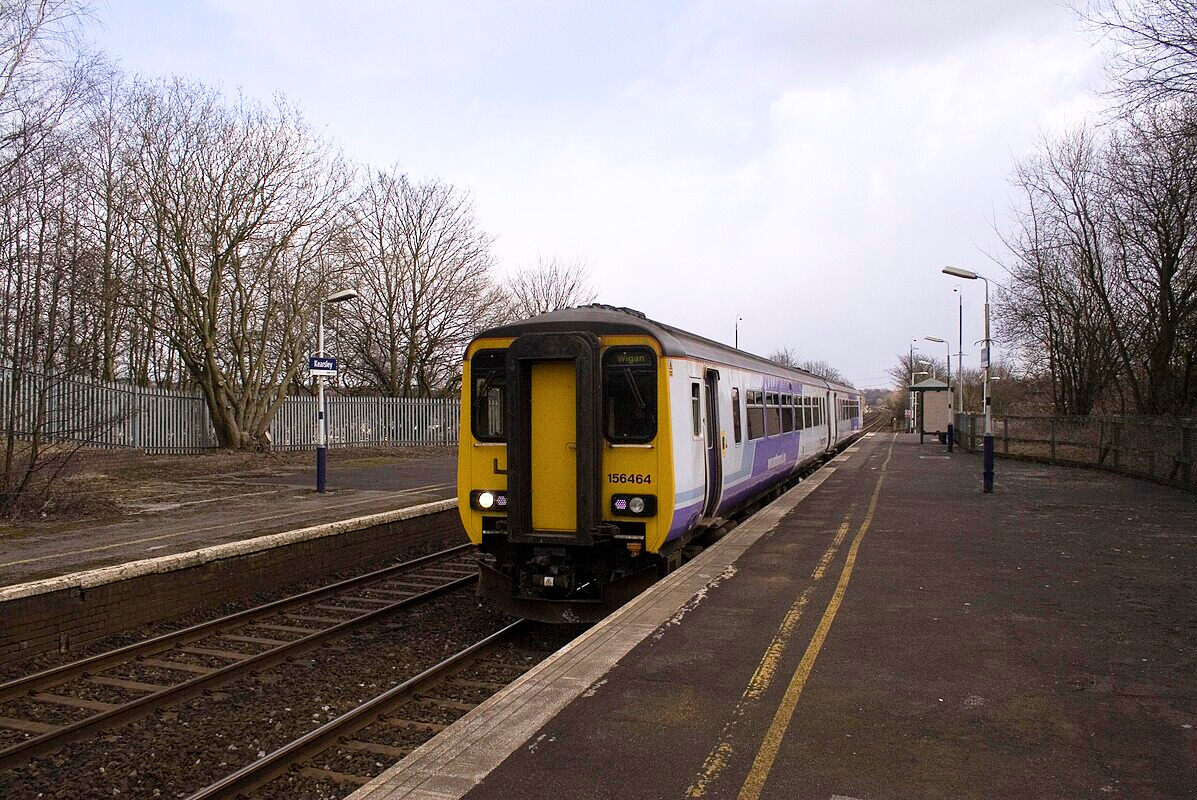
The top 10 ‘worst performing’ UK train stations in 2024 have been named, according to new figures / Credit: Network Rail | Northern
That’s because, new figures released by On Time Trains has seen Kearsley train station, just outside of Bolton, ranked as the country’s lowest performing’ station over the four weeks leading up to 28 May.
ADVERTISEMENT
The company analysed station’s performances based off the frequency and length of delays, plus how often trains are cancelled.
When it comes to the Bolton-based station’s punctuality and cancellation rate, On Time Trains found that 81% of the trains due to stop at Kearsley were either delayed or cancelled entirely over the one-month period, and most delays recorded exceeded the two-minute mark.
ADVERTISEMENT
Top 10 ‘worst performing’ UK train stations
Kearsley
Taynuilt
Crianlarich
Moses Gate
Penrith
Farnworth
Ince and Elton
Connel Ferry
Bescar Lane
Blackrod
Bolton hasn’t escaped lightly with just Kearsley in the top spot either, as unfortunately for the Greater Manchester borough, three of its other stations have also made the top 10 list.
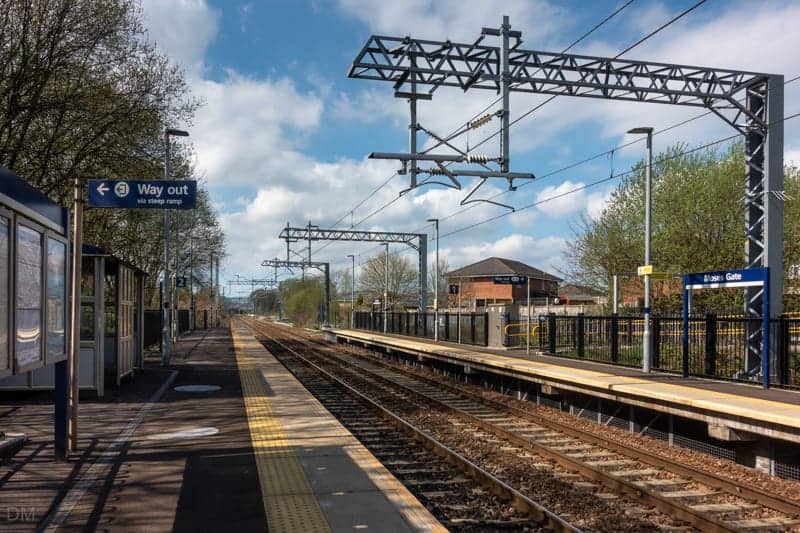
Moses Gate takes the fourth spot on the list, while Farnworth has found itself in sixth place, and the top 10 is rounded out by Blackrod.
Moses Gate station, just outside of Bolton, which also makes it into the top 10 / Credit: Platforms (via Visit North West)
Some of the other Northern stations ranking in the top 10 include Penrith, and Ince and Elton.
ADVERTISEMENT
Speaking in reaction to its poor performance in the recent results, a spokesperson for Northern commented: “Recently, our performance and reliability have not been up to scratch, and for that we are sorry.
“We are very actively managing higher levels of staff sickness, and on Sundays, which rely on crews volunteering to work additional hours, we have seen a reduction in train crew making themselves available on parts of the network.
“In addition, the ongoing industrial relations issues have their own impact, but we are working hard with our colleagues and other train operators to improve service reliability.”
Featured Image – Wikimedia Commons
Travel & Tourism
Drinks prices revealed as Manchester Airport’s first-ever Wetherspoons pub opens inside T2
Emily Sergeant
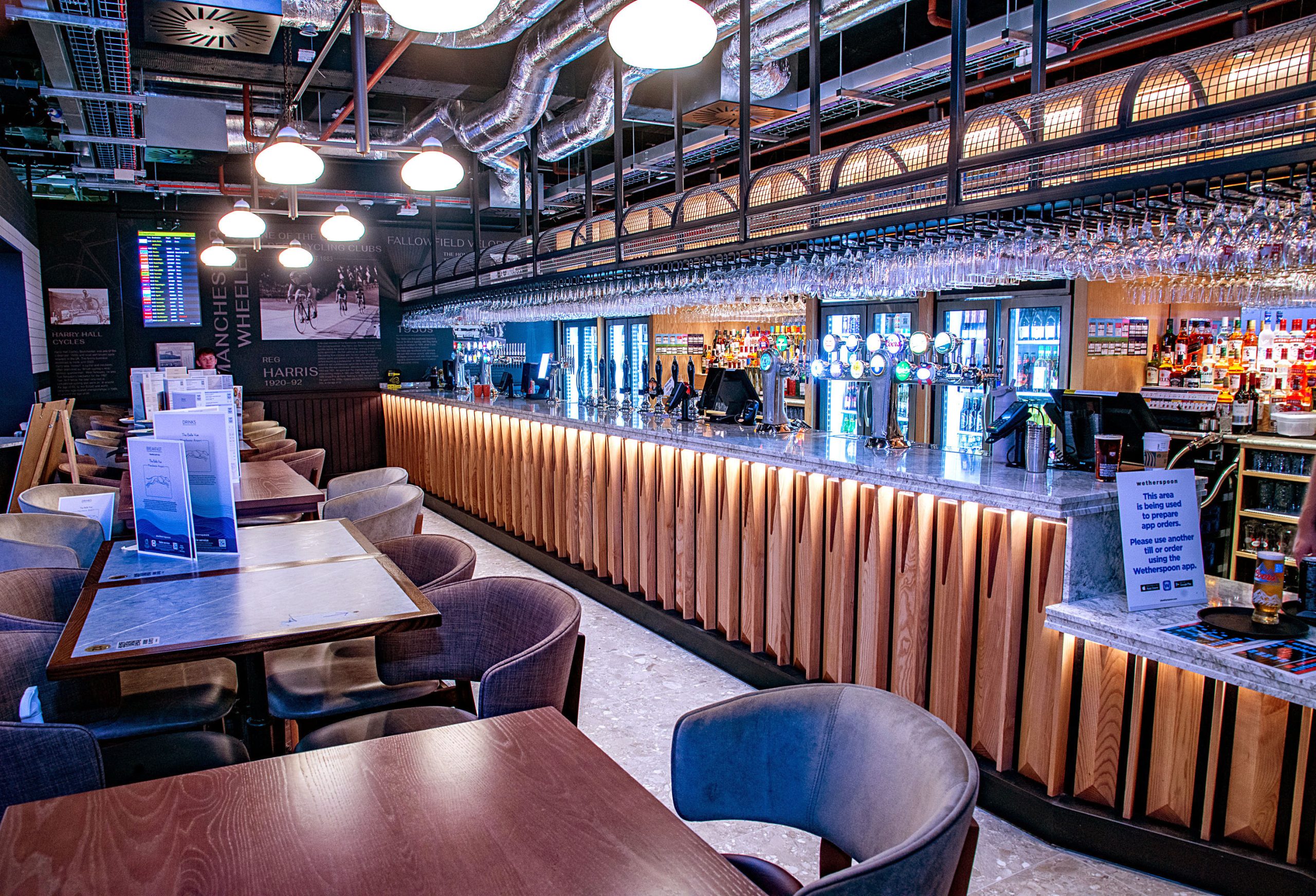
It’s official… Manchester Airport’s first-ever JD Wetherspoon pub has officially opened its doors inside Terminal 2.
The 300-seater pub – which welcomed its first customers earlier this week – is named The Belle Vue after Manchester’s historic showground.
Throughout the pub, you’ll spot design features that nod to the city’s sporting heritage – including vintage event posters and memorabilia, a ‘locker wall’ hosting trophies and other sporting exhibits, and a cricket-themed design in the carpets and bar panels.
Creating around 150 jobs in the process, The Belle Vue is the final planned new eatery to open in the airport’s redeveloped Terminal 2, marking one of the final steps in the super-terminal’s decade-long, £1.5bn transformation.
Manchester Airport’s first-ever Wetherspoons pub has opened inside Terminal 2 / Credit: Supplied
According to the MEN, pints are priced from £6.20 for Carling and Coors lager, £6.45 for Budweiser, £6.60 for Guinness, and £6.70 for Poretti and 1664 Biere.
Prosecco is £9.20 for 175ml glass and £37.10 for the full bottle, while spirts and mixers are £6.80 for singles and £10.20 for doubles.
There’s also the classic Wetherspoons tea and coffee machines, where you can refill as many times as you like for just £3.60.
“It’s a proud moment to see the final new retail unit opening in our new-look Terminal 2,” commented Richard Jackson, who is the Retail Director at Manchester Airport.
“To be rounding off this 10-year programme by adding such an iconic name as Wetherspoon to the terminal is particularly special and we know that it will prove extremely popular with passengers. We think they’ll love the nods to Manchester’s heritage in the décor and design – and of course the name.”
The Belle Vue will be open from the first flight to the final flight each day, and food will be served from opening until 10pm.
Featured Image – Supplied
Travel & Tourism
Etihad Stadium showcases City Hall, the new beating heart of Manchester City match days
Lonnie Bowes
There’s a particular kind of Manchester buzz you only get pitch-side. If you’re a seasoned Cityzen this one’s for you – one of three major new hospitality options for your next game day at the Etihad Stadium.
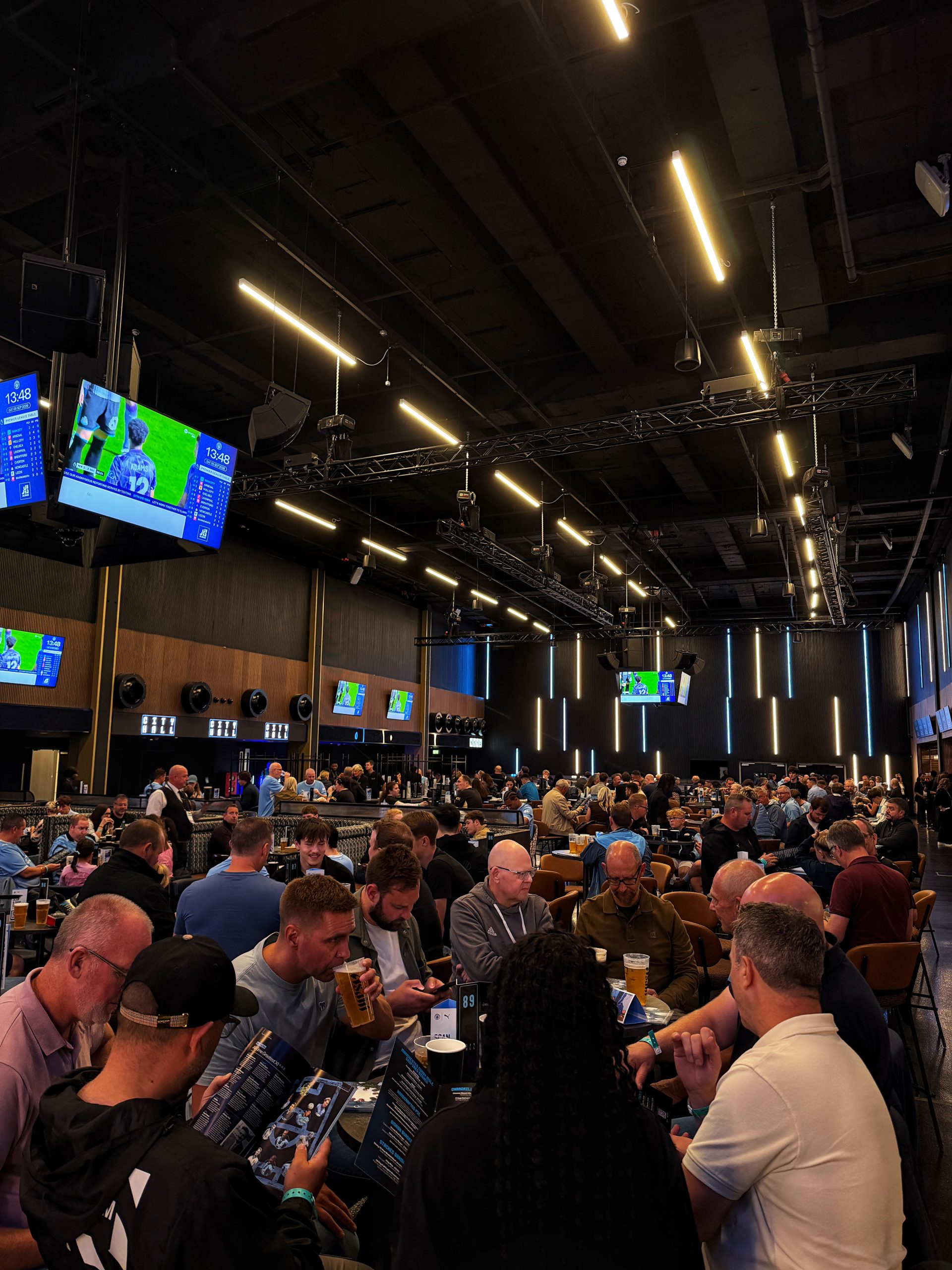
Tucked in the heart of the new Pep Guardiola Stand, directly behind the goal, we have the brand-new City Hall.
City Hall is built for people who actually want to watch football in comfort, and with a massive 500 capacity hall a stone’s throw from the pitch, it’s a hard one to pass up.
Doors open a full two hours before the match, and that early access turns the day into an occasion rather than a scramble.
There’s time to properly soak up the atmosphere in what is a genuinely lively, buzzing bar, and I have to say potentially one of the best I’ve come across on a match day.
Food and drink are where the local flavour really comes through. The street food menu leans into Manchester’s own identity with a modern twist.
The catering is relaxed and doesn’t take itself too seriously, let’s just say having a chip barm and chicken madras pie on the run-up to a kick-off is my idea of heaven.
Every guest gets an inclusive drink as part of your booking, too. You get to pick from a selected wine, beer or soft drink which you can claim at any point during your visit.
It’s a setup that suits everyone, whether you’re in it for a proper pre-match pint with your mates or meal with your family before a day of making pitch side memories.
The little touches matter too. A matchday programme is a nice, old-school addition in an era where so much matchday content has gone digital.
And crucially, the experience doesn’t end at the final whistle: with an hour’s access after the match, there’s no need to bolt for the exits the second the referee blows for full-time. You can sit and finish your drink, and let the ground empty out around you instead of fighting through it.
Put it all together and City Hall feels like hospitality done with an actual sense of place.
Manchester street food, a proper buzzing bar, and one of the best seats in the house, all wrapped around a schedule that respects the fact that match day is about more than just the 90 minutes.
For anyone looking to upgrade how they watch City this season, it’s well worth a look.
Have a look and make a booking at City Hall at the Etihad Stadium HERE.

 Emily Sergeant -
4th June 2024
Emily Sergeant -
4th June 2024