An amber health warning has been issued for the North West and other regions as temperatures continue to drop across the country.
Having already provided an update on the “possibility of snow” and the imminent cold snap earlier this week, the Met Office and UK Health Security Agency (UKHSA) have now added a heat-health warning to their forecast for the new few days as things get increasingly colder across Great Britain.
With temperatures expected to reach as low as -5C by Friday, 29 November, the Met Office and UKHSA pushed out an amber heat-health alert on Wednesday, with the elderly, clinically vulnerable and the health sector in general said to be those most at risk.
Although the freezing weather obviously has the potential to affect everyone — with the likes of the North East and Northern Ireland having already been given a yellow weather warning as well — amber heat-health warnings are deemed to require an ‘enhanced response‘ as they are likely to significantly impact “across the whole health service” and possibly other sectors too.
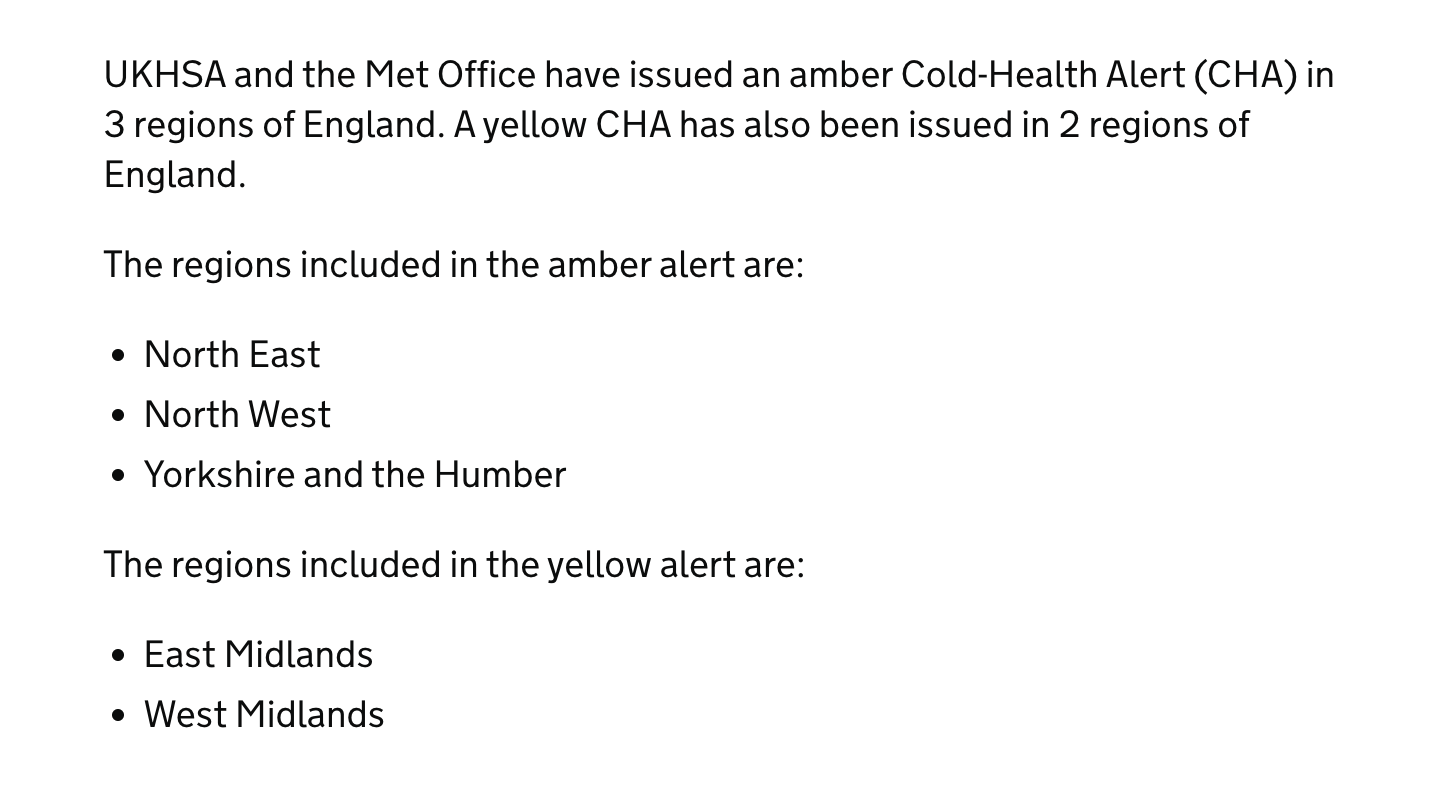
The current heat-health alerts that have been issued for the UK. (Credit: gov.uk)
Under the relatively new CHA (cold-health alert) system, anything beyond a yellow level alert means that it is expected that there will be increased use of healthcare services by vulnerable populations and an increase in risk to health to individuals over the age of 65, those with pre-existing health conditions, including respiratory and cardiovascular diseases and other vulnerable groups like rough sleepers.
ADVERTISEMENT
As well as the Met Office offering their verdict, the UKHSA’s Head of Extreme Events and Health Protection, Dr Agostinho Sousa, said: “With a risk of widespread overnight frosts and some snow across the country this week, it’s important to check in on the wellbeing of those most vulnerable to the cold.
“Cold weather can have a serious impact on health, particularly older people, and those with pre-existing health conditions, as it increases the risks of heart attacks, strokes and chest infections.
ADVERTISEMENT
“If you have a pre-existing medical condition or are over the age of 65, it is important to try and heat the rooms where you spend most of your time in[doors], such as your living room or bedroom.”
For those considered to be at risk during this cold snap and amber-heat health warning, the official government-sanctioned advice is that if you can’t heat all the rooms in your home, it is important to heat the rooms you spend the (i.e. living room in the day and bedroom before going to sleep) to at least 18 degrees if possible.
They also recommend wearing a few thin layers instead of one thick layer, as the former is better at trapping heat than just one big jumper etc.
ADVERTISEMENT
Other advice on how to stay safe during these colder periods includes stocking up on food and medicine, keeping windows closed and reducing draughts at home, as well as getting vaccinated against flu and COVID-19.
If you or someone you know is in need of help, you can get in touch with the NHS on 111 and if it is an emergency please call 999 immediately.
Even more of the Gay Village will be turned into outdoor seating this summer
Daisy Jackson
The Gay Village is set to get even more outdoor seating this summer, with the council moving to partially close several key streets to traffic.
The news lands mid-heatwave when thousands of Mancs are clamouring for a seat in the nearest beer garden or cafe terrace – with a huge proportion of those flocking to Canal Street.
Now, plans have been revealed to bring ‘a touch of cafe culture’ to the Gay Village, with even more outdoor seating space created for businesses in the area.
Initially running as a trial this summer, it will mean new terraces for New York New York, The Goose and The Eagle on Bloom Street, plus more locations on Richmond Street.
Manchester City Council has said that similar schemes on Thomas Street and Stevenson Square have been hugely popular with both punters and businesses, especially during the summer months, and can give local operators a huge boost.
So now it’s time for this thriving corner of the city to get the same treatment, as part of the ongoing work through the Gay Village Action Plan identified the need for more outdoor seating areas.
The two locations which will have the changes will be Bloom Street, between Abingdon Street and Chorlton Street; and Richmond Street, between Sackville Street and Chorlton Street.
In order to put these protected spaces into effect, some changes to the existing road network will be made:
Bloom Street becomes one-way from Chorlton Street towards Princess Street
Richmond Street is closed to through traffic between Chorlton Street and Sackville Street.
The scheme will initially run on a trial basis from 10 July throughout the summer to evaluate if it could be a viable long-term solution.
During this, plans will also be in place to ensure that deliveries and loading can go about unhindered, as well as daily waste collection and access for residents.
Councillor Mandie Shilton Godwin, Executive Member for Clean Air, Environment and Transport, said: “The Gay Village is one of our most precious communities. For decades the queer community has been able to call this neighbourhood its own, establishing a long and proud place in the history of the fight against bigotry and discrimination.
“Needless to say, it’s one of the most-visited places in Manchester and sees thousands of people tread its cobbled streets every year. Because of that we’re always looking at how we, as its custodians, can continue to support its legacy and ensure that it meets the needs of people who live and work there.
“We’re excited to be trialling additional outdoor seating for these streets, and we hope to bring the same success that we’ve seen in the Northern Quarter after putting similar schemes in place.
“But, above all this has to work for everyone, so I would urge people to take part in this consultation and help shape the future of the Gay Village.”
Fire service urges Greater Manchester public to ‘act responsibly’ as heatwave continues
Emily Sergeant
People across Greater Manchester and beyond are being urged by the fire service to ‘act responsibly’ as the heatwave continues this week.
Greater Manchester Fire and Rescue Service (GMFRS) has issued an urgent plea residents and visitors to take extra care on moorland and in rural areas as part of the annual ‘Be Moor Aware’ campaign – which is aimed at preventing wildfires and reducing the impact they have.
GMFRS has issued the plea alongside its partners at United Utilities, the Royal Society for the Protection of Birds (RSPB), neighbouring fire and rescue services, and local councils.
It comes as Amber Extreme Heat warnings and heat-health alerts have been issued by the Met Office and the UK Health Security Agency (UKHSA) through to Thursday this week – with temperatures widely exceeding 35°C nationwide, and in some areas – particularly on the south coast – potentially even reaching 38°C.
Heatwave conditions in the UK are met when a location records a period of at least three consecutive days with temperature values meeting or exceeding the heatwave temperature threshold for that location.
The fire service urges the Greater Manchester public to ‘act responsibly’ as the heatwave continues / Credit: Mick Garrett (via Geograph)
It does seem, however, that northern parts of the country – especially the North West – are missing most of the extremely hot conditions, with current forecasts indicating peak temperatures of 33°C.
But this doesn’t stop the wildfire risk, and the fire service is warning that prolonged periods of dryness but the countryside in danger.
GMFRS data shows there have been 83 wildfires across Greater Manchester since 2021, including a significant rise in 2025, when 38 incidents were record, and there has already been six wildfires recorded in 2026.
“Wildfires can spread rapidly, especially during warm and dry weather, putting lives, wildlife and property at risk,” explained GMFRS Wildfire Lead, Adrian Taylor.
“Many of these fires are preventable, and we’re asking everyone to take responsibility when visiting our moorland areas. Small actions, such as not using disposable barbecues and taking litter home, can make a huge difference in preventing devastating fires.”