The UK’s best and worst airlines for customer service over the past year have been revealed in a new Which? survey.
It’s peak holiday season for millions of Brits nationwide at the moment, with August having just arrived and schools across the country now out for the summer, so it stands to reason that more people will be hopping on a plane in search of some sunshine than usual, and with that, airlines will have a lot more customers to keep satisfied.
But which airlines are considered to be the ‘worst’ when it comes to customer service?
Well, in a bid to get to the bottom of this, Which? decided to run one of its annual surveys to see “where customer service is going wrong” – and, on the flip side, where it’s going right – and find out who the worst offenders are.
The leading consumer group asked more than 1,000 adult passengers who had travelled with and contacted a major UK airline in the last year about their experiences of customer service, and asked them a series of questions to answer with ratings based on how satisfied or dissatisfied they were with that experience.
ADVERTISEMENT
Which? also used undercover researchers posing as customers to contact some of the UK’s most popular airlines, as well as those that previously rated poorly for customer service or rated poorly overall in its recent surveys, during the busy Easter break earlier this year.
British Airways, easyJet, Jet2, KLM, Tui, Ryanair, Vueling, and Wizz Air were the airlines contacted.
ADVERTISEMENT
Unfortunately, it was Wizz Air that claimed the not-so-coveted top spot on the 2024 list, with fellow budget airline Ryanair following close behind in second.
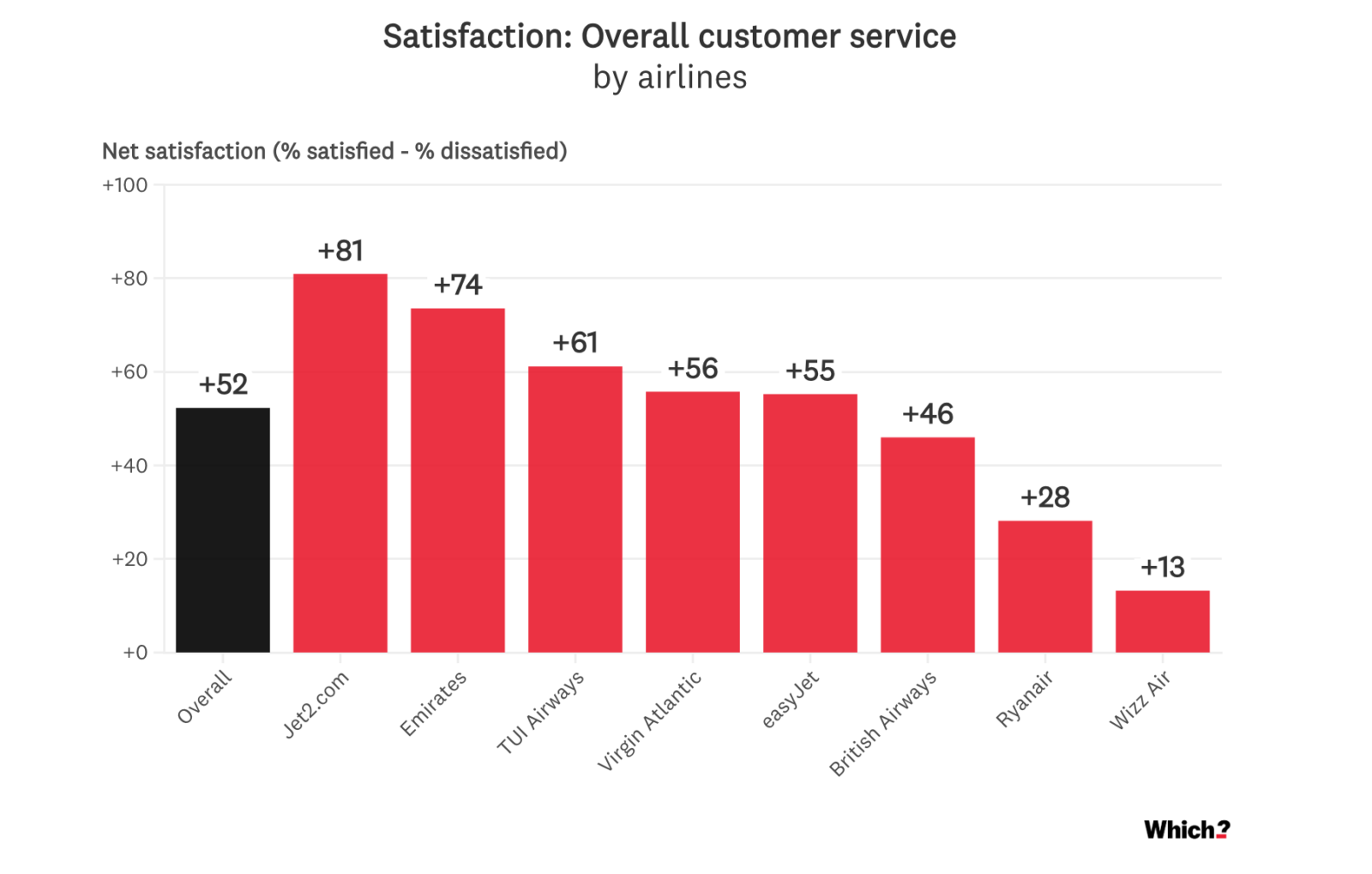
A table of results showing the UK’s worst airlines for ‘overall customer service’ in 2024 / Credit: Which?
Wizz Air received the lowest scores with only +13 satisfaction rating for ‘overall customer service’, which is 39 points behind the sector average of +52, while Ryanair also performed poorly and sits at nearly half the sector average with a mere +28.
British Airways was the only other airline to perform below average for ‘overall customer service’, sitting third-from-bottom of the table with a score of +46, which is 6 points below the average.
ADVERTISEMENT
While Which? says its latest survey findings go some way to suggesting there may be some underlying issues affecting airlines’ customer service that needs to be addressed, and that improving these should be a “priority to regain customer trust and satisfaction” for the airlines found to be the worst offender, it’s not all doom and gloom.
That’s because, on the positive side, Jet2 achieved the highest satisfaction scores across nearly all categories – including ‘overall customer service’.
The only exception for Jet2 was the question ‘how well my issue/query was resolved’, where Emirates instead claimed the top spot here, with a rating of +81.
Drinks prices revealed as Manchester Airport’s first-ever Wetherspoons pub opens inside T2
Emily Sergeant
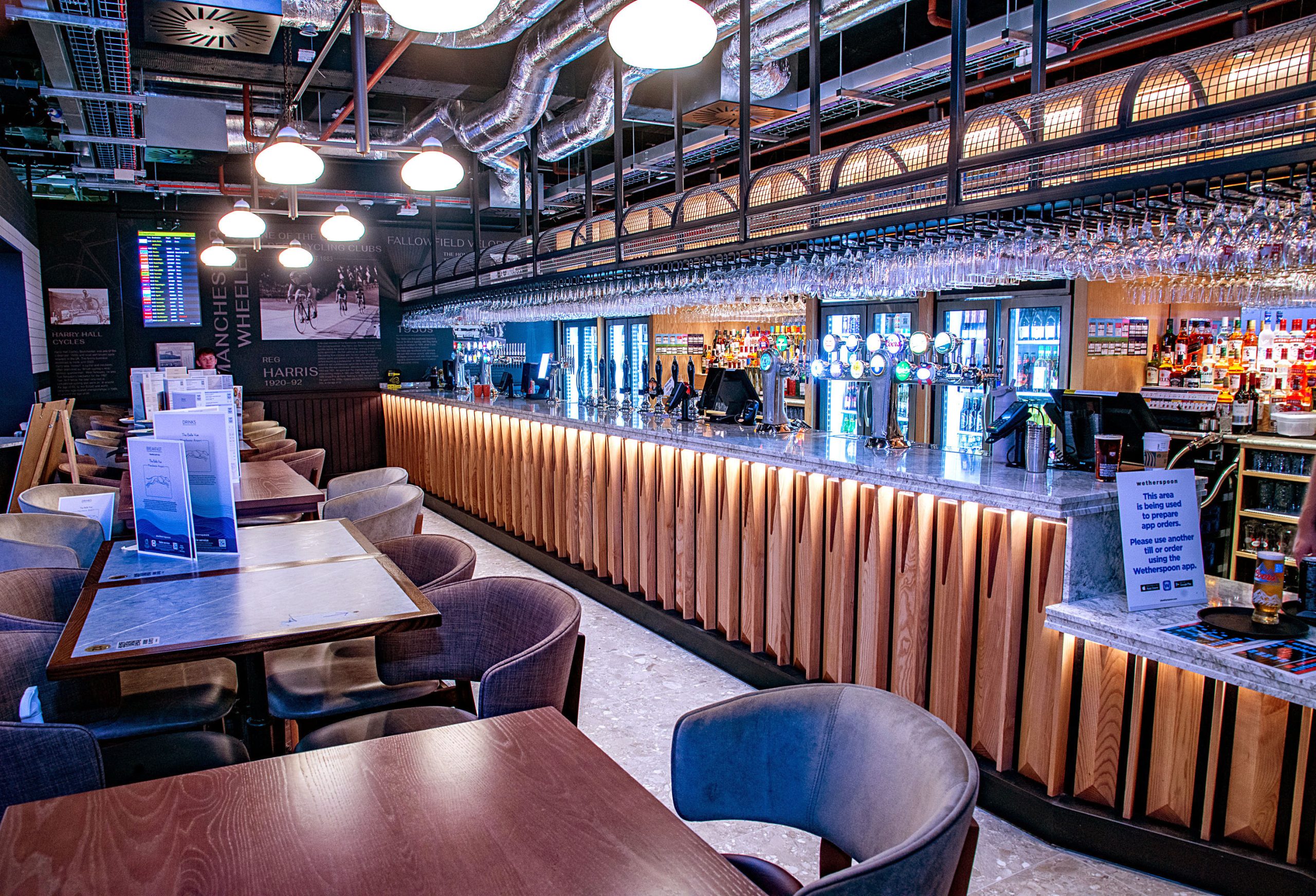
It’s official… Manchester Airport’s first-ever JD Wetherspoon pub has officially opened its doors inside Terminal 2.
The 300-seater pub – which welcomed its first customers earlier this week – is named The Belle Vue after Manchester’s historic showground.
Throughout the pub, you’ll spot design features that nod to the city’s sporting heritage – including vintage event posters and memorabilia, a ‘locker wall’ hosting trophies and other sporting exhibits, and a cricket-themed design in the carpets and bar panels.
Creating around 150 jobs in the process, The Belle Vue is the final planned new eatery to open in the airport’s redeveloped Terminal 2, marking one of the final steps in the super-terminal’s decade-long, £1.5bn transformation.
Manchester Airport’s first-ever Wetherspoons pub has opened inside Terminal 2 / Credit: Supplied
According to the MEN, pints are priced from £6.20 for Carling and Coors lager, £6.45 for Budweiser, £6.60 for Guinness, and £6.70 for Poretti and 1664 Biere.
Prosecco is £9.20 for 175ml glass and £37.10 for the full bottle, while spirts and mixers are £6.80 for singles and £10.20 for doubles.
There’s also the classic Wetherspoons tea and coffee machines, where you can refill as many times as you like for just £3.60.
“It’s a proud moment to see the final new retail unit opening in our new-look Terminal 2,” commented Richard Jackson, who is the Retail Director at Manchester Airport.
“To be rounding off this 10-year programme by adding such an iconic name as Wetherspoon to the terminal is particularly special and we know that it will prove extremely popular with passengers. We think they’ll love the nods to Manchester’s heritage in the décor and design – and of course the name.”
The Belle Vue will be open from the first flight to the final flight each day, and food will be served from opening until 10pm.
Featured Image – Supplied
Travel & Tourism
Etihad Stadium showcases City Hall, the new beating heart of Manchester City match days
Lonnie Bowes
There’s a particular kind of Manchester buzz you only get pitch-side. If you’re a seasoned Cityzen this one’s for you – one of three major new hospitality options for your next game day at the Etihad Stadium.
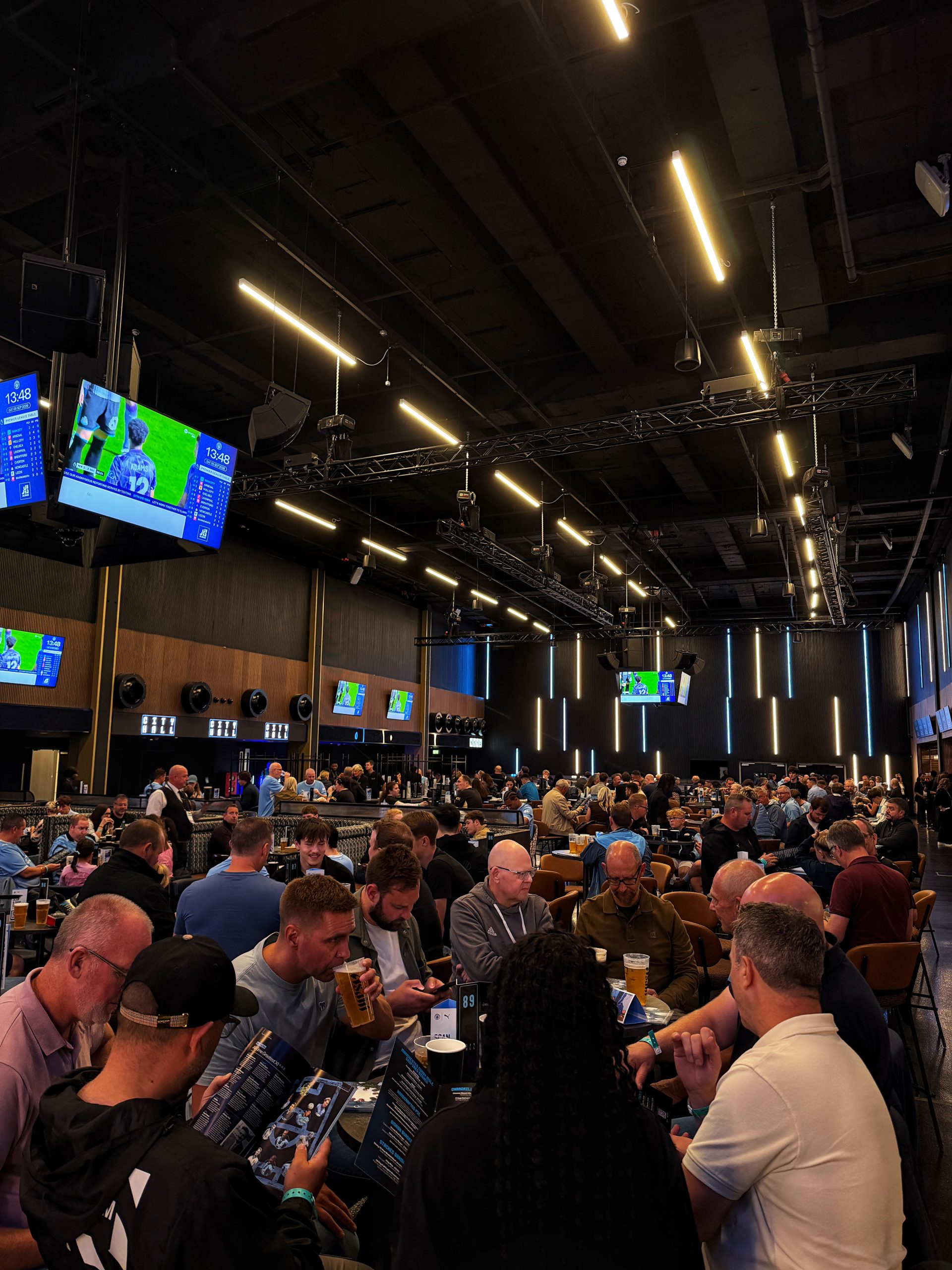
Tucked in the heart of the new Pep Guardiola Stand, directly behind the goal, we have the brand-new City Hall.
City Hall is built for people who actually want to watch football in comfort, and with a massive 500 capacity hall a stone’s throw from the pitch, it’s a hard one to pass up.
Doors open a full two hours before the match, and that early access turns the day into an occasion rather than a scramble.
There’s time to properly soak up the atmosphere in what is a genuinely lively, buzzing bar, and I have to say potentially one of the best I’ve come across on a match day.
Food and drink are where the local flavour really comes through. The street food menu leans into Manchester’s own identity with a modern twist.
The catering is relaxed and doesn’t take itself too seriously, let’s just say having a chip barm and chicken madras pie on the run-up to a kick-off is my idea of heaven.
Every guest gets an inclusive drink as part of your booking, too. You get to pick from a selected wine, beer or soft drink which you can claim at any point during your visit.
It’s a setup that suits everyone, whether you’re in it for a proper pre-match pint with your mates or meal with your family before a day of making pitch side memories.
The little touches matter too. A matchday programme is a nice, old-school addition in an era where so much matchday content has gone digital.
And crucially, the experience doesn’t end at the final whistle: with an hour’s access after the match, there’s no need to bolt for the exits the second the referee blows for full-time. You can sit and finish your drink, and let the ground empty out around you instead of fighting through it.
Put it all together and City Hall feels like hospitality done with an actual sense of place.
Manchester street food, a proper buzzing bar, and one of the best seats in the house, all wrapped around a schedule that respects the fact that match day is about more than just the 90 minutes.
For anyone looking to upgrade how they watch City this season, it’s well worth a look.
Have a look and make a booking at City Hall at the Etihad Stadium HERE.

 Emily Sergeant -
1st August 2024
Emily Sergeant -
1st August 2024