Manchester United Football Club suffered its biggest share price drop this week after rumours that the business was no longer for sale began circulating – with more than £600 million wiped off their market value.Yikes.
After a number of reports over the weekend suggested that the much-maligned Glazer family are now set to take the club off the market after months of takeover talk that now looks to have stalled, Man United‘s share price closed at $23.66 on Friday and dropped to as low as $18.83 on Tuesday.
With the final figure on 5 September closing at $19.35, this was the biggest dip the club has ever seen (18.22%) in a single day since it became a publicly traded company back in 2012, breaking the previous record of a 13.8% drop set just a few years back on March 12, 2020, during the pandemic.
Speaking to Sky Sports, football finance expert Kieran Maguire explained exactly how the share price plummeted, stating that a lot of the club’s market value prior to the drop was actually being “propped up to a degree by speculators who thought there would be a full sale”.
As Maguire goes on to detail, many of those invested in the club would have been hoping to sell off their shares Man United shares for “between $27-30” once a potential buyout was complete but since there has been little movement on the long drawn out takeover, many simply decided to offload them now.
ADVERTISEMENT
The Price of Football podcast host also argued that the Glazers’ supposed second thoughts over selling United might have come not only from their two lead bidders — Sheikh Jassim and Sir Jim Ratcliffe — failing to meet their valuation but from seeing others like Barcelona just “selling off slices” of their club.
He also added that there is a confident assumption that TV rights deals will increase next year as they so often do and that new technologies like AI and VR could allow for “new ways to deliver content to Man United’s global fan base”.
ADVERTISEMENT
While we’re on the subject of digital technologies, these reports come in light of the suggestion the club’s media team and hierarchy are already editing out ‘Glazers Out‘ chants and their numerous offensive lyrics.
Are Manchester United editing out the Glazer protest chants from their footage?
Various times when ‘we want Glazers out’ has mysteriously disappeared on United’s social media.
United issued a statement updating fans on the ongoing Antony situation on Wednesday 6 September, confirming that they are now looking into the matter alongside the investigation being carried out by Greater Manchester Police and Brazilian authorities, adding that they will be making “no further comments”.
ADVERTISEMENT
Despite insisting that they are considering the impact these claims will have on “survivors of abuse”, it is now being reported that the club have so far “resisted calls from domestic abuse charities” to suspend the 23-year-old.
Man City release statement after being found guilty of all charges related to Premier League’s financial rules
Emily Sergeant
Manchester City has finally broken its silence after being found guilty all of its charges related to the Premier League’s financial rules.
Yesterday, the Premier League released a formal statement confirming that an independent Commission had found Manchester City guilty of all charges related to serious breaches of the Premier League’s financial rules over a nine-season period.
On top of that, the club was also found guilty of the majority of charges in relation to its failure to co-operate with the League’s investigation.
According to the Premier League, the independent Commission found that Manchester City had arranged so-called ‘sham’ commercial deals with a number of its sponsors during the nine-season period – which were part of a disguised funding scheme, with those sponsors only required to pay a portion of the relevant sponsorship fees.
The remainder was then funded by Abu Dhabi United Group Investment & Development Ltd (ADUG), which owned the club.
The Commission also concluded, as quoted by the Premier League, that the club had ‘made concerted efforts to stop and frustrate the Premier League investigation’.
Following this report being published yesterday, Manchester City has now finally released a statement of its own, breaking its silence on the topic for the first time since the news broke last Friday.
The statement reads in full: “Manchester City FC is both disappointed and surprised by the opinion of the Premier League Commission, that has been published today.
“The Club is innocent of the accusations made by the Premier League and a comprehensive body of irrefutable evidence exists in support of all of its positions, relating to this case. The Club will therefore be relentless, and where necessary proactive, in any and all appropriate regulatory and legal forums.
“The Premier League process remains ongoing, with significant elements uncompleted. Manchester City FC will now pursue the appeal avenues open to it, on the basis that the opinion contains clear material errors, of law, principle and fact, and is unsafe.
“The Club has diligently respected due process for eight years on the basis that the Premier League Board and Executive would behave as an independent, impartial and fair-minded regulator, free from partisan influence.
“The Club is obviously restricted in what it can say further until all future proceedings are complete.”
Featured Image – The Manc Group
News
Scheme approved and date set for work to begin on Piccadilly Gardens transformation
Emily Sergeant
The long-awaited Piccadilly Gardens transformation is a go.
It’s official – planners have given the green light for the scheme to transform Piccadilly Gardens, with Manchester City Council having received no objections to the proposals which meant that officials were able to approve the full planning application without it needing to be considered at next month’s Planning Committee.
The decision means that preparation works can continue at pace, ready for the main works due to get underway this autumn.
In case you aren’t up to date with the Piccadilly Gardens transformation plans, the idea is, in a nutshell, to put the ‘Gardens’ back in Piccadilly Gardens.
But what exactly does this mean?
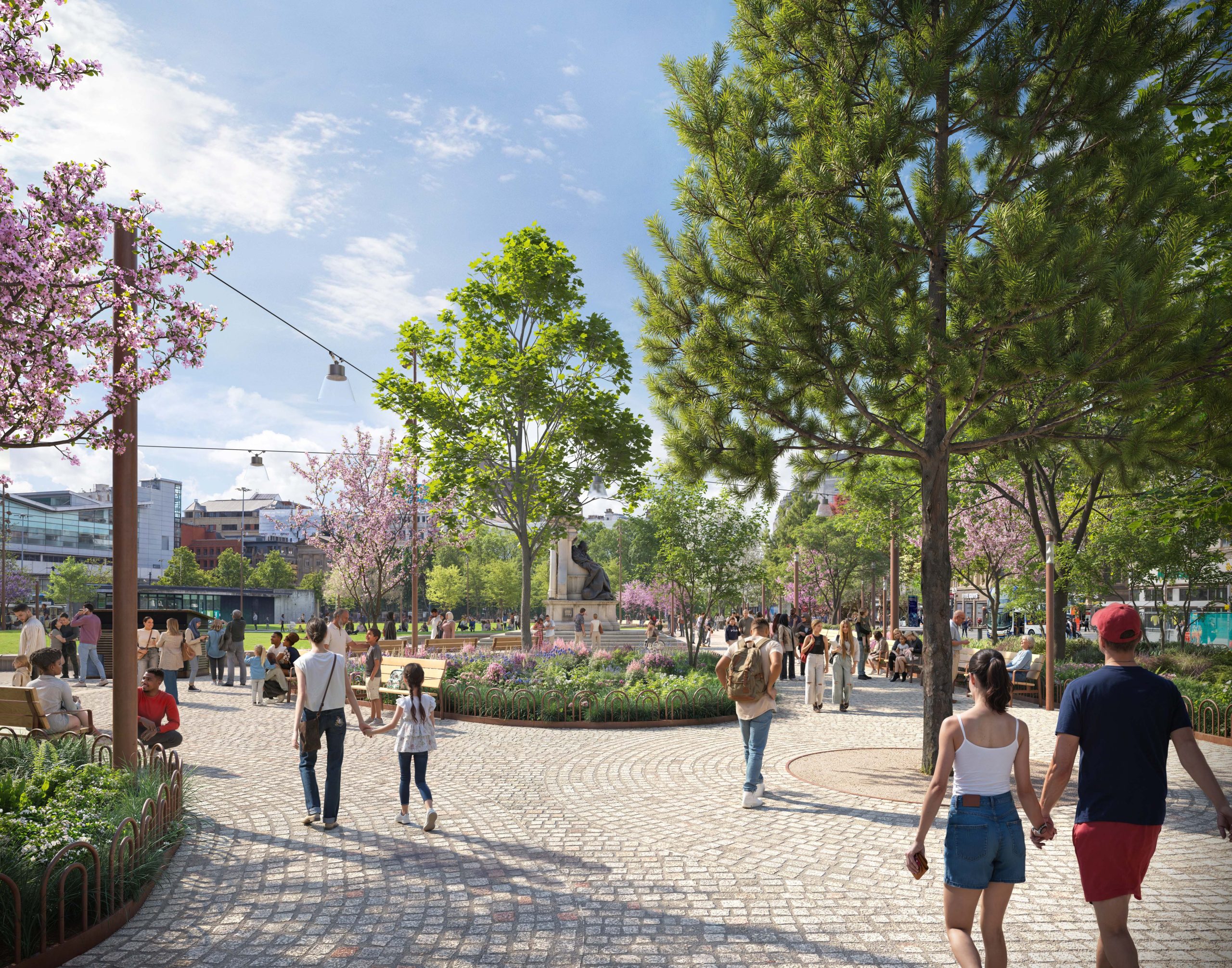
Well, the approved plans show a vision for more green space – including lawns, trees, planting, seating, and colourful horticultural displays – with the temperamental fountains being removed for good and replaced with a new space called The Pavilion that will host family-friendly events.
Date set for work to begin on Piccadilly Gardens transformation / Credit: Supplied
The low concrete walls and raised planters at the edge of the gardens will be ripped out, improving the setting of the Queen Victoria statue.
An there’ll be a new, larger playground for younger children, created in the same high-quality style as the new parks at Mayfield Park and Ancoats Green.
The plan is to also make the space ‘safer’ overall, through improved sightlines, better lighting, and enhanced CCTV.
The Council and its partners say they are ‘clear’ that delivering a ‘better’ Piccadilly Gardens cannot just be about physical improvements, but it also requires improvements to how the area is managed and maintained.
We're putting the Gardens back into Piccadilly Gardens
The major regeneration plan to transform the square has now been approved by planners.
This means we can start work this autumn to make the Gardens more colourful, vibrant and safer for residents and visitors. pic.twitter.com/5Ayv2k9SRw
This process is said to have already started, primarily with a strengthened police presence, but a new management model is also being developed to ensure that improvements are sustained.
“Securing planning permission means that before this year is out, we can get started properly on work to transform the space and have it finished and ready for the public to use next year,” explained Councillor Garry Bridges, who is the Leader of Manchester City Council.
“Piccadilly Gardens has huge potential to be a real asset to the city and its people. We know it hasn’t been good enough – but that’s about to change.”

 Danny Jones -
6th September 2023
Danny Jones -
6th September 2023