Our Manc of the Month series is back, but this time round, we wanted to do something a little bit different.
We all know that Manchester is home to plenty of special people, some born here and others drawn here, who have inspired and led us through tough times, so we decided to start a series that shines a light on those who should be celebrated.
Following on from our ‘The Mancs of the Year’ feature towards the end of 2020, Manc of the Month officially kicked off in July 2021 – with Marcus Rashford MBE, Manchester’s mural king Akse P-19, the local chef feeding the region’s vulnerable families Mary-Ellen McTague, and Manchester’s groundbreaking new Council leader Bev Craig among previous honourees.
In earlier editions, we had chosen to feature people who had an impact on our region in the recent weeks prior, but for this month, we want to cast our minds back and pay worthy tribute to an inspirational pair who are sadly no longer with us.
With International Women’s Day – a global holiday marked annually to commemorate the cultural, political, and socioeconomic achievements of women – coming up on Tuesday 8 March, and Manchester getting ready to celebrate the females who have made our city what it is today, we cannot think of a better time to remember the careers of a duo who not only changed the comedy landscape for women, but changed the game entirely.
ADVERTISEMENT
Victoria Wood and Caroline Aherne truly left their mark.
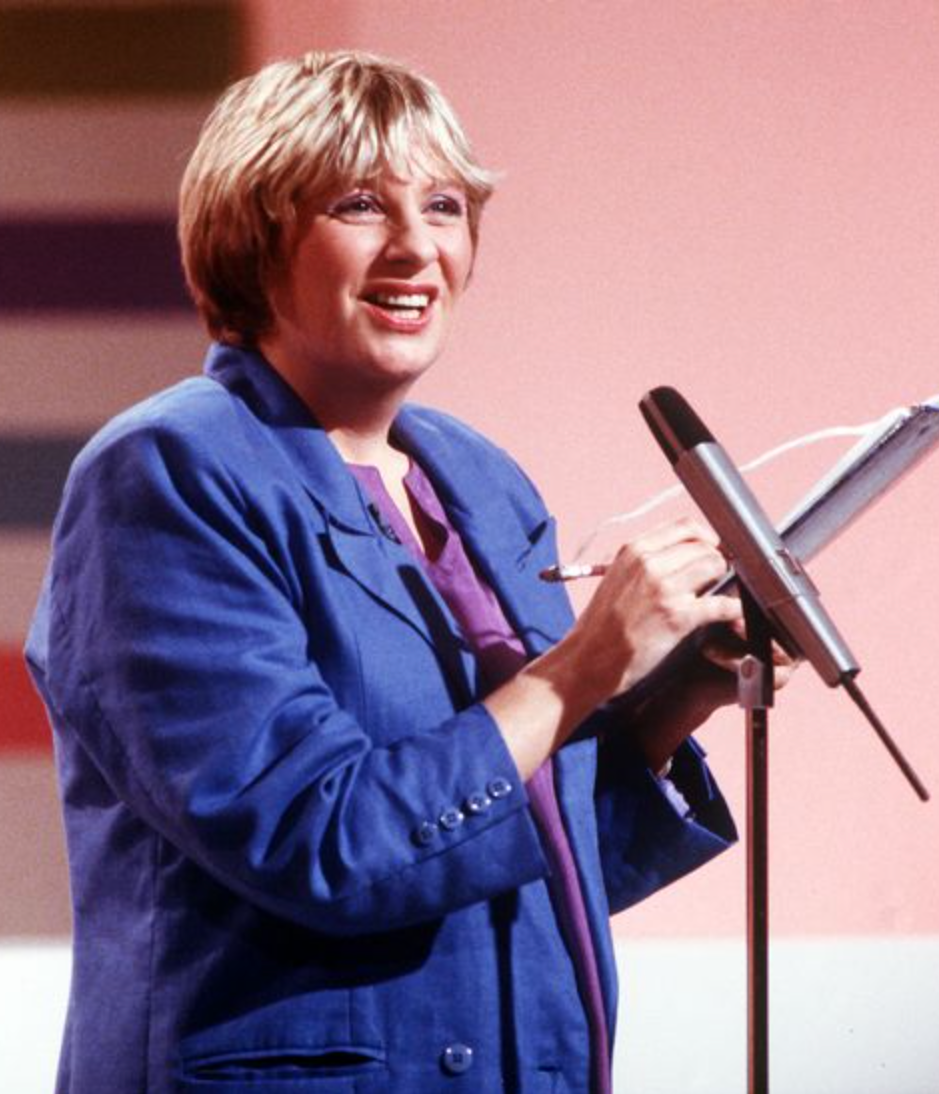
Victoria Wood: As Seen on TV and The Mrs Merton Show / Credit: BBC
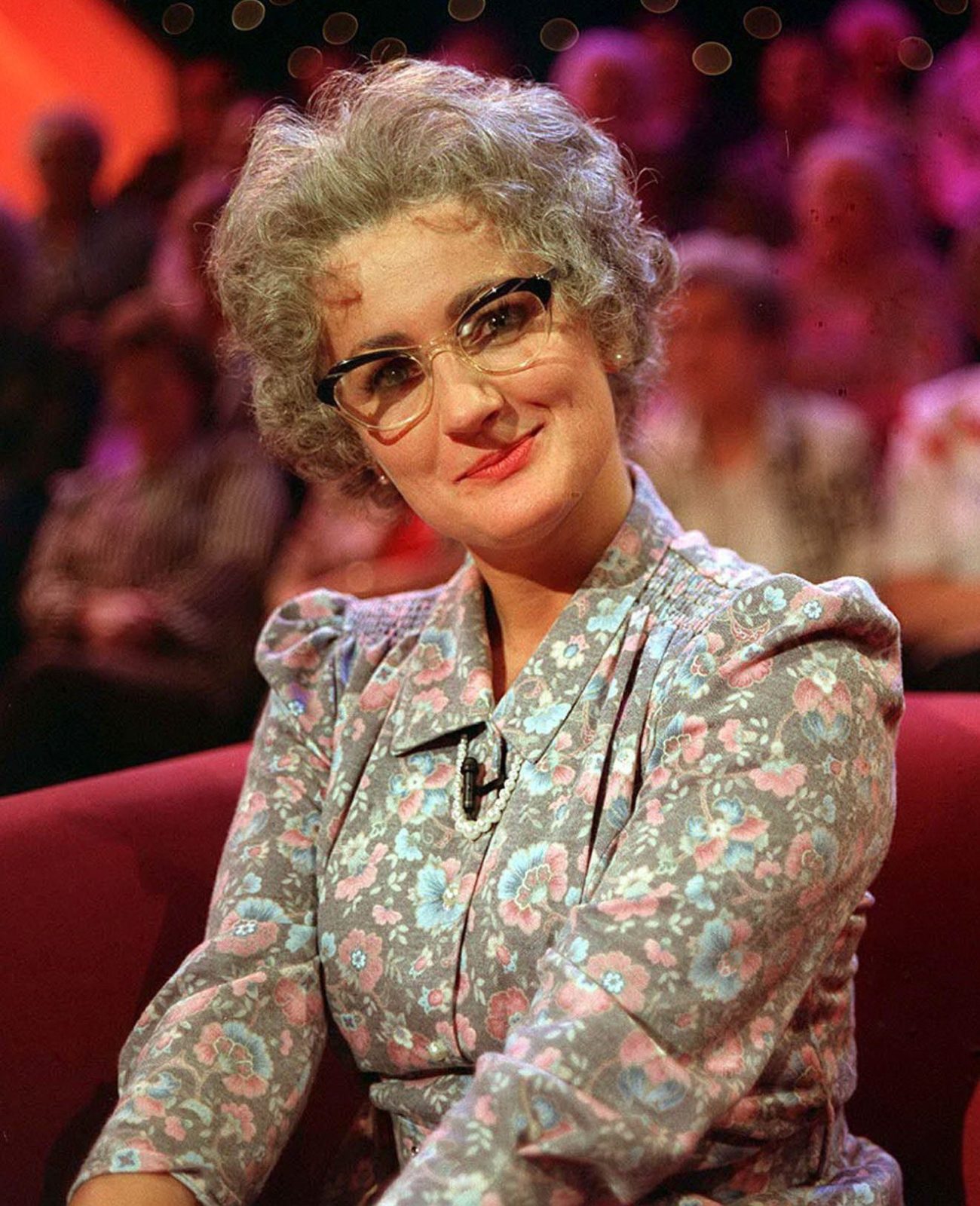
Although born in London to Irish parents, BAFTA award-winning actress, comedian, and writer Caroline Aherne moved to Manchester at the age of two, was raised in Wythenshawe, went to school in West Didsbury, and kick-started her illustrious career on the city’s comedy circuit by performing as a collection of characters, before developing the iconic ‘Mrs Merton’.
ADVERTISEMENT
Aherne developed her Mrs Merton character with Frank Sidebottom for his show on Piccadilly Radio, where she worked as a receptionist.
She made a number of television appearances as the hilarious character, before rising to prominence in 1994 with the mock chat show The Mrs Merton Show, where she was known for asking celebrity guests a series of outrageous fake questions – the most-memorable example being to the wife of magician Paul Daniels, Debbie McGee, asking: “So, what first attracted you to the millionaire Paul Daniels?”.
Aside from the Mrs Merton character, Aherne was known for appearing on BBC comedy sketch programme, The Fast Show, and then cemented her place in the heart of us Mancunians when she co-wrote and starred as Denise in beloved Manchester-based sitcom, The Royle Family – which ran for three series from 1998 to 2000, and was a largely stereotypical portrayal of working-class family life at the turn of the millennium, with almost all of the episodes taking place in the Royles’ telly-centric living room and showing the hilarious conversations they’d have.
ADVERTISEMENT
The Royle Family could not be a more perfect lasting legacy for Aherne, as it’s often included in the conversation when it comes to Britain’s best sitcoms, and was named in BFI’s 100 greatest British television programmes of all time.
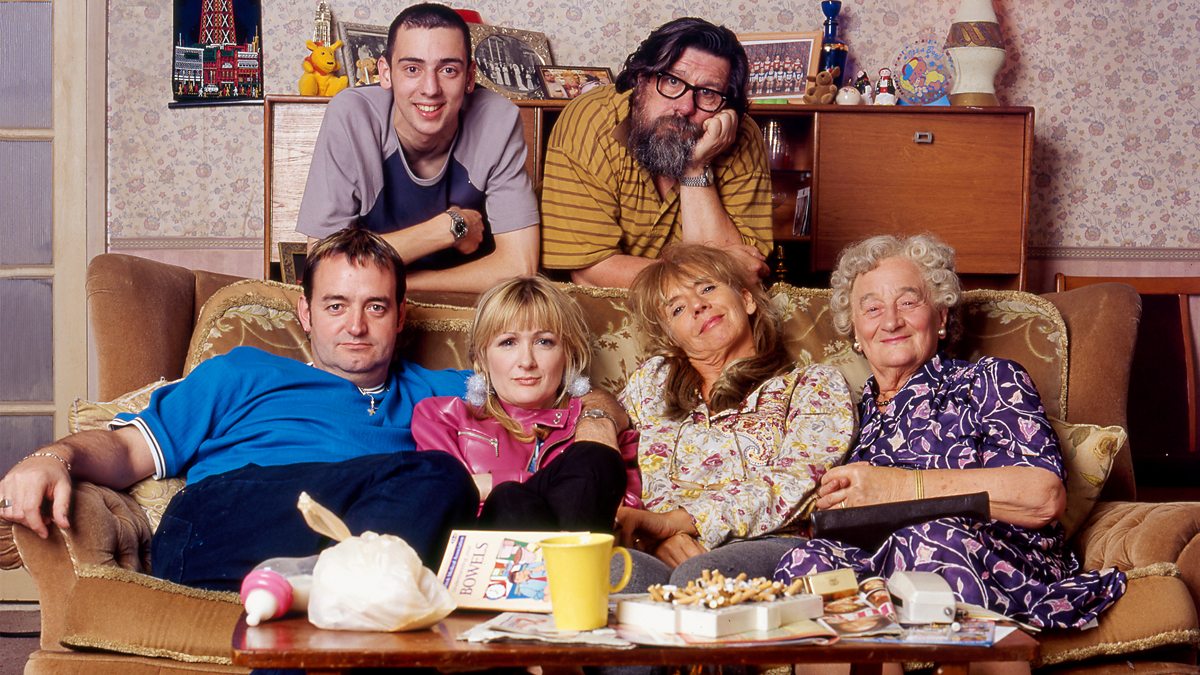
The Royle Family was co-written and starring Caroline Aherne / Credit: BBC
Known for having an instantly-recognisable voice, Aherne narrated the Channel 4 reality television series Gogglebox from its inception in 2013 up until her death in 2016.
She passed away from cancer on 2 July 2016 at her home in Timperley at the age of 52.
2016 was also the year that the world tragically lost the multi-talented Victoria Wood, who, just like Aherne, had a wealth of strings to her bow as a comedian, actress, lyricist, singer, composer, pianist, screenwriter, producer, and director.
Born in Prestwich, and raised and educated in the Greater Manchester borough of Bury, Victoria Wood was struggling with self-confidence, identity, and her place in the world when she discovered a love for performing after her father gifted her a piano for her 15th birthday and she joined the Rochdale Youth Theatre Workshop later that same year.
ADVERTISEMENT
Wood began her career in show business while she was undergraduate studying drama at The University of Birmingham in the 1970s.
Throughout her decorated and multi award-winning career that spanned over four decades, Wood wrote and starred in countless sketches, plays, musicals, films, and sitcoms, and she was particularly known for humour grounded in everyday life that included references to activities, attitudes, and products that are considered to be typically British, with eclectic live stand-up shows that were often interspersed with her own musical compositions that she performed at the piano.
Her very-own comedy variety sketch show, Victoria Wood: As Seen on TV, aired on the BBC from 1985 to 1987, undoubtedly making her a household name and paving the way for her to become a mainstay on our screens.
But if you ask Mancs what Wood’s career highlight is, most would point to the cult-classic sitcom, dinnerladies – which ran for two series from 1998 to 2000.
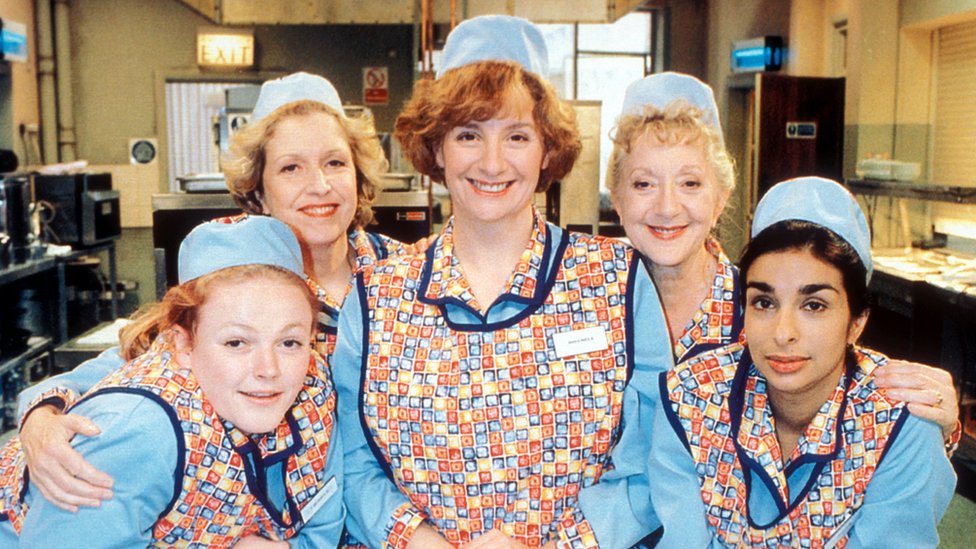
BBC sitcom dinnerladies ran for two series from 1998 to 2000 / Credit: BBC
Created, co-written, produced by, and starring Wood herself as Brenda “Bren” Furlong, dinnerladies is set entirely in the canteen of the fictional Manchester-based factory of HWD Components, features the caterers and regular customers as the show’s main characters, and was beloved for the fact that it depicted the lives, and social and romantic interactions of all of the staff.
ADVERTISEMENT
Victoria Wood also sadly died of cancer on 20 April 2016 at her London home, surrounded by her children and former husband.
Although we’ve done our best to take you through the lives of these two late local legends and give a worthy nod to everything they went onto achieve throughout their careers from humble beginnings, it’s almost impossible to truly sum-up the impact that Caroline Aherne and Victoria Wood had and quantify just what they mean to the people of our proud city.
Their talents will always live on, and Manchester will never forget our comedy heroines.
Featured Image – BBC
Feature
Beat-Herder Festival 2026 – the wonderfully weird festival we can’t stop coming back to
Emily Johnson
Another weekend done in the magical, mystical world that is Beat-Herder.
For one weekend every year, a farm in Clitheroe transforms into what the organisers describe as “a place full of beats and barminess” – and honestly, they couldn’t have summed it up any better.
Big enough to keep you discovering something new all weekend, yet small enough that you’ll keep bumping into the same friendly faces, Beat-Herder strikes the balance perfectly.
Every corner has something different going on, every stage has its own personality, and every sound system is absolutely dialled in.
Where else can you go for a swim, get a tattoo, pop into church, visit Paris and dance until sunrise? No, we’re not describing a chaotic stag-do… we’re talking about Beat-Herder.
Every stage deserves a mention, but a few really stood out this year.
Julie’s Barn, a.k.a. ‘Gay Paris’, remains one of the festival’s best-kept secrets. Hidden away in the woods, it’s worth every wrong turn trying to find it.
A glowing dancefloor, disco balls hanging from the trees and a crowd that somehow never seems to leave. We even stumbled across a secret ‘Samurai Breaks SSBB’ set that had the place bouncing all the way through until sunrise.
Credit: The Manc Group
Over at Stumblefunk At The Factory, Breakage delivered one of the sets of the weekend. The bass rattled the roof, the crowd never stopped moving, and the whole place felt like it was about to lift off.
It’s also home to one of Beat-Herder’s many weird little surprises, with hidden missions and the chance to spy on other festival-goers. If you know, you know.
The Garage is another annual favourite. DJs squeezed into the front seat of a car while everyone else danced on the bonnet of old scrapped cars, bouncing to the bass that rattled from White Noise Audio’s soundsystem. It’s those ridiculous little details that make this festival unlike anywhere else.
Then there’s Beat-Herder’s Got Talent, which has become a non-negotiable part of our weekend. The winner earns a slot on the main stage, so every act gives it everything. This year’s line-up featured everything from incredible harmonica performances and live bands to rap duos.
But one contestant completely stole the show.
She walked on stage, admitted she wasn’t sure her talent was quite as impressive as everyone else’s, and the crowd fell silent. No instrument. No backing track. You could hear a pin drop. What on earth was this contestant about to do? And then she proceeded to fit her entire fist in her mouth.
If that doesn’t sum up Beat-Herder, we’re not sure what does. The wonderful woman didn’t win the contest unfortunately, but let’s hope she can get booked for next year, ey?
One of this year’s new additions was The Dub Tub, which quickly became one of our favourite discoveries. Artists like Woody Cook swapped high-energy sets for slower, dub-inspired sessions, creating the perfect place to reset before diving back into the madness.
Oh, and of course, in true Beat-Herder fashion, the DJs were performing in a bathtub, of course.
And speaking of madness… all the classics are still there. The famous tunnel leading to hidden stages, the weird and wonderful walkabout performers, the random discoveries you’ll never find on a map, the hidden swimming pool, fancy dress costumes, and the constant feeling that you’re about to stumble across something completely unexpected.
Massive credit has to go to everyone behind the scenes. From the organisers to the volunteers and crew, everything runs incredibly smoothly, despite how wonderfully chaotic it all feels. Beat-Herder, you’ve done it again; roll on 2027.
Meet the team that reimagined The Horse and Jockey into a gastropub masterpiece
Lydia Mastrolonardo
The Horse and Jockey is a historic neighbourhood pub that has forever been a cornerstone in the heart of Chorlton, with its iconic Tudor exterior and outdoor seating looking out onto The Green.
Since the team behind the well-known and loved The Black Friar and Leo + Roobs in Salford, headed by Managing Director Neil Burke and Executive Chef Ben Chaplin, reopened the pub in October 2025, we have since seen some significant changes.
Positioning themselves as Chorlton’s first-ever proper gastropub, they’ve expertly balanced maintaining the pub’s character and restoring the cosy indoors while catering for Manc foodies, with an ever-evolving menu consisting of fresh local produce as well as a wide selection of Joseph Holt award-winning beers.
Credit: Bigger Boat Hospitality
We’re not the only ones who have noticed the hard work these two have put in – the transformation has led to the Horse and Jockey being crowned as one of the best local boozers at the Pub and Bar Awards.
Today, we had a chance to talk with Ben, who is the mastermind behind their delicious dishes and makes it all possible…
For anyone who doesn’t know you, give us a little bit of background on your career as a chef thus far?
“I started in the kitchen when I was 15 and worked my way up through different kitchens. Ended up working for Aiden Byrne, who remains the youngest person ever to achieve a Michelin star at 22. I worked for him for about nine years, ran one of his pubs for him and helped develop Manchester House.”
“I then went off and worked as head chef at Australasia for two years and 20 Stories for another three years before meeting Neil. Together we opened The Black Friar in 2021, Leo + Roobs in 2024, now the Horse and Jockey and are 100% looking for more venues.”
How would you sum up the Manc food scene at the minute?
“Very diverse. Within the industry side of it, it’s difficult with a lot going on with VAT and wages, but there are some great venues doing some great food even just in Chorlton alone, and there is a lot of choice – I actually think it rivals London.”
This has become a staple of their annual calendar of events. See more from this year’s edition HERE.
We already know you’ve worked wonders bringing The Black Friar back to life and taking it beyond just a pub – what lessons have you taken from that experience to the Horse and Jockey?
“I think not just the Horse and Jockey but one of our values as a company for Bigger Boat is we are ‘yes people.’ So trying new things and not just saying no to something because we don’t want to do it, saying yes first and trying to find a way to achieve it.”
“It’s something that we don’t just do here, but we do it at the cafe, The Black Friar, and we’re going to do it going forward, opening more and more places.”
If you could describe how the approach is different between the two venues, what would you say?
“The spaces in The Black Friar allow us to do a lot more events; we obviously have a bigger outdoor area, so that leads to us being able to sell different areas for different events. We don’t have that as much here, and this is more of a neighbourhood, local pub, serving gastro-style food.
“The Black Friar we can go from events to weddings pretty seamlessly – we do a lot more there as there’s space for it and even more to come.”
They’ve even started doing a picnic basket offer. (Credit: The Manc Eats)
What is your favourite dish on the menu?
“We change the menu so often here (the Horse and Jockey) following the seasons, often changing a dish a week. However, right now my favourite is probably our lamb rump with a red pepper and harissa hummus with a hazelnut and sesame seed dhukka.”
And if you could sum up the food in three words, what would they be?
“Evolving, tasty and bold.”
These two truly know what they’re doing with these restorations, and we can’t wait to experience what else they take over in the future.
Don’t believe us? Go on down and try it for yourself.
You can read our full review of the food and drink from when they first reopened the gorgeous suburban, village-style spot down below.