The University of Bolton has officially changed its name.
That’s right… after more than a year of deliberation, including opposition from other higher education institutions across the region, claiming it would be a cause of confusion for prospective students, Bolton‘s university has now successfully become the University of Greater Manchester in what has been described as a “historic” move.
The institution was given the go-ahead by the regulator, the Office for Students (OfS), to adopt the new name with immediate effect after submitting the change 17 months ago.
Current and past Students’ Union Presidents of the university, alongside its governors, unanimously supported the name change.
The name change was approved after an independent economic impact assessment report – which was commissioned by the university earlier this year – revealed that the benefit to the local economy would be millions of pounds per year.
With the name change coming ahead of the university’s 200th anniversary next year, this means that, as of 2025, all graduating students will receive degree certificates from the University of Greater Manchester instead.
On top of this, any former graduate dating back to when the institution achieved university status in 2005 can be issued with a replacement certificate featuring the new name, if they request one.
ADVERTISEMENT
Announcing the name change last week, Professor George E Holmes, who is the President and Vice Chancellor called it a “historic moment” for the university.
“Bolton is an amazing town and it is our base, and it is our home where we intend to stay, it is the home of the University of Greater Manchester, now in Bolton.
“This is an institution that students and staff can be remarkably proud of. The name change is very good news for our students, very good news for the institution, very good news for the town and amazing news for jobs.”
Featured Image – University of Greater Manchester
News
Molly-Mae Hague and adidas drop new collection inspired by matcha and iced lattes
Daisy Jackson
Today, adidas has finally released its hotly-anticipated parnership with Manchester-based influencer Molly-Mae Hague.
The social media superstar has collaborated with the sportswear giant for a limited-edition footwear collection inspired by matchas and iced lattes.
Molly-Mae and adidas Originals have just given fans a look at the shoes for the first time.
The star has curated a limited-edition collection of iconic Originals silhouettes – a Samba and a Superstar.
The first is the Samba Matcha shoes, a premium leather and suede shoe in a soft green colour, with double pink and white laces.
The other is a Superstar II Latte, which again features double laces in coffee-coloured hues, but in the iconic leather Superstar silhouette.
In behind-the-scenes footage of the design process on Molly-Mae’s Amazon Prime documentary series, Behind It All, she described them as ‘matcha cool girl in London’ shoes – and the vision has definitely come to life.
Molly-Mae said: “Seeing my creative vision come to life on two iconic adidas Originals silhouettes that have long been staples in my wardrobe is a true dream.
“Being so closely involved in the design process and creating products that feel fun, timeless, and an authentic extension of my own personal style has been the best experience.
“I am so excited to see how others style them in their own way.”
Steve Marks, VP Brand adidas UK commented: “At adidas, we partner with individuals who define style through authenticity and a deep-rooted connection to our brand.
“Molly-Mae’s relationship with adidas Originals has developed organically over time as a key advocate of the brand and this partnership represents a natural evolution – bringing her signature aesthetic to two of our most iconic silhouettes.”
The limited-edition adidas Originals x Molly-Mae collection drops in stores and online on 9 April, priced at £100 per pair.
Greater Manchester’s homicide rates have now dropped to a ‘historic’ low
Emily Sergeant
Homicide rates in Greater Manchester are now at the lowest they’ve been for 25 years, according to new figures.
Thanks to a major programme introduced by Greater Manchester Combined Authority (GMCA) to prevent violent crime and keep communities safe, known as the Violence Reduction Unit (VRU), it has been revealed that the region’s homicide rate has fallen by 32% in 2025 to what is its lowest level on record since 1990.
If you’re unfamiliar with what the VRU is, it brings together GMP, Greater Manchester Probation Service, health and education professionals, youth justice, local authorities, and the voluntary, community and faith sector to address the underlying causes of violent crime.
It’s this multi-agency approach that’s said to be delivering ‘tangible results’ and driving a reduction in violent crime in Greater Manchester.
As well as homicide rates, the VRU’s partnership work with Greater Manchester Police (GMP) is also said to be having ‘major impact’ across the region on issues like knife crime.
Thanks to operational activity helping to disrupt serious violence and remove more weapons from the region’s streets, the police have also recorded that knife crime in Greater Manchester has fallen by 15% in the last year too.
Following a steady decline since 2021, rates of personal robbery have fallen by 17% in the last year in Greater Manchester.
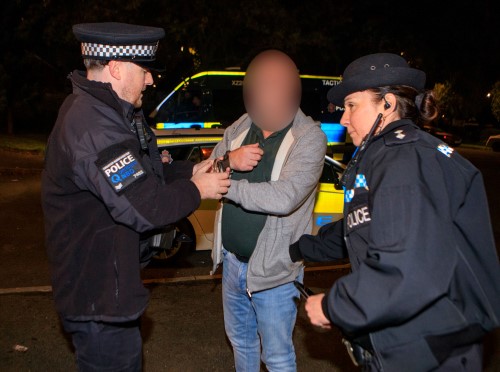
Greater Manchester’s homicide rates have now dropped to a ‘historic’ low / Credit: Wikimedia Commons
Additionally, A&E attendances due to assault decreased by 3% in the same time period, with a 9% reduction among young people aged 10–24, and ambulance callouts for assault also fell by 9% in relation to this.
GMCA says that the reductions in demand for emergency services, as revealed in the latest figures, prove just how much the VRU’s combined prevention and enforcement approach is working.
“These latest figures show the real progress being made in tackling violent crime and making our streets safer,” commented Mayor Andy Burnham.
“Reductions in knife crime and homicides don’t happen by chance – they come from early intervention, our strong partnership with the police and our work with communities to tackle the root causes of violence.”