153 years ago this week, central Manchester’s high-security prison opened its doors for the first time.
HM Prison Manchester – which is commonly referred to as Strangeways by all that know it, which was its former official name derived from the area it’s located, until it was rebuilt following the major riots in 1990 – was declared open on 25 June 1868.
Built to replace the New Bailey Prison in Salford which closed in 1868, Strangeways was famously designed by architect Alfred Waterhouse.
With construction said to cost in the region of £170,000, the eye-catching Grade II listed building has the capacity to hold 1,000 inmates and is instantly recognisable to Mancunians primarily thanks to its 234 feet (71 m) ventilation tower – which is often mistaken for a watchtower, and has become a local landmark.
The prison’s walls are rumoured to be 16 feet thick, and are said to be impenetrable from both the inside and the out.
ADVERTISEMENT
Because of this, Strangeways has been home to some pretty notorious inmates over the years.
From some of the UK’s most-prolific serial killers, to television personalities, Premier League footballers and more, here’s a handful of famous faces who’ve spent time behind bars at Strangeways during its 153 year history.
ADVERTISEMENT
___
Harold Shipman
Harold Shipman was held at Strangeways in 1998 / Credit: Biography
Harold Shipman remains to this day one of Britain’s most prolific serial killers.
Serving as a GP at a medical centre in Hyde, Shipman often targeted the elderly by injecting them with lethal doses of diamorphine, resulting in a victim number thought to be between 215 and 260 people over a 23 year killing spree – which is one of the worst ever documented.
ADVERTISEMENT
Shipman was eventually arrested on 7 September 1998, and was held in Strangeways.
His trial took place at Preston Crown Court in 1999, where it took four months to find him guilty of just 15 cases of murder, and he was sentenced to 15 life sentences.
Ian Brady
Ian Brady served a three month stint at Strangeways prior to the Moors Murders / Credit: Biography
Ian Brady is most-known as one half of Britain’s infamous killing pair, The Moors Murderers.
Many will know that Brady and Myra Hindley devastatingly murdered five innocent children between 12 July 1963 and 6 October 1965 and buried their bodies in the vast landscape of the Saddleworth Moors, which eventually led to Brady being found guilty of three murders and sentenced to life imprisonment.
Prior to all of this though, within a year of moving to Manchester, Brady was caught with a sack full of lead seals that he had stolen and was trying to smuggle out of the market.
ADVERTISEMENT
He was subsequently sent to Strangeways for three months.
Joey Barton
Joey Barton served 74 days of a six month sentence / Credit: Wikimedia Commons
Former Manchester City midfielder Joey Barton’s prolific football career and life have been marked by numerous controversial incidents and disciplinary problems over the years, as well as two convictions for violent crimes.
On 20 May 2008, Barton was sentenced to six months’ imprisonment after pleading guilty for common assault and affray during an incident in Liverpool city centre.
Barton served 74 days of this prison term at Strangeways, being released on 28 July 2008.
Ian Brown
Stone Roses frontman Ian Brown was sentenced to four months imprisonment in 1998 / Credit: YouTube
One of the more well-known names to serve a stint behind bars at Strangeways is Stone Roses’ frontman, Ian Brown.
ADVERTISEMENT
Brown was charged for threatening behaviour towards a British Airways flight attendant and captain, and was sentenced to four months in the summer of 1998.
He served only two months of his sentence at Strangeways, and admitted that while locked up, he wrote three songs – including ‘Free My Way’.
David Dickinson
Credit: ITV
Another one of the more surprising Strangeways residents comes in the form of Cheadle Heath-born antiques expert and television personality, David Dickinson – who you’ll probably recognise as the host of Bargain Hunt and Dickinson’s Real Deal.
Believe it or not, at the tender age of just 19 years old, Dickinson served three years of a four-year prison sentence for mail-order fraud, with the majority of that sentence being spent at Strangeways.
Dickinson has since described this time as “horrendous”, and that he’s learned to “take it on the chin and accept it was his own fault”.
ADVERTISEMENT
Dale Cregan
Dale Cregan is one of Manchester’s most notorious killers / Credit: Greater Manchester Police
Undeniably one of Manchester’s most notorious killers of this century is one-eyed murderer Dale Cregan.
He began his life of crime from an early age dealing drugs, but then notably turned to gun crime by first shooting Mark Short in the Cotton Tree Pub in Droylsden and attempting to kill three other men, before violently murdering Short’s father a few months later.
He then made national headlines when he tricked two female police officers to a property in Mottram in Longendale by reporting a burglary, before ambushing them with gunfire and a grenade which murdered them both.
Greater Manchester’s chief constable Peter Fahy called the attack “cold-blooded murder”, and then Prime minister David Cameron said it was a “despicable act of pure evil”.
Cregan handed himself in and was sentenced to life imprisonment, with a whole life order on June 13 2013.
ADVERTISEMENT
Emily Davison
Suffragette Emily Davison was detained at Strangeways twice / Credit: Wikimedia Commons
Suffragette Emily Davison was detained at Strangeways twice as a result of her efforts for the women’s rights movements during the early twentieth century.
Her first stint was for disrupting a meeting with Chancellor David Lloyd George and throwing rocks at the windows, and during this imprisonment, she famously went on a significant hunger strike, which resulted in her losing 21 pounds.
She was released just five and a half days later.
Her second Strangeways stint came just two months after, again for throwing stones, and lasted two and a half days.
Paul Taylor
Paul Taylor was the ringleader of the infamous 1990 Strangeways Prison riots / Credit: Merseyside Police
Unlike the other people on this list, it was Paul Taylor’s actions during his time inside Strangeways rather than prior that have ensured his name is written in the prison’s history books.
It all started when a visiting Church of England preacher had just delivered the sermon, and the prison chaplain stood to thank him before Taylor took the microphone and addressed the congregation.
Over the course of 25-days, the riots – which are still the longest in British prison riot history, with one prisoner killed, and 147 prison officers and 47 prisoners injured – spread throughout much of the prison, and Taylor famously ended up on the roof.
Much of the prison was damaged or destroyed, with the cost of repairs coming to £55 million.
Featured Image – Wikimedia Commons / Biography
Feature
The most magical Christmas displays have now landed at one of the North West’s best garden centres
Emily Sergeant
Christmas has officially arrived at one of the best garden centres in the North West, and it’s just as magical as you’d hope it would be.
Just outside of Greater Manchester in the village of Glazebury in Warrington, you’ll find Bents Garden and Home – a multi award-winning destination garden centre that’s often voted one of the region’s best. It’s great place to visit all year round, but as anyone who has ever made the trip there will tell you, this place really comes alive during the festive season.
Bents first started out life all the way back in 1937, when Alfred and Margaret Bent began growing and selling roses in the front garden of their terraced house in Glazebury.
Ever since then, the business has gone from strength to strength – opening its first dedicated garden centre building in the early 1950s, and then undergoing several expansions in the 60 years that followed to create the place we know and love today.
A place that’s home to everything you need to kit out your home and garden, several cafes and restaurants, a food hall, a cook shop, a children’s boutique, and plenty more.
Christmas has arrived at Bents Garden and Home for 2026 / Credit: The Manc Group
And then at Christmas time, you can also get to wander around all the magical festive displays and stop for a bite to eat at the winter food markets.
Christmas at Bents originally began in the 1970s, establishing what would become one of the garden centre’s most successful – and favourite – times of the year, with people travelling in their thousands from all across the North West to visit, making it an annual tradition in the festive events calendar for many families.
With a jaw-dropping display to suit everyone’s festive decor tastes, Christmas at Bents really does need to be seen to be believed.
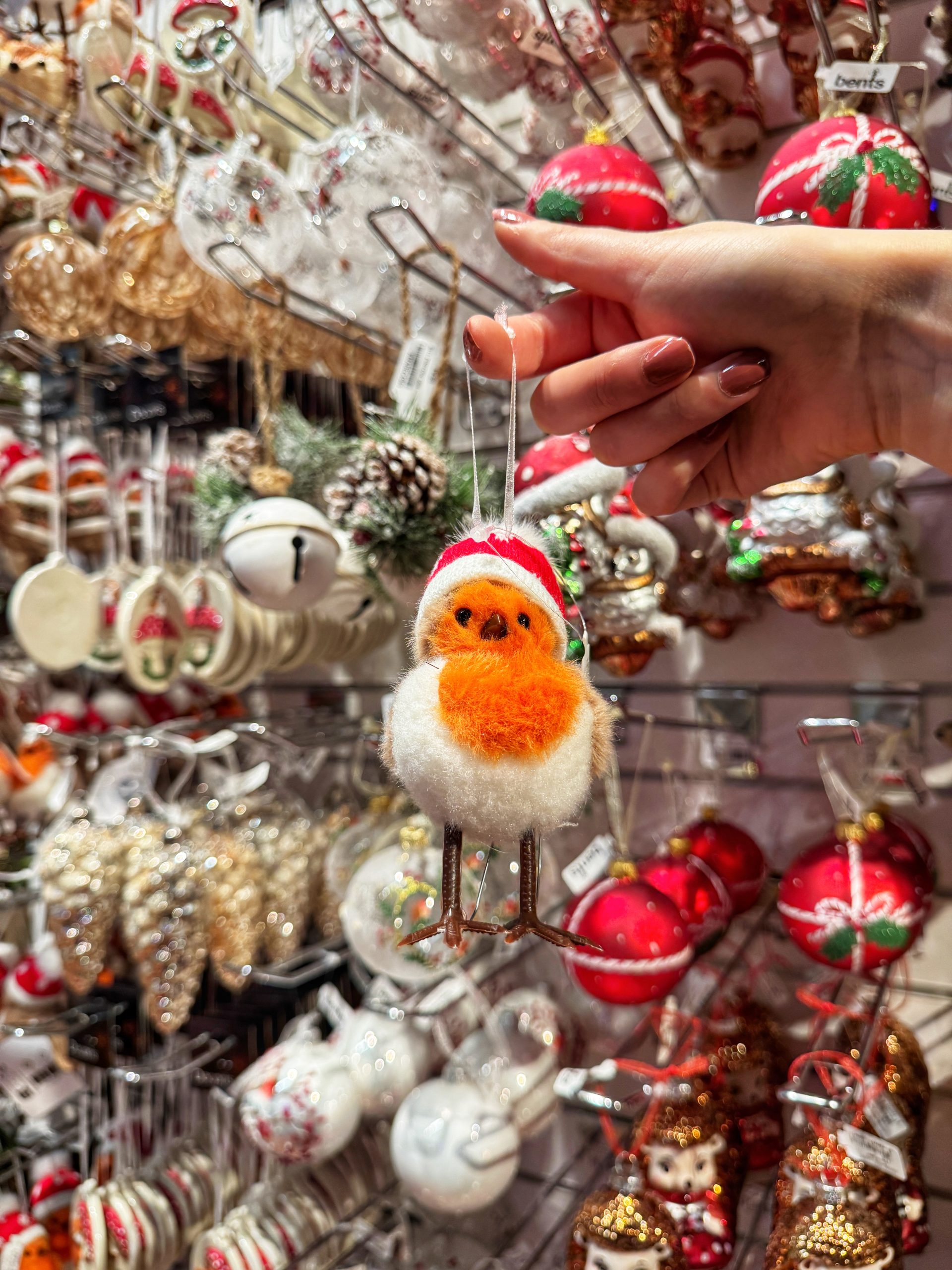
Expertly decorated trees form the centrepiece of each display, with all the baubles and decorations adorning them for sale by the side for you to recreate yourself at home.
Walking around the centre, you’ll also find every type of artificial tree (both normal and pre-lit), an array of fairy lights, wreaths, and garlands, before you arrive at what is sure to be one of the best Christmas Lemax Model Village set-ups you’ve probably ever seen.
A trip to Bents is an annual festive tradition for thousands across the North West / Credit: The Manc Group
Then, once you’ve filled your basket up with all the decs you need, you have to stop off at the Winter Food Markets before you head home.
There’s a wide array of different street food options to choose from like bratwursts, giant filled Yorkshire puddings, loaded fries, nachos, mac and cheese, crepes, churros, and build-your-own crumble, before taking a pew in one of the little wooden huts and washing it all down with festive-themed hot chocolates and mulled wine.
Don’t forget to stop off at the food hall, farm shop, and deli counters to stock up on plenty of goodies there before you leave too.
Basically, if you’ve never been to Bents before, we honestly cannot recommend it enough – even more so during Christmas time.
Don’t forget to stop off at the Winter Food Markets before heading home / Credit: The Manc Group
But it is really important to note that it does get very busy here, especially on weekends and at peak times like the run up to Christmas.
So you may have to be prepared to patiently wait for parking spaces and cooperate with your fellow shoppers, as well as join queues at the cafes and restaurants, all while respecting the hard-working staff at all times.
Let’s be as respectful as possible, and make this a place where everyone can enjoy a magical festive experience in 2026.
Meet Larishka – the DJ making her mark on Manchester’s Garage scene
Emily Johnson
It’s time to meet Larishka – Audio North’s Artist of the Month for October.
For Larishka, music has always been around her in some form. Growing up surrounded by classical and rock music, she never expected her route into electronic music to begin with a Parklife set from Carl Cox, before eventually becoming a DJ, promoter, and co-owner of Manchester’s Ghosts of Garage.
Today, she runs events, DJs across House, Garage and Bass, and is helping build a community around one of Manchester’s most exciting electronic music brands.
From promoter to DJ
Larishka actually started out as a promoter while doing an apprenticeship at a music booking agency. She always knew she wanted to work on the events side rather than bookings, but felt like she wasn’t going to make many connections within the industry while living in Oldham.
Her plan was to go to university to study music, with the hope of learning to produce while also moving into Manchester and making connections within the city’s music scene.
Quite quickly into her studies, she joined Ghosts of Garage. After about a year, she had something of a lightbulb moment.
Meet Larishka, the DJ making her mark on Manchester’s Garage scene / Credit: Supplied
“I was studying music, I run my own nights, and I was always on the aux at house parties, so why have I not learned to DJ yet?” she explained.
That realisation came while she was sitting on MATTIK’s living room sofa, where she asked if he would teach her. Before long, she was calling him every day asking if they could go to the studio and practise mixing.
“I owe it to him really, he was a brilliant teacher.”
“I get it” – the Parklife moment that changed everything
Larishka’s introduction to electronic music wasn’t exactly the traditional one.
“I grew up on classical and rock music – my dad was a sound engineer in the 70s so that was his thing really, and my mum played the piano every single day so that’s what I was constantly around.”
She first heard house music when she was around 15 or 16, after a friend sent her a track they had found on SoundCloud.
“I listened to it out of my phone and didn’t really get it, it was too repetitive.”
A few years later, everything changed. After hearing Parklife from her window every year growing up, Larishka eventually went to the festival for the first time and watched Carl Cox close The Valley. He played ‘Finder’ by Ninetoes, and it was the first time she had experienced electronic music on a huge sound system.
“I remember being in absolute awe and turning to my friend and saying ‘I get it’ and from then, I was just absolutely hooked.”
It became a genuine turning point.
“I had my A Level exams that following week and when I was revising all I was listening to was house music and I remember my Dad coming in and saying ‘Is this you forever now?’ and I said ‘Yeah I think it is'”.
Larishka is Audio North’s Artist of the Month for October / Credit: Supplied
Why Manchester means so much
“I mean it’s home, and always has been.”
Having become part of the city’s music scene, she says she feels incredibly lucky to have found a community around her.
“There’s a certain camaraderie that exists here that I don’t know that you’d find anywhere else.”
For her, that sense of community is what makes Manchester’s music scene so special.
“Seeing people you know everywhere you go, you kinda feel like you’re never alone and that you’re actually part of something.”
That spirit extends beyond electronic music, too.
“And it’s not just in electronic music either, that spirit exists across all genres – Manchester music history is so rooted across such a broad spectrum of genres, and to see that still prevailing today is something we should all be proud of.”
Building Ghosts of Garage
It’s impossible to talk about Larishka’s journey without talking about Ghosts of Garage.
She’s a co-owner of the brand, having joined in 2021, and works across its marketing, bookings and creative direction alongside Rich Reason. For her, one of the biggest things that makes a Ghosts of Garage night stand out is its commitment to the music.
“The music and lineups truly never miss, which is a credit to Rich. The guy knows how to program a lineup.”
The team makes a conscious effort to champion new talent, often including at least one Manchester or UK debut on a lineup.
“A big part of each event is making them unique while keeping the brand consistent – each event has to have its own USP or else the nights get boring and people think they can just skip this one and go to the next and it’ll be the same.”
For Larishka, music has always been around her in some form / Credit: Supplied
Community is a huge part of the brand.
“We’re also big advocates of community and want to create the gap between audience and DJ as little as possible, so try to get the crowd involved as much as possible through things like our WhatsApp community.”
The aim is to make people feel like buying a ticket means becoming part of something bigger.
“We want people to feel like if you buy a ticket for our event, then you’ve unlocked a key to be part of something.”
Larishka’s advice for getting into Manchester’s music scene
For anyone hoping to break into Manchester’s music scene, Larishka’s advice is simple – go out.
“I’m way more likely to book you if we’ve met and we’ve had a good chat because it means I can put a face to a name and I know what you’re like.”
For her, being part of the community is about more than simply sending messages and asking for opportunities.
“Being an active member of the community means you’re already part of the night, so booking you to DJ just makes you even more part of it than you already are, rather than someone I’ve never met before who’s in my DMs.”
Ultimately, it comes back to the same thing that has shaped so much of Larishka’s own journey – showing up, meeting people, and becoming part of something.

 Emily Sergeant -
21st June 2021
Emily Sergeant -
21st June 2021