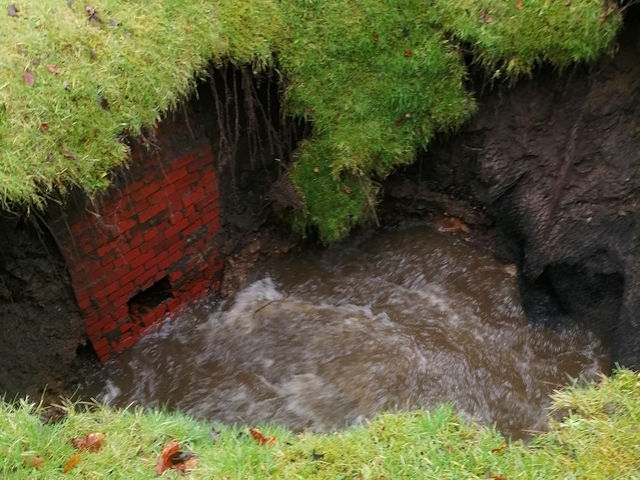
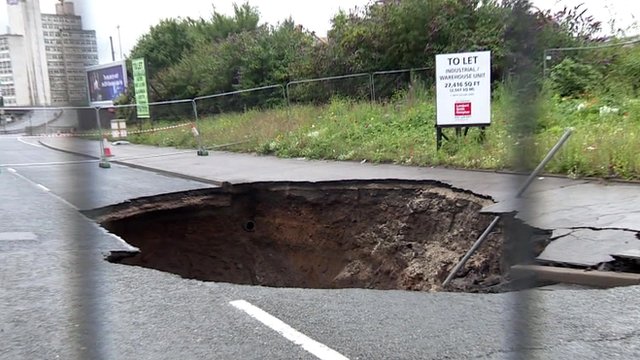
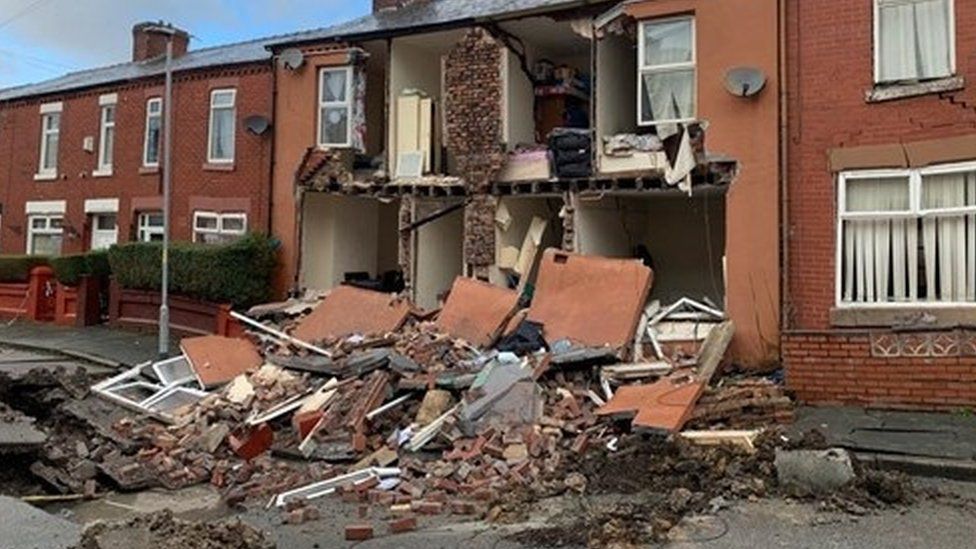
It also brought with it dramatic scenes of a sinkhole opening up – which even “swallowed” a car – on Wednesday evening on a residential street in the Abbey Hey area of Gorton, that even shockingly led to the collapse of the frontage of at least two terraced properties as a result.
But as many will know, this is far from the first time sinkholes have caused drama in the region as of late.
In 2016 alone – the year that will be remembered by Mancunians for Brexit, the electing of Donald Trump, and of course, sinkholes – at least six major sinkholes opened up across Greater Manchester.
ADVERTISEMENT
The Mancunian Way sinkhole – which was caused by a collapsed water culvert destroying a main sewer, and quickly became a tourist attraction until it was finally fixed and reopened on 16th June – grabbed most of the headlines, but there was also a 10ft deep, 2ft wide sinkhole that appeared on Tib Street in the Northern Quarter in April, the collapse of an old brick sewer that opened one in Whitefield on 12th September, a super storm caused traffic chaos in Cheetham Hill as a crater closed Waterloo Road two days later, and several other notable instances that can all be referenced from that same year.
But now that we’ve actually highlighted the sheer scale of the problem, what actually is a sinkhole? What makes them occur? And just why do we seem to be so plagued with them here in Greater Manchester?
ADVERTISEMENT
We had a dig around to get to the bottom of this – and this is what we found.
Amanda Webster
What are sinkholes?
If we’re going to get technical with it, the Oxford English Dictionary defines a sinkhole as: “a cavity in the ground, especially in a limestone formation, caused by water erosion and providing a route for surface water to disappear underground”, but in a nutshell, a sinkhole is essentially any hole in the ground created by erosion and the drainage of water.
Sinkholes can either be just a few feet across, or in the case of the aforementioned instances in Gorton earlier this week, large enough to swallow whole vehicles and whole buildings.
ADVERTISEMENT
Although they’re more often than not the result of natural processes, they can also be triggered by human activity too.
Are there different types of sinkhole?
The short answer is yes – there are two basic types of sinkhole.
There’s those that are created slowly over time, which are known as cover-subsidence sinkholes, and those that appear suddenly, which are known as a cover-collapse sinkhole, and as you’d expect, it’s the latter type that creates the sort of headlines we’ve seen this week and in recent years, but both varieties are formed by the same basic mechanism.
Why do they occur?
Now, this is where the real geological explanations have to come into it.
Sinkholes mainly occur in what is known as ‘karst terrain’ – areas of land where soluble bedrock, such as limestone or gypsum, can be dissolved by water.
ADVERTISEMENT
With cover-subsidence sinkholes, the bedrock becomes exposed and is gradually worn down over time, with the holes often becoming ponds as the water fills them in, but with a cover-collapse sinkhole, this same process occurs out of our sight.
With cover-collapse sinkholes, naturally-occurring cracks and small voids underneath the surface are hollowed out by water erosion, with a cover of soil or sediment remaining over the top, and eventually, as the hole expands over time, this cover can no longer support its own weight and suddenly collapses to reveal the cavern that’s been hiding underneath.
BBC
Pothole vs Sinkhole
There are a number of differences between a pothole and a sinkhole, that aren’t just the size of the hole and the drama that goes along with it.
It was revealed earlier this month, thanks to a recent study by Manchester-based personal injury lawyers JMW Solicitors and data from fixmystreet.com, that as of January 2021, there were 7,114 reported open pothole cases reported across Greater Manchester – a whopping 2,356 of those being in the City of Manchester itself – with the situation only predicted to get worse, so it would seem that sinkholes aren’t the only recurring issue we have in the region.
But what is the difference between the two?
ADVERTISEMENT
To keep it brief, and without repeating too much of what has already been explained, a sinkhole is a closed natural depression in the ground surface caused by removal of material below the ground, whereas a pothole is usually a fairly small feature caused by a failure of paving materials.
Potholes are known to become more abundant in late winter and spring due to freeze-thaw damage.
Why do we get so many sinkholes in Greater Manchester?
And now we’ve come down to the crux of it.
What is it about the region of Greater Manchester that seems to be revealing so many dangerous and damaging sinkholes in comparison to others? Well, according to Dr Domenico Lombardi – a lecturer in Geotechnical Engineering at the University of Manchester, who gave his two cents on the topic after the year of sinkhole mayhem that was 2016 – our sinkholes are not a natural phenomenon as much as they are man made.
It’s all about the number of old mines, sewers, a growing population and ongoing building works that we have going on in the region – and of course, increasing rainfall.
ADVERTISEMENT
We know by now that sinkholes occur when underground cavities collapse, causing the failure of the ground above, but in Greater Manchester, our geology is mainly sand and sandstone – which are hardly soluble – so Dr Lombardi says we need to look to old mines and collieries, which are eroded during heavy rainfall or when there is a leaking water main or sewer pipe.
In these cases an underground cavity can form super quick, and the collapse can happen in a matter of hours – as was reported by United Utilities to the case in Abbey Hey yesterday.
Dr Lombardi said: “In recent years, an increasing number of sinkholes have been observed in Greater Manchester and in other regions of the United Kingdom. Arguably, this can be attributed to the increasing number of extreme rainfall events… flooding and an ageing utility infrastructure.”
The solution?
Dr Lombardi recommends timely repairs and maintenance of piping, and a more sustainable drainage system, with more urban green areas too.
ADVERTISEMENT
Greater Manchester Fire & Rescue Service
It’s hard to decipher for sure at this point whether the necessary action is being undertaken to prevent more dangerous and damaging sinkholes from opening up across the region – especially as the number of freak weather occurrences are becoming harder to predict – but with work now officially being underway on Manchester’s first city centre park in 100 years, and the City of Trees initiative – which will see three million trees planted across Greater Manchester as part of The Northern Forest – starting to take shape, there’s no denying that positive ground is being made.
Time will surely tell.
Feature
The most magical Christmas displays have now landed at one of the North West’s best garden centres
Emily Sergeant
Christmas has officially arrived at one of the best garden centres in the North West, and it’s just as magical as you’d hope it would be.
Just outside of Greater Manchester in the village of Glazebury in Warrington, you’ll find Bents Garden and Home – a multi award-winning destination garden centre that’s often voted one of the region’s best. It’s great place to visit all year round, but as anyone who has ever made the trip there will tell you, this place really comes alive during the festive season.
Bents first started out life all the way back in 1937, when Alfred and Margaret Bent began growing and selling roses in the front garden of their terraced house in Glazebury.
Ever since then, the business has gone from strength to strength – opening its first dedicated garden centre building in the early 1950s, and then undergoing several expansions in the 60 years that followed to create the place we know and love today.
A place that’s home to everything you need to kit out your home and garden, several cafes and restaurants, a food hall, a cook shop, a children’s boutique, and plenty more.
Christmas has arrived at Bents Garden and Home for 2026 / Credit: The Manc Group
And then at Christmas time, you can also get to wander around all the magical festive displays and stop for a bite to eat at the winter food markets.
Christmas at Bents originally began in the 1970s, establishing what would become one of the garden centre’s most successful – and favourite – times of the year, with people travelling in their thousands from all across the North West to visit, making it an annual tradition in the festive events calendar for many families.
With a jaw-dropping display to suit everyone’s festive decor tastes, Christmas at Bents really does need to be seen to be believed.
Expertly decorated trees form the centrepiece of each display, with all the baubles and decorations adorning them for sale by the side for you to recreate yourself at home.
Walking around the centre, you’ll also find every type of artificial tree (both normal and pre-lit), an array of fairy lights, wreaths, and garlands, before you arrive at what is sure to be one of the best Christmas Lemax Model Village set-ups you’ve probably ever seen.
A trip to Bents is an annual festive tradition for thousands across the North West / Credit: The Manc Group
Then, once you’ve filled your basket up with all the decs you need, you have to stop off at the Winter Food Markets before you head home.
There’s a wide array of different street food options to choose from like bratwursts, giant filled Yorkshire puddings, loaded fries, nachos, mac and cheese, crepes, churros, and build-your-own crumble, before taking a pew in one of the little wooden huts and washing it all down with festive-themed hot chocolates and mulled wine.
Don’t forget to stop off at the food hall, farm shop, and deli counters to stock up on plenty of goodies there before you leave too.
Basically, if you’ve never been to Bents before, we honestly cannot recommend it enough – even more so during Christmas time.
Don’t forget to stop off at the Winter Food Markets before heading home / Credit: The Manc Group
But it is really important to note that it does get very busy here, especially on weekends and at peak times like the run up to Christmas.
So you may have to be prepared to patiently wait for parking spaces and cooperate with your fellow shoppers, as well as join queues at the cafes and restaurants, all while respecting the hard-working staff at all times.
Let’s be as respectful as possible, and make this a place where everyone can enjoy a magical festive experience in 2026.
Meet Larishka – the DJ making her mark on Manchester’s Garage scene
Emily Johnson
It’s time to meet Larishka – Audio North’s Artist of the Month for October.
For Larishka, music has always been around her in some form. Growing up surrounded by classical and rock music, she never expected her route into electronic music to begin with a Parklife set from Carl Cox, before eventually becoming a DJ, promoter, and co-owner of Manchester’s Ghosts of Garage.
Today, she runs events, DJs across House, Garage and Bass, and is helping build a community around one of Manchester’s most exciting electronic music brands.
From promoter to DJ
Larishka actually started out as a promoter while doing an apprenticeship at a music booking agency. She always knew she wanted to work on the events side rather than bookings, but felt like she wasn’t going to make many connections within the industry while living in Oldham.
Her plan was to go to university to study music, with the hope of learning to produce while also moving into Manchester and making connections within the city’s music scene.
Quite quickly into her studies, she joined Ghosts of Garage. After about a year, she had something of a lightbulb moment.
Meet Larishka, the DJ making her mark on Manchester’s Garage scene / Credit: Supplied
“I was studying music, I run my own nights, and I was always on the aux at house parties, so why have I not learned to DJ yet?” she explained.
That realisation came while she was sitting on MATTIK’s living room sofa, where she asked if he would teach her. Before long, she was calling him every day asking if they could go to the studio and practise mixing.
“I owe it to him really, he was a brilliant teacher.”
“I get it” – the Parklife moment that changed everything
Larishka’s introduction to electronic music wasn’t exactly the traditional one.
“I grew up on classical and rock music – my dad was a sound engineer in the 70s so that was his thing really, and my mum played the piano every single day so that’s what I was constantly around.”
She first heard house music when she was around 15 or 16, after a friend sent her a track they had found on SoundCloud.
“I listened to it out of my phone and didn’t really get it, it was too repetitive.”
A few years later, everything changed. After hearing Parklife from her window every year growing up, Larishka eventually went to the festival for the first time and watched Carl Cox close The Valley. He played ‘Finder’ by Ninetoes, and it was the first time she had experienced electronic music on a huge sound system.
“I remember being in absolute awe and turning to my friend and saying ‘I get it’ and from then, I was just absolutely hooked.”
It became a genuine turning point.
“I had my A Level exams that following week and when I was revising all I was listening to was house music and I remember my Dad coming in and saying ‘Is this you forever now?’ and I said ‘Yeah I think it is'”.
Larishka is Audio North’s Artist of the Month for October / Credit: Supplied
Why Manchester means so much
“I mean it’s home, and always has been.”
Having become part of the city’s music scene, she says she feels incredibly lucky to have found a community around her.
“There’s a certain camaraderie that exists here that I don’t know that you’d find anywhere else.”
For her, that sense of community is what makes Manchester’s music scene so special.
“Seeing people you know everywhere you go, you kinda feel like you’re never alone and that you’re actually part of something.”
That spirit extends beyond electronic music, too.
“And it’s not just in electronic music either, that spirit exists across all genres – Manchester music history is so rooted across such a broad spectrum of genres, and to see that still prevailing today is something we should all be proud of.”
Building Ghosts of Garage
It’s impossible to talk about Larishka’s journey without talking about Ghosts of Garage.
She’s a co-owner of the brand, having joined in 2021, and works across its marketing, bookings and creative direction alongside Rich Reason. For her, one of the biggest things that makes a Ghosts of Garage night stand out is its commitment to the music.
“The music and lineups truly never miss, which is a credit to Rich. The guy knows how to program a lineup.”
The team makes a conscious effort to champion new talent, often including at least one Manchester or UK debut on a lineup.
“A big part of each event is making them unique while keeping the brand consistent – each event has to have its own USP or else the nights get boring and people think they can just skip this one and go to the next and it’ll be the same.”
For Larishka, music has always been around her in some form / Credit: Supplied
Community is a huge part of the brand.
“We’re also big advocates of community and want to create the gap between audience and DJ as little as possible, so try to get the crowd involved as much as possible through things like our WhatsApp community.”
The aim is to make people feel like buying a ticket means becoming part of something bigger.
“We want people to feel like if you buy a ticket for our event, then you’ve unlocked a key to be part of something.”
Larishka’s advice for getting into Manchester’s music scene
For anyone hoping to break into Manchester’s music scene, Larishka’s advice is simple – go out.
“I’m way more likely to book you if we’ve met and we’ve had a good chat because it means I can put a face to a name and I know what you’re like.”
ADVERTISEMENT
For her, being part of the community is about more than simply sending messages and asking for opportunities.
“Being an active member of the community means you’re already part of the night, so booking you to DJ just makes you even more part of it than you already are, rather than someone I’ve never met before who’s in my DMs.”
Ultimately, it comes back to the same thing that has shaped so much of Larishka’s own journey – showing up, meeting people, and becoming part of something.

 Emily Sergeant -
22nd January 2021
Emily Sergeant -
22nd January 2021